Music Travel Repeat! › Cities That Sing Back›
Cities That Sing Back: Washington, D.C.
Washington, D.C. isn’t just the capital of the United States. It’s a capital of sound, sweat, and survival. The city that wears politics on its sleeve also carries a heartbeat in its chest — a pulse that’s been playing on every corner since long before the rest of the country thought to listen.
To know D.C.’s music is to understand how rhythm keeps people alive when everything else feels stacked against them. These aren’t just songs played in clubs — they’re testimonies, battle cries, and benedictions. And if you walk the streets of U Street, Shaw, or Anacostia on a humid summer night, you’ll hear it: the music still remembers.
Because here’s the thing: Washington is a city that forgets quickly when it comes to people, but it never forgets a sound. Politicians cycle in and out, administrations rise and fall, but the beat doesn’t care who’s in office. The beat has been steady since before there were cameras in the Capitol, since before the world thought to call this city powerful. In back rooms and basements, on porches and playgrounds, music has been the one constant in a place that prides itself on being anything but permanent.
It’s easy to think of D.C. as marble and monuments, a postcard city full of speeches and statues. But if you stay past sunset, you start to see the truth: this is a city where the real monuments are made of sound. They don’t stand still; they move, they shake, they bleed into the night.
- A saxophone riff echoing down an alley in Shaw can be as historic as anything carved into stone
- A bassline pounding from a go-go band at a block party can tell you more about the soul of the city than a thousand campaign slogans
And maybe that’s why the music here matters so much — because it belongs to the people. It isn’t polished for tourists or staged for cameras. It rises up from the sidewalks, carried by those who needed a place to shout, to pray, to laugh, to mourn. For generations, music has been the one language that everybody in D.C. can speak, even when they don’t agree on anything else.
- You see it in the way elders close their eyes when they hear Duke Ellington’s name mentioned, as if he’s still alive in the very air
- You see it in kids banging on buckets with drumsticks outside Metro stations, keeping rhythm alive even if they don’t own a real kit
- You hear it in choirs lifting gospel into the rafters of churches that have stood through segregation, riots, and gentrification, still offering sanctuary in song.
Music here is stubborn. It refuses to leave. Even when neighborhoods are torn down, even when condos replace the clubs, the music hangs in the air like smoke that won’t clear. It waits for the next pair of hands, the next voice, the next generation ready to pick it up.
Washington’s rhythm is more than background noise — it’s survival. And when the rest of the country forgets that this city is more than headlines and hearings, the music is what reminds us. It whispers through the cracks in the concrete, it thunders in packed clubs, it hums in the stillness after protests. It’s proof that no matter how heavy the weight of politics becomes, the people of D.C. still find a way to dance.
Because rhythm — unlike policy — doesn’t expire.
- it outlasts the filibusters and the fundraisers
- it outlasts the scandals
- it even outlasts the years
And when the speeches fade, the songs remain.
Black Broadway and the First Sparks
Before Washington was known for marches and monuments, it was known for music. U Street was “Black Broadway,” a stretch where the clubs burned brighter than the White House ever could.
- Bohemian Caverns
- Club Bali
- The Howard Theatre
these weren’t just music venues in DC. They were sanctuaries.
Duke Ellington grew up here, learning piano in a neighborhood that carried him farther than he ever imagined. Jelly Roll Morton, Shirley Horn, Ella Fitzgerald — they played here not just for the applause, but because the city made them feel like they belonged.
The Howard Theatre opened in 1910, even before the Apollo in Harlem, becoming the first theater in America built for Black artists and audiences. Imagine the power of that. Imagine walking into a room that said, “This space was made for you,” when the rest of the country said the opposite.
But “Black Broadway” was more than a nickname. It was
- a promise
- a declaration
- a beacon lit in the middle of segregation
U Street glowed with neon and possibility, pulsing like a single artery in the body of the city. And in those clubs, something greater than entertainment was happening — survival was being rehearsed in every set, dignity restored in every encore.
Picture a night in the 1930s: outside, the country was struggling under the weight of the Great Depression, but inside Club Bali, the horns were bright, the piano alive, the dance floor a blur of sweat and hope. For a few hours, nobody was worried about what tomorrow might take away. The music gave them a present tense worth holding on to.
Ellington himself carried that spirit far beyond Washington, but he never stopped bringing it home. When he played Harlem’s Cotton Club, he carried U Street with him. When he toured Europe, the echo of Black Broadway went too. He wasn’t just making jazz — he was carrying a piece of Washington’s heartbeat into the world, proof that the city’s story wasn’t written only in marble and laws but also in notes and chords.
The Howard Theatre became the crown jewel. Long before it fell into decline and long before its rebirth in 2012, it was the stage where impossibility was made flesh. Ella Fitzgerald’s voice, Cab Calloway’s swing, Louis Armstrong’s trumpet — these weren’t just performances. They were testimonies. They said, “Even here, even now, we rise.”
Segregation may have drawn lines on the map, but those walls didn’t stop the music. In fact, they may have made it louder. When doors closed, people built their own doors — and filled them with brass, with bass, with voices that refused to be silenced. Washington’s Black community carried each other through song, creating a soundtrack that wrapped around the city like armor.
And it wasn’t just the giants we remember — Ellington, Fitzgerald, Morton. It was the countless unnamed players who picked up instruments after long days of hard work, who played in smoky basements and back rooms until dawn. They’re the reason “Black Broadway” wasn’t just a place — it was a feeling, a collective defiance, a living, breathing church of rhythm and soul.
The first sparks of D.C.’s music scene were lit there, in those sanctuaries. Sparks that still glow today, even after riots, even after gentrification, even after time itself tried to snuff them out. Because U Street didn’t just give Washington music. It gave Washington its voice.
The Sound That Couldn’t Be Silenced: Go-Go
Every city has a sound it calls its own. Nashville has country. New Orleans has jazz. Washington, D.C. has go-go.
But go-go isn’t just music you turn on in the background. It’s not an album you put on shuffle while you fold laundry. Go-go is sweat dripping from the ceiling. It’s the call of a voice at the front of the stage and the roar of hundreds answering back. It’s rhythm as survival — a groove that keeps moving even when the world feels stuck.
Chuck Brown, the “Godfather of Go-Go,” didn’t set out to invent a genre. He just wanted to make sure the party never stopped. Funk and R&B would fade when a song ended, and people would drift toward the bar or the door. Brown wanted to keep them in the moment, so he found a way to stretch the groove until it became the night itself. Congas, cowbells, rototoms — percussion stacked on percussion, looping endlessly. A living heartbeat.
And in a city where politics told people to wait their turn, where injustice told them to sit still, go-go gave them something else entirely: motion. It said, don’t stop. It said, stay here, stay moving, stay alive.
What made go-go sacred wasn’t just the instruments, though. It was the communion. Call-and-response wasn’t a gimmick; it was the essence. When the band shouted, the crowd shouted back, and suddenly the lines blurred. Audience became performer, performer became congregation. In that sweaty circle of sound, everybody mattered. You weren’t just watching music — you were part of it.
That’s why the genre never really cared if it went mainstream. Sure, there were flashes — Chuck Brown’s “Bustin’ Loose” topping the R&B charts, E.U.’s “Da Butt” making it into Spike Lee’s School Daze. But go-go’s soul was never meant for charts or awards. It belonged to D.C., to the neighborhoods, to the block parties where the rhythm shook rowhouses until dawn.
And that’s why it hurt so deeply when the sound came under fire. In the ’90s, the city labeled go-go clubs as trouble. Police cracked down. Venues shut their doors. Once again, Black joy was miscast as violence. But the music kept slipping through cracks
- backyard bands setting up in makeshift spots
- DJs keeping the groove alive
- kids banging out go-go beats on buckets by Metro stations
You couldn’t erase it, because it wasn’t just a sound. It was an inheritance.
Then came 2019, when a single phone call tried to silence it for good. A Metro PCS store on the corner of Florida and Georgia Avenue was told to turn off the go-go music it had played on the sidewalk for years. Just another complaint from new neighbors who thought they’d bought quiet with their condos.
But the people of D.C. had seen too much taken already. This time, they pushed back. The city erupted in rhythm and protest, spilling into the streets under the banner of #DontMuteDC. Thousands marched, danced, and demanded — not just for the music, but for the culture, the memory, the dignity it carried. Go-go became more than entertainment. It became resistance, proof that the city’s identity couldn’t be bought out or pushed aside.
And the resistance worked. In 2020, the D.C. Council declared go-go the official music of Washington, D.C. A law can’t invent a culture, but it can admit the truth: go-go was the heartbeat of the city, and it always would be.
By 2025, that truth had walls and a roof — the Go-Go Museum & Café in Anacostia. Exhibits. Archives. Live shows. A place to teach kids that what started as a groove in Chuck Brown’s hands had become something unbreakable.
Because go-go isn’t just what D.C. sounds like. It’s what D.C. feels like when it refuses to be erased. It’s rhythm as rebellion, percussion as prayer. It’s a city reminding itself, over and over again: we are still here, and we are not going anywhere.
HarDCore: Punk in the Capital of Action
The 1980s gave Washington another sound that didn’t ask permission — hardcore punk. Or, as the city stamped it: harDCore.
- Bad Brains
- Minor Threat
- Fugazi
These weren’t just bands, they were pressure valves for kids growing up in the shadow of power without any of its privileges.
- In a city defined by rules, they chose noise
- In a city obsessed with image, they chose rawness.
Their songs weren’t dressed up, they were stripped down to nerves and bone.
And that made sense here, in the capital. Punk in New York sneered. Punk in London spat. But D.C.’s version moved. It wasn’t content with tearing things down — it wanted to build something better from the rubble. As one musician said, “punk is singing about the problem, but hardcore is singing about doing something about the problem.” And in a town where everyone came to argue about solutions, that urgency landed like a sermon.
Bad Brains lit the fuse. An all-Black punk band playing at lightning speed, fusing reggae and thrash in a way no one else dared, they broke open the door for the scene. Suddenly kids who didn’t fit anywhere — kids too loud for church, too restless for school, too angry for silence — had somewhere to go. Church basements, community centers, grimy little clubs like the first 9:30 Club on F Street. Places where the sound bounced off peeling walls but still managed to shake the whole city awake.
And then came Minor Threat. Ian MacKaye shouting about straight edge living — no booze, no drugs, no crutches. Just conviction and sound. They were proof that punk didn’t have to self-destruct to matter. It could hold a line. It could stand for something.
What made harDCore unforgettable wasn’t only the music. It was the ethic. DIY before DIY became a brand. Dischord Records was born out of garages and borrowed tape machines. No corporations, no middlemen — just kids making records because they had to, because silence wasn’t an option. Five-dollar shows. No merch tables. Just music, sweat, and a sense that you were part of something no outsider could ever package or sell.
That sense of community grew legs. By 1985, the scene hit what they called “Revolution Summer.” The aggression was still there, but the lyrics turned inward, vulnerable. Punk kids started writing about heartbreak, isolation, longing — carving out what would later become emo and post-hardcore. In most cities, vulnerability was weakness. In D.C., it became rebellion. To admit pain in the capital of power was to tear the mask off.
And when Fugazi formed in 1987, everything the scene stood for seemed to crystallize in one band. MacKaye and his crew refused to play the industry’s game. Tickets never more than five dollars. No opening acts unless they believed in them. No flashy lights. Just relentless sound and an insistence that music could still be honest. Fugazi wasn’t just a band. They were a compass pointing the way toward integrity in an industry that had forgotten the word.
The legacy of harDCore wasn’t only in the records. It was in the way it taught a whole city that you don’t need permission to create, that art belongs in the hands of the people. It was in the way the scene refused to separate activism from art — Positive Force using punk shows to raise money for the homeless, for racial justice, for anyone left behind. It was in the way teenagers with no future suddenly found family, not through blood but through chords and choruses.
And maybe that’s why harDCore could only have been born here. Because D.C. is a city obsessed with change, for better or worse.
- Laws change
- Leaders change
- Policies shift like sand
But in the middle of all that uncertainty, punk kids carved out something steady: a sound, a scene, a sanctuary.
Even now, decades later, you can feel it. Walk past Fort Reno Park in the summer when local bands play for free, and you’ll hear it echo. Open the D.C. Public Library’s Punk Archive and see the flyers, the photos, the hand-scrawled notes — a paper trail of defiance.
HarDCore wasn’t just music. It was Washington screaming into the void, and finding out the void screamed back.
Other Voices, Same City
For every go-go bounce and punk breakdown, there were folk singers, soul shouters, and jazz dreamers holding down their corners of the District. Washington has never been one-note. It’s a city of many tongues, many rhythms, and many truths sung at once.
Take Marvin Gaye. Before the world knew him as Motown royalty, he was just a kid in D.C., singing in church choirs, trying to find a sound that matched the ache in his chest. You can almost hear Washington in his voice if you listen closely enough — the mix of gospel reverence and street-corner grit, the tender falsetto that carried both pain and prayer. Marvin didn’t just sing songs. He carried a city’s longing into the mainstream, and every time “What’s Going On” plays, you can feel that it started here, in pews and neighborhoods that knew both joy and struggle.
Or Roberta Flack — discovered in a Georgetown piano lounge. She wasn’t flashy, she wasn’t chasing trends. She sat at a piano and told the truth in a way that made time stop. “Killing Me Softly” wasn’t just a hit, it was a confession — and it came from a woman who cut her teeth in the District, night after night, singing to small crowds until the world finally caught up.
Parliament-Funkadelic looked at the city and declared it “Chocolate City.” They saw what Washington was — majority-Black, unapologetically funky, a town that knew how to groove even when it was struggling to get by. Their anthem wasn’t just a song; it was an identity. A reminder that in this capital of contradictions, the culture belonged to the people, not the politicians.
And then there was the bluegrass. You might not think of banjos when you picture D.C., but you should. The Seldom Scene played in suburban bars like the Red Fox Inn and turned Tuesday nights into holy nights. They weren’t singing about policy or power — they were singing about rivers, heartbreak, and survival. And in their own way, they were as political as any protest song. Because in a city of glass buildings and deadlines, they reminded people that the roots still mattered, that Appalachia wasn’t as far away as it seemed.
Fast forward a few decades, and Thievery Corporation was building their own world inside an unassuming D.C. lounge. Their sound was electronic, global, borderless — beats stitched together with influences from Brazil, India, Jamaica. In a city obsessed with borders and rules, they made music that ignored them all. They showed that Washington wasn’t just a capital of America. It was a capital of the world, a place where cultures collided and turned into soundtracks for late-night wanderers.
This is what makes Washington’s music sacred: its refusal to be boxed in. A single week in this city could take you from a gospel service in Southeast
- to a punk basement in Columbia Heights
- to a go-go block party on Georgia Avenue
- to a jazz jam in Adams Morgan
- to an EDM set at a club by the Wharf
Each genre might feel different, but together they tell the same story — a story of a city that survives by refusing to sing in unison.
Because D.C.’s magic isn’t in having one sound. It’s in holding them all at once. Funk and folk. Punk and pop. Jazz and go-go. Each scene speaks to a different truth, but together they hum the same refrain: we are here, we are alive, and we will not be silenced.
Venues: Where the Walls Remember
If you want to trace a city’s heartbeat, trace its venues. Because buildings don’t just hold sound — they hold memory. And in Washington, D.C., every stage tells a story.
The Howard Theatre still stands like an elder who has seen too much but refuses to be forgotten. In its bones are the echoes of Duke Ellington and Ella Fitzgerald, of Cab Calloway swinging so hard the rafters shook, of teenagers sneaking in because they couldn’t bear to miss the chance to breathe the same air as Marvin Gaye. When the riots of ’68 left U Street in flames, the Howard went dark. But even in its silence, the building remembered. Its rebirth in 2012 wasn’t just a renovation — it was resurrection. Every note played there now carries the weight of history, a reminder that even ashes can find their way back to fire.
The Lincoln Theatre, just down the street, is its sibling in spirit. Gilded walls, velvet curtains, and a past that spans vaudeville, big band, and Motown. For decades, it sat shuttered, a husk of what it once was. But like the city itself, it refused to stay down. Today, when modern acts take the stage, they’re sharing it with ghosts — and if you close your eyes during a show, you can almost hear Sarah Vaughan’s voice weaving through the present like silk.
Then there’s Blues Alley, tucked away in a Georgetown carriage house. It doesn’t scream for attention. It whispers. Only about 125 seats, tables pressed tight, brick walls sweating history. Dizzy Gillespie, Wynton Marsalis, Eva Cassidy — they all played there, filling the room with something so intimate you could feel it vibrating in your chest. Cassidy’s Live at Blues Alley album turned a tiny club into a global shrine. Step inside and you’ll know instantly: this isn’t just a venue. It’s a living room where jazz has been keeping house for sixty years.
The 9:30 Club tells a different story. The original space on F Street was a mess — grimy, cramped, infamous for its smell. But it was holy ground for punk kids who needed somewhere to scream. When it moved to V Street in 1996, it grew up without selling out. Today, it’s one of the most beloved clubs in the world. Prince played there. Radiohead played there. Go-go bands still tear it up there. And if you’ve ever stood shoulder to shoulder in that room, sweating and shouting and losing yourself in sound, you know why. The 9:30 isn’t just a venue. It’s a proving ground.
The Black Cat carries that same punk DNA — gritty, stubborn, dedicated to giving the underdog a stage. Founded by Dante Ferrando with help from Dave Grohl, it was built for kids who weren’t looking for polished arenas. It was built for those who wanted the raw, the real, the music before it got cleaned up for radio. Thirty years on, it’s still standing, still serving as home base for anyone who believes music should be honest before it’s profitable.
And then there’s The Anthem, the new kid on the block, gleaming on the Wharf with room for six thousand bodies. It’s modern, state-of-the-art, but it doesn’t erase the past. It adds to it. When Foo Fighters christened the stage, they weren’t just opening a building — they were reminding the world that Washington could play at the big table without losing its soul.
Even Fort Reno Park, a patch of grass in Tenleytown, belongs in this story. No walls, no lights, no velvet seats — just open sky and a tradition of free summer concerts that’s lasted for half a century. Fugazi once played there for crowds that couldn’t believe what they were seeing. And still today, kids and families spread blankets on the grass, letting local punk and indie bands carry them into the night. No tickets. No pretense. Just community.
Each of these places — the gilded theaters, the sweaty clubs, the open-air lawns — reminds us that venues aren’t just where music happens. They’re where music remembers. They’re the city’s lighthouses, guiding people back to the truth that D.C. is, and always has been, a music town.
Related: Live Music Venues In Washington DC
Festivals: Streets That Sing
Washington doesn’t keep its music locked indoors. It spills out into parades, block parties, and festivals that feel like a city exhaling together. In a place known for its gridlock and grandstanding, these moments are the release — the days when the whole city seems to breathe in rhythm.
The DC Jazz Festival is one of those breaths. Every summer, the city tips its hat to Duke Ellington, not with speeches or plaques, but with horns and strings and voices carrying his spirit through the streets. The Wharf lights up with stages, the Kennedy Center opens its doors, and suddenly Washington remembers that it is, in many ways, a jazz town first. Locals sit beside tourists, children chase bubbles between songs, and for a few days the city is less about politics and more about swing. It’s Ellington’s hometown giving thanks to the man who taught it how to sing itself alive.
Then there was the Funk Parade, a day-long celebration on U Street that felt less like an event and more like a family reunion. Brass bands march past murals of Duke and Chuck, dancers spin in the middle of the street, and go-go bands remind everyone why the beat has never died. It wasn't slick or polished; it was messy, loud, joyful. It’s was block party with history on its shoulders. The Funk Parade didn't just entertain. It remembers. It carries the DNA of Black Broadway and says, “We’re still here. We’re still moving.”
The Broccoli City Festival brings its own kind of energy — rooted in hip-hop, R&B, and a mission that goes beyond music. It’s a festival with purpose, teaching sustainability, health, and activism in the same space where kids scream for Cardi B or Wale. It’s proof that you can dance and still demand better, that celebration and responsibility can live in the same song. For a generation that doesn’t separate culture from conscience, Broccoli City feels like home.
The All Things Go Music Festival is another chapter — indie, pop, and alternative bands coming together in lineups that push for inclusion and representation. In recent years, the festival has leaned heavily into female-fronted and LGBTQ+ artists, earning it nicknames like “Gaychella” and turning it into one of the most affirming weekends in D.C. music. It started small, but now fills the fields of Merriweather Post Pavilion with thousands of voices singing along to songs that might never have found space on the city’s bigger stages otherwise. It’s indie gone mainstream, without losing its heart.
And then there’s Chuck Brown Day — the most D.C. festival of them all. Every August, the Godfather of Go-Go is remembered not with silence, but with sound. Free shows in city parks. Families dancing with their kids. Bands stretching grooves until the sun goes down. It’s less memorial, more resurrection — proof that even death can’t mute a legacy.
Each of these festivals carries its own flavor, but together they say the same thing: music in Washington isn’t something you buy a ticket for. It’s something you belong to. It moves beyond clubs and concert halls and takes over entire neighborhoods, turning pavement into dance floors and strangers into family.
And maybe that’s the real secret. In a city that too often divides, music festivals remind people what it feels like to gather without needing sides, without needing arguments. Just a stage, a sound, and a shared belief that the best things in life should be heard together.
Music as Protest, Music as Prayer
You can’t separate Washington’s music from its politics. The two have been braided together from the start, like rhythm and breath. In this city, music has never been just entertainment. It’s been testimony, it’s been protest, it’s been prayer whispered through amplifiers and shouted from stages.
Think back to 1939, when Marian Anderson stood at the foot of the Lincoln Memorial after being denied the chance to sing at Constitution Hall because of the color of her skin. The nation heard her voice rise against injustice before it heard Dr. King’s “I Have a Dream” on those same steps decades later. That concert wasn’t planned as a revolution, but it became one. Anderson didn’t just sing. She bent history with a song. That’s the Washington way — the right note at the right moment can move a country.
Fast forward, and you’ll find the same truth echoing through punk basements in the 1980s. HarDCore wasn’t only about speed or volume — it was about conscience. Teenagers with guitars and fury turned benefit shows into lifelines. Positive Force collected donations for the homeless. Punk kids who couldn’t vote yet were already raising their voices
- for South Africa
- for racial unity
- for environmental justice
The music might have been loud and raw, but the message was crystal clear: silence was complicity.
Go-go carried its own gospel of resistance. In the ’90s, when the city tried to link the music to violence, shutting down clubs and pushing the culture underground, go-go became even more vital. For many, it was the only place where Black D.C. felt seen, heard, and whole. And when gentrification came knocking years later, trying to mute the sound once again, the community marched. Drums became megaphones. Chants became declarations. What some called noise, D.C. called identity.
That’s the beauty of Washington’s music: it lives at the crossroads of protest and prayer. The same voice that cries out against injustice on a stage downtown can lift hallelujahs in a Southeast church service the next morning. The same rhythm that fuels marches on the Mall can be heard in gospel choirs rocking pews on Sunday night. To live in D.C. is to learn that protest and prayer are sometimes the same thing — different verses of the same song.
Even the institutions here know it. The Kennedy Center has hosted hip-hop concerts that felt like town halls. Nas performed Illmatic with the National Symphony. Common stood onstage and turned rap verses into meditations on justice. In Washington, even highbrow halls eventually learn: you can’t keep music and message apart. They find each other. They always do.
And that’s because in this city, music isn’t just for passing time. It’s for passing truth. It’s how the people remind themselves of who they are when laws and headlines try to tell them otherwise. It’s the soundtrack of resilience. The hymn of survival.
D.C.’s music doesn’t just entertain.
- It testifies
- It remembers
- It resists
And sometimes, when the lights go low and the crowd leans in, it prays.
The Present Tense
Today, Washington is finally getting the recognition it’s always deserved. For decades, the city’s music lived in the shadows of its politics
- overlooked
- underestimated
- misrepresented.
But if you walk the streets now, or step into the clubs, you can feel it: D.C. has stepped into the light.
The 9:30 Club and The Anthem are ranked among the best venues in the world, not just in the country. These aren’t sterile spaces. They are cathedrals where sweat becomes sacrament and every show feels like a ceremony. When Radiohead or Prince or the Foo Fighters took the 9:30 stage, the energy in that room was proof that intimacy doesn’t fade with fame. And The Anthem — sleek, sprawling, gleaming on the Wharf — has shown that Washington can host massive shows without losing the intimacy of the underground. Even at six thousand bodies deep, the sound still feels like it belongs to you.
The Go-Go Museum & Café is open now in Anacostia, and that changes everything. It says to the world: this music, this culture, is not disposable. It’s permanent. You can walk into its exhibits and see the photographs, the drum kits, the flyers from nights when neighborhoods gathered to dance their fears away. And then you can walk outside and hear that same rhythm alive on the street — proving that go-go is both history and present tense at once.
Hip-hop, indie, jazz, and punk haven’t gone anywhere either. They’ve just adapted to the times. You can still find a rap cypher on a street corner, still catch an indie band crammed into a backroom, still hear jazz players stretching notes until dawn. The torch isn’t being passed — it’s being carried together, every genre holding a corner of the flame.
And then there’s the beauty of cross-pollination. In 2025, D.C. artists refuse to be boxed in. A rapper might sample a go-go conga line. A punk band might invite a jazz horn section to sit in. An electronic duo might pull gospel vocals into their track. Genres are bending, twisting, fusing. The same way this city has always been a crossroads for people, it’s now a crossroads for sound.
Technology has helped D.C. musicians keep their roots without having to leave home. For years, artists felt like they had to move to New York or L.A. to “make it.” But now, thanks to streaming and social media, they can build global followings while staying rooted here. Brent Faiyaz writes love songs that reach the world but still sound like the DMV. Indie bands like Priests prove you don’t need to trade your zip code for a shot at relevance. Washington has stopped exporting its talent just to see it thrive — the talent is thriving right here.
Of course, challenges remain.
- Gentrification still looms
- Rent still rises
- Venues still fight to stay open
But this is a city that knows how to resist. From #DontMuteDC to #SaveOurStages, the community has proven again and again that music here is more than nightlife. It’s lifeblood.
The present tense of Washington’s music scene is this: a living jukebox, still spinning, still humming, still reminding anyone willing to listen that this city cannot be defined by politics alone. The monuments are stone. The speeches fade. But the music? The music is alive. And it’s still writing the city’s story every single night.
People Still Hold The Song In DC
The thing about Washington, D.C. is that if you only come here for the monuments, you’ll miss the miracle. You’ll stand in front of marble and metal, and you’ll think you’ve seen the city. But you haven’t. Not really.
The real monuments are in the sounds that refuse to die.
- In the swing of Duke Ellington still echoing down U Street
- In the call-and-response of go-go that turns strangers into family
- In the furious guitars of harDCore that refused to bow down to silence
- In the gospel choirs, the folk pickers, the bluegrass strummers, the DJs spinning global beats in hidden corners.
Every genre has left its fingerprints here. Every voice has added to the hymn.
Washington’s music is what happens when people decide they won’t wait for permission to be heard. It’s what happens
- when joy becomes resistance
- when rhythm becomes survival
- when art becomes testimony
It’s a city teaching itself, over and over again, that no matter who holds office or writes the laws, the people still hold the song.
If you come here looking for power, you’ll find it. But it won’t just be in the Capitol dome or the White House lawn.
- It’ll be in the drumbeat of a go-go show that refuses to end
- It’ll be in the whisper of a jazz solo that carries more truth than a hundred speeches
- It’ll be in the shouts from a punk basement, in the harmonies spilling out of a church, in the streets that sing when the festivals return each year.
This city has been scarred, rebuilt, gentrified, and misunderstood. And yet the music keeps rising.
- It remembers when people forget
- It resists when people give up
- It heals when nothing else can.
Washington, D.C. is a living jukebox, yes — but more than that
- It’s a prayer set to rhythm
- It’s a protest put to melody
- It’s a story told in a thousand voices that somehow always harmonize.
And if you’re lucky enough to stand in a D.C. crowd
- to feel the floor shake
- to sweat with strangers who suddenly feel like kin
- to hear your own voice carried back to you in a chorus — you’ll understand what I mean.
This city is music. And music, here, is survival.
Catch you in the chaos,
Haha
Written By Haha Bailey
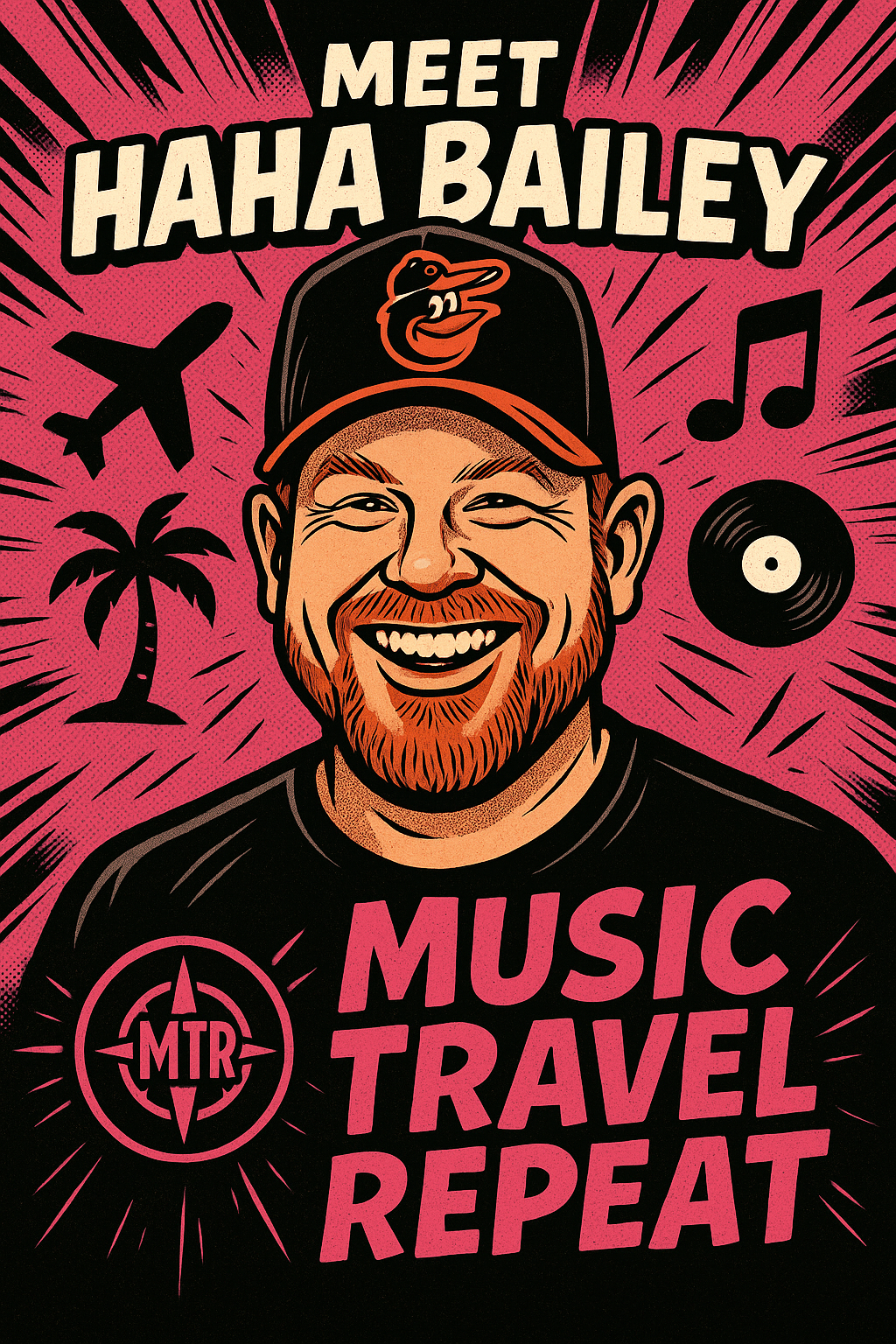
For Haha Bailey, writing is the purest form of honesty. After decades of guarding musicians, comedians, and strangers, he learned that true protection starts with telling the truth. Music Travel Repeat is where he lays it bare — the heartbreak, the humor, and the holy in-between. His voice feels like a late-night confession you didn’t know you needed. Read The Restless, The Hopeful, and The Broken.