Music Travel Repeat! › Haha Bailey ›
How To Hire Haha Bailey: Stillness in the Chaos. Safety Without the Show.
My name is Haha Bailey.
You won’t see me on the flyer.
You won’t find me in the photos.
Most of the time, you won’t even notice I’m there.
And that’s exactly how it should be.
Because the measure of my work isn’t whether I get noticed — it’s whether the person I’m protecting doesn’t have to.
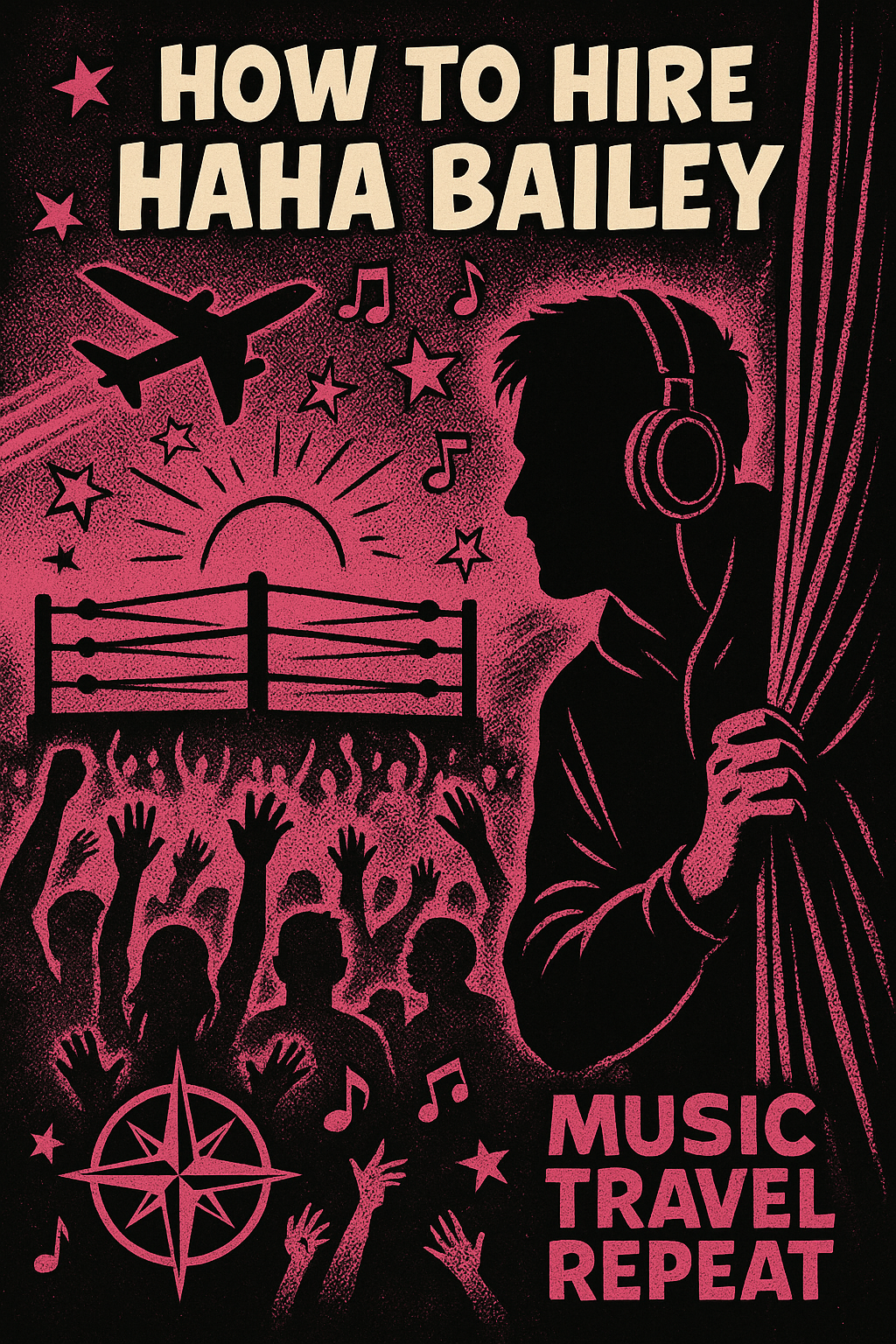
If I’m there, you’ll feel it.
- You’ll feel it in the calm backstage, where the noise outside can rattle the walls but never breaks through the walls of your spirit
- You’ll feel it in the tension that never quite erupts, because someone already spotted it, read it, and quietly redirected it before you ever had to flinch
- You’ll feel it in the way everything moves smoother than it should when the night gets loud — not because chaos didn’t try to show up, but because it never got the chance.
That’s the work I do.
It isn’t glamorous. It isn’t loud. It doesn’t look like what most people imagine when they hear the word security.
But it’s real. It’s necessary. And for almost two decades now, it’s been my calling.
Why I Walk in the Shadows
When most people think of security or executive protection, they picture the stereotype: a man in dark glasses, arms folded, jaw clenched, a visible barrier of muscle daring the world to make a move.
That’s not me.
I’ve never been interested in playing the caricature of protection. Because the truth is, when you’re really doing the job right, you don’t need to make yourself bigger. You don’t need to dominate the room. You don’t need to draw attention to the very person you’re supposed to be shielding.
The best protection doesn’t announce itself.
The best protection slips into the fabric of the space — invisible but undeniable.
My job is not to be the star of the story. My job is to make sure the person I’m protecting gets to tell their story without interruption.
- Wrestlers stepping into a ring with 20,000 eyes on them
- Musicians pouring their heart out under the lights
- Fighters walking into cages where adrenaline runs like a flood
- Public figures moving through airports, hotels, and venues where one wrong glance can turn into an incident
For all of them, my presence is meant to be a quiet shield. A calming weight. A layer of protection so integrated into the atmosphere that they can do their work, live their moment, and carry their purpose without worrying about what might go wrong.
Because I’ll already be carrying that.
The Philosophy of Presence
If there’s one word that defines what I bring, it’s presence.
Not the kind that comes with a spotlight.
Not the kind that feeds on being seen.
But the kind that steadies a room without saying a word.
- Presence is what keeps a tense situation from snapping
- Presence is what allows an artist to exhale before walking onstage
Presence is the invisible hand that guides chaos back into order, long before anyone realizes chaos had arrived
When people ask me what I do, I could tell them about training, about courses in behavioral threat recognition, about certifications and protocols and defensive tactics. And yes, I’ve done all of that. But none of it fully explains why I’ve been trusted with the safety of people whose names you know, whose songs you sing, whose matches you’ve watched under blinding lights.
What explains it is presence.
- The presence of someone who has stood in enough storms that his nerves no longer rattle at thunder
- The presence of someone who has memorized exits before anyone else thought to look for them
- The presence of someone who notices the man in the second row who’s too still in a place meant for motion, or the fan whose eyes don’t match the joy in their voice.
Presence isn’t about being louder than the crowd.
It’s about being calmer than the chaos.
It’s the art of carrying stillness inside you, even when the night is shaking with sound.
Beyond Muscle and Training
Make no mistake — I’m trained. I can handle myself. Years in Baltimore clubs, in arenas, backstage at events where the stakes were higher than anyone knew — those sharpened me.
But here’s the truth: the hardest part of this job isn’t strength. It isn’t size. It isn’t even skill.
It’s restraint.
It’s knowing when not to move.
When not to escalate.
When not to let your own adrenaline take over.
Most of the time, the best protection doesn’t look like action. It looks like prevention. Like awareness. Like an invisible shift in the air that keeps trouble from ever surfacing.
Anyone can puff their chest out and throw a punch. It takes something else entirely to read the storm before it breaks — and to calm it without anyone ever knowing.
That’s what I bring.
- Not just the body of a protector, but the mind of one
- Not just the ability to respond to chaos, but the patience to dissolve it before it arrives
- Not just force — but presence.
The Weight of Trust
Over the years, I’ve worked with people who’ve been stalked, harassed, targeted, and tested. I’ve stood in rooms where anxiety was thicker than smoke, where the weight of expectation pressed down harder than any threat.
And I’ve learned that sometimes, the most valuable thing I can offer isn’t my strength. It’s my steadiness.
Because trust is everything in this work.
Not the loud kind of trust that demands recognition, but the quiet kind you can feel without asking for it.
- The trust that lets an artist walk onstage without checking over their shoulder
- The trust that lets a fighter enter the cage without wondering who’s in the first row
- The trust that lets a public figure walk into a crowd without carrying the burden of hyper-vigilance — because they know I’m carrying it for them
That’s the real gift I offer.
Not peace of mind as a slogan.
Peace of mind as a lived experience.
The Baltimore Years
I Was Baptized by Noise
Before I ever stood behind a stage curtain or walked through a green room with a headset in my ear, I stood at the doors of Baltimore nightclubs.
And if you know Baltimore, you know this: it doesn’t care if you’re ready. It will test you anyway.
It’s not the kind of city that lets you fake awareness. If you aren’t watching, if you aren’t reading the room before you step into it, you’ll find out quick — and usually the hard way.
For over a decade, those clubs, bars, and after-hours warehouses became my classroom. Every night was a lecture, every shift an exam, every crowd a textbook written in sweat, bass, and trouble waiting to announce itself.
I didn’t just learn in Baltimore. I survived Baltimore.
The Unseen Lessons
It’s one thing to train in a classroom, to run through scenarios with instructors who know the script.
It’s another thing entirely to stand in a crowded club where the music is louder than thought, where alcohol sharpens some people and unravels others, where tension builds without warning.
That’s where I learned the lessons that shaped everything I do now:
Read before you react. The first man to throw a punch isn’t the first man you needed to notice. He’s the one who was already losing the quiet fight inside himself fifteen minutes earlier. His drink stayed too full because he stopped socializing. His shoulders squared in a crowd that was supposed to sway. His eyes went sharp in a place that should blur. By the time his fist moved, the story had already been written.
Memorize the exits. Before you even know the band, the set-list, or the vibe of the night — know the exits. Fire exits. Side doors. The “employees only” path no one else sees. Because when chaos hits, you don’t rise to the occasion. You fall back to what you prepared. And in Baltimore, the only people who walked out calm were the ones who knew how to walk out fast.Ever have an ex employee use the employees only path and stick a gun to your belly ? I have and it's not a fun situation to get yourself out of.
Never underestimate stillness. A man pressed against a wall, silent, jaw clenched, is more dangerous than the drunk who’s dancing too loud. One is burning energy. The other is storing it. I learned that quick.
Control isn’t about force. I’ve pulled weapons off men who never made it to the dance floor and those who have. I’ve de-escalated fights without a single word. I’ve carried bleeding strangers through side exits while the DJ never missed a beat. The lesson? Control isn’t always about the hand you place on someone. Sometimes it’s about the calm you bring to the room.
Scars That Don’t Show
You don’t work in Baltimore security without scars. Some you can see. Some you can’t.
There are the physical ones, sure — split knuckles, a busted bicep that was never repaired, broken ribs, reminders of nights when the tension snapped and there was no way around it.
But the deeper scars are quieter. The ones you carry in memory.
- The faces of people who didn’t make it home.
- The sounds of panic in a room not built for panic.
- The silence afterward, when you replayed every detail wondering if you could have done something different.
Those scars never go away. But they don’t weaken you. They sharpen you.
Baltimore taught me that vigilance is more than habit — it’s survival. And it’s the kind of survival that stays in your bones long after you leave.
A Sixth Sense
I don’t say this lightly: Baltimore gave me a sixth sense.
It’s not magic. It’s not luck. It’s repetition. Thousands of nights of watching, scanning, noticing. Thousands of hours of standing in rooms where things went wrong and still walking out intact.
Now, I can read a room without scanning it.
I can sense when energy shifts before the crowd even knows.
I can clock a potential threat from the corner of my eye while still blending into the background.
That’s not something you learn in a two-week training course. That’s not something you get from a laminated certificate.
That’s something you learn when you’ve stood in enough storms that the thunder doesn’t make you flinch anymore.
And it’s the very sense I carry with me into every arena, every backstage, every airport tarmac I step onto today.
From Baltimore to the Bigger Stage
Baltimore didn’t just shape my instincts. It shaped my standards.
Because if you can keep a nightclub in Baltimore calm on a Saturday night, you can keep a concert crowd steady.
- If you can de-escalate a fight before it erupts in a parking lot, you can navigate an anxious green room
- If you can hold steady when weapons come out under flashing lights, you can hold steady when thousands of people press against a barricade at once
The context changes. The noise changes. The stage changes.
But the principle doesn’t.
Stay calm.
Stay invisible.
Stay two steps ahead of whatever chaos might be warming up in the wings.
That’s Baltimore’s gift to me. And it’s the gift I carry to everyone I protect now.
Why This Matters Now
I tell you about Baltimore not to glorify it. Not to sell you some story of toughness or street credibility.
I tell you about it because that’s where my presence was forged.
Every lesson I learned there now translates into something bigger:
- The patience to stand in silence
- The awareness to spot trouble before it arrives
- The calm to keep chaos from spreading
- The humility to know this job isn’t about me
it’s about the one I’m protecting.
Baltimore made me. And everything I offer today — every ounce of steadiness, every layer of presence, every quiet breath of safety — was earned in those nights.
So when you see me standing in the shadows, remember: that shadow was cast by years of hard nights and hard lessons.
And it’s why, if I’m behind you, you’ll never have to look back.
On the Road: Wrestling, Concerts, Fighters
Baltimore hardened my instincts. But the road taught me something different: how to carry that instinct into spaces where the noise wasn’t just loud — it was sacred.
Because a wrestling arena isn’t just a building. It’s a cathedral of chaos.
A concert stage isn’t just wood and lights. It’s a lifeline for an artist who’s carried their pain into melody.
A fight walkout isn’t just a few steps. It’s the heaviest path a man will ever walk — and sometimes, the loneliest.
And my job? To make sure that, in all that chaos, they never have to carry the weight of safety on top of it.
Vignette 1: The Wrestler
There’s a moment before the music hits when even the toughest wrestler looks small.
Not physically. These men are giants. But emotionally. Vulnerable in a way the crowd will never see.
I remember one night standing just off the curtain. He kept pacing, adjusting his gear, mouthing words like they were prayers. The roar of the crowd outside was already shaking the walls, but his world had shrunk to the ten feet of concrete under his boots.
I didn’t say anything. I didn’t need to.
I just stood close enough that when his eyes flicked up — searching for something, someone, anything steady — I was there. Grounded. Silent.
He nodded once, barely perceptible. And then his music hit.
That night, thousands of people cheered for a man who looked untouchable. What they never knew was that, moments before, he had needed someone to be his anchor in the silence.
That’s what protection looks like sometimes. Not a fight. Not a take down. Just presence.
Vignette 2: The Musician
Green rooms are strange places. They’re both sanctuaries and pressure cookers.
I once worked with an artist who had been targeted before — harassed, stalked, even threatened. By the time I joined, they weren’t just nervous about going onstage. They were carrying a weight that had nothing to do with music.
That night, they sat in the corner, head in their hands, a bottle of water untouched on the table. The band was restless. Crew members whispered. Anxiety spread like static.
I positioned myself by the door, not saying a word. But I let my calm fill the room. My stillness gave everyone else permission to breathe.
Eventually, the artist looked up. Our eyes met.
“You good?” I asked quietly.
They nodded, a little too fast.
“Then I’ve got the rest,” I said.
It wasn’t bravado. It wasn’t a line. It was a transfer of weight. They carried the songs. I carried the rest.
Minutes later, they walked out and lit up the stage like the world hadn’t pressed down on them an hour earlier. The crowd never knew. They only saw the fire.
But I knew. And they knew. That was their last show together. Each went out to start solo careers after that night.
That’s why I do this.
Vignette 3: The Fighter
The walk to the cage is unlike anything else.
I’ve seen men who could bench twice my weight look like children taking their first steps. Not because they’re weak, but because they know what waits for them on the other side of that walk: pain, survival, judgment.
One fighter I protected once told me, “I’m not scared of him. I’m scared of all of them.”
He wasn’t talking about his opponent. He was talking about the crowd. The boos. The cheers. The eyes that turned men into monsters, win or lose.
That night, I walked half a step behind him. My eyes scanned the crowd, my hand free, my body angled. He didn’t look back once.
Afterward, when the fight was over — and his face was a map of exhaustion and bruises — he sat down, breathing ragged.
“You didn’t even blink,” he told me.
And he was right. I didn’t.
Because that’s what presence is. Not blinking when they need someone to see the danger so they can keep walking into destiny.
What the Road Taught Me
Every city, every tour, every fight night taught me something new about this work:
It’s not about the crowd. The noise will always be there. The lights will always flash. The real work is in the quiet moments before the noise. That’s where you steady someone.
It’s not about the stage. Whether it’s a squared circle, a lit-up arena, or a cage, the stage is never where the danger first shows itself. It’s in the lead-up. The travel. The green room. The walkout.
It’s not about the fighter or the singer or the wrestler. It’s about the human being underneath it all. The one who feels fear, who doubts, who prays in silence before stepping into the storm.
And my role is always the same: to let them be human, while I hold the line against everything else.
The Noise That Heals
Here’s the irony: I love the noise.
I love standing in the middle of an arena when the crowd roars so loud it rattles your bones. I love the crackle of guitars through amps, the chants echoing through wrestling arenas, the chants of fight fans that rise like thunder.
But I don’t love it for me.
I love it because I know the person I’m guarding can actually enjoy it without carrying the fear of what else might come with it.
The noise heals them. My silence holds them.
That’s the balance.
Executive Protection: The Role Nobody Sees
People see the lights. They hear the music. They feel the adrenaline of a show or a fight night.
What they don’t see is the man standing still in the shadows, eyes moving but body unmoved, carrying the weight of a thousand possible outcomes before they ever happen.
That’s me.
- I don’t stand in the spotlight
- I don’t sign autographs
- I don’t walk out to cheers
I stand behind it all — in the wings, in the hallways, in the corners of green rooms where nobody’s looking.
And the strange truth is this: my best work is measured by absence.
- The absence of panic
- The absence of disruption
- The absence of harm
If I’ve done my job right, the story the world tells never includes me.
The Loneliness of Stillness
There’s a loneliness in this life that most people will never understand.
Imagine standing in a room full of energy — thousands of people screaming, chanting, singing — and knowing that none of it is yours to join.
You can’t drink it in.
You can’t lose yourself in it.
You can’t even relax for a second to enjoy what everyone else paid to experience.
Because while they’re losing themselves, you’re finding everyone else.
- The drunk in the third row
- The stalker who traveled three cities to stand too close
- The stagehand who doesn’t belong in this hallway
- The shadow that moves wrong under the light
That’s where my focus lives. Always on the edge. Always on the perimeter. Always slightly removed from the joy I’m protecting.
And sometimes, when the night is over and the crowd has gone home, that removal lingers. The people you protected are laughing, celebrating, drinking in the moment. And you’re still scanning — still holding the weight, even though the world already thinks the night is safe.
It’s a job of discipline. But also of solitude.
Leadership and Loss
For years, I wasn’t just on the detail. I was running the whole company.
I carried not only my presence but the presence of others. Training them. Guiding them. Making sure the standard never slipped.
And here’s something I learned the hard way: in this line of work, people don’t follow orders. They follow presence.
After I left, the company folded. Not right away. Not because the contracts weren’t there. Not because the money disappeared.
But because the faith did.
Clients don’t renew contracts based only on the numbers. They renew them because they believe in the person behind the numbers.
When I left, so did that belief.
It’s not arrogance. It’s reality. Protection is personal. A client doesn’t just hire a logo or a company name. They hire trust. They hire leadership. They hire the quiet certainty that when things go wrong, the person in charge won’t flinch.
And when that person is gone? The foundation cracks.
I watched it happen. Slowly at first. Contracts that once renewed without question suddenly hesitated. Clients who once felt anchored now felt unsettled. And it wasn’t about cost. It was about confidence.
Because in this business, protection isn’t a commodity. It’s a covenant.
And covenants are tied to people — not paper.
The Weight of Being Followed
I’ve had men tell me, “The only reason I stayed on the team was because you were leading it.”
At first, I thought it was just respect. But over time, I realized it was something deeper: they weren’t following me because of fear or authority. They were following me because of trust.
- Trust that I would never ask them to do something I wouldn’t do myself
- Trust that when chaos came, I wouldn’t be the first one to hide
- Trust that my calm would hold long enough for theirs to catch up
That’s the real currency in this work. Not money. Not contracts. Not company logos.
It’s presence.
It’s leadership.
It’s the quiet knowledge that someone is carrying the weight — and carrying it well.
The Inner Code
Every protector develops a code — whether they admit it or not. Mine is simple:
Stay invisible. This job isn’t about me. It never will be.
Stay steady. If I crack, the whole room cracks. So I don’t.
Stay ahead. The danger is always ten steps away. So I stay eleven.
Stay human. Because the second I forget the humanity of the person I’m protecting, I’ve already failed them.
It sounds simple. But living by it isn’t.
It means long nights of silence. It means carrying adrenaline without release. It means knowing the stories of others will be told while yours remains unwritten.
But it also means living a life that matters in ways the spotlight will never understand.
Why I Still Choose This
After nearly twenty years, I could have stepped away. When the company folded, when the contracts dissolved, when I had every reason to walk into a quieter life — I could have.
But I didn’t.
Because this isn’t a career I chose once. It’s a vow I choose daily.
- A vow to walk into chaos with stillness
- A vow to hold the perimeter so others can hold the stage
- A vow to lead with presence, even when nobody sees it
It’s not glamorous. It’s not loud.
But it’s real. And it’s mine.
What I Bring
More Than a Resume
It would be easy to list certifications. To stack acronyms. To rattle off the agencies, schools, and tactical training - I’ve completed over the years.
But here’s the truth: no piece of paper, no laminated credential, no name-drop will ever capture what I actually bring into a room.
Because what I bring can’t be measured in a line on a resume.
It’s measured in stillness.
In steadiness.
In the way tension dissolves before it becomes visible.
Still, for the sake of clarity, let’s begin with the tangibles — the hard skills. The ones you can name, measure, and point to.
The Tangibles: Hard Skills
Crowd Intelligence & Environmental Scanning
I’ve worked rooms where thousands pressed against barricades, where energy turned volatile in a heartbeat.
I’ve learned to scan an environment in seconds, noting exits, choke points, blind spots, and potential flash points long before they become obvious.
In Baltimore, that meant reading the flow of alcohol and anger. On the road, it means reading the swell of a crowd and the way a single ripple can signal a storm.
Behavioral Threat Recognition
I’m trained to read micro-behaviors, facial expressions and am considered a super recognizer — the jaw that clenches too tight, the posture that’s too rigid, the eyes that scan instead of settle.
I can pick out the man who isn’t dancing at a concert, the fan whose energy doesn’t match the crowd, the stalker who tries to disappear into “normal.”
Years of exposure sharpened what training first taught: people broadcast intent long before they act.
De-escalation & Conflict Diffusion
Force is always a last resort. Presence, tone, and calm resolve dissolve more threats than fists ever could.
I’ve de-escalated men twice my size without raising my voice. I’ve redirected panic into quiet without drawing attention.
The art is knowing when to step in and when to step back — and doing both so smoothly no one ever remembers the moment.
VIP Transport & Close Protection
I’ve protected high-profile individuals in cars, buses, airports, and hotel lobbies where exposure was unavoidable.
I know how to move people from one space to another with dignity, safety, and discretion.
I plan routes. I memorize alternatives. I create space where there isn’t any.
International Travel Security
Over 100,000 miles a year. Multiple countries. Different laws, different risks, same responsibility.
I’ve learned how to operate in places where language, culture, and terrain aren’t on my side.
I know how to keep someone safe in airports where anonymity is impossible, in border towns where rules bend, and in arenas where the crowd speaks a language I don’t — but threat still translates.
Crisis Response
- I’ve pulled weapons before they reached the dance floor and when they were pulled on the dance floor
- I’ve carried bleeding bodies through side exits while the show went on
- I’ve held the line during surges, panics, and breakdowns
And in all of it, I never cracked.
The Intangibles: Heart Skills
If those are the skills you can measure, here are the ones you can only feel.
Presence
The steady calm in a room.
The invisible authority that tells people without words: “You’re safe. I’ve got this.”
The difference between walking onstage with tight shoulders and walking onstage breathing free.
Intuition
The sense that tells me something’s off long before there’s proof.
The sixth sense born in Baltimore, sharpened in arenas, confirmed on tarmacs and tour buses.
The gut-level awareness that has saved lives, prevented chaos, and kept nights quiet when they could have turned violent.
Restraint
The discipline not to act when action would escalate.
The humility to let my presence, not my ego, guide the room.
The strength to remember this job isn’t about proving myself. It’s about preserving someone else’s moment.
Emotional Intelligence
Understanding that artists, fighters, wrestlers — they’re human first.
Knowing when to speak and when silence steadies more.
Carrying not just physical protection, but emotional steadiness — absorbing panic without spreading it, holding fear without amplifying it.
Loyalty
The kind of loyalty that doesn’t end when the show does.
The kind of loyalty that makes me the first in the building, the last to leave.
The loyalty that lets people exhale, because they know I’m not here for the photo, the clout, or the clink of a glass. I’m here for them.
A Story of Restraint
One night, backstage, a situation escalated fast. An argument between crew members turned physical. Shouting. Pushing. Tension rising like smoke.
Everyone expected me to intervene with force. Instead, I stepped between them, held my hands open, and simply said:
“Not here. Not tonight. This can wait. ”
It wasn’t the words. It was the presence behind them.
They froze. The energy shifted. The chaos drained before it boiled over. Minutes later, the artist walked onstage to a crowd that never knew how close the night came to unraveling.
That’s what restraint looks like. Not weakness. Wisdom.
A Story of Instinct
One night in Baltimore, I was protecting a rapper during a show when a dispute broke out with one of his opening acts. Words turned sharp, bodies pressed forward, and I could see the tension spiraling.
But I also saw something else: the glint of a gun tucked beneath a hoodie, and the look of a man who wasn’t bluffing. I knew his temper, knew the weight of that weapon wasn’t for show.
I didn’t argue. I didn’t wait. I didn’t try to play tough.
I moved.
I grabbed my client and physically steered him away — through the chaos, down the corridor, and almost 250 yards to his tour bus. Away from the shoving. Away from the shouting. Away from the danger nobody else seemed willing to name.
When the door shut behind us, I thought I’d done my job. But that night, my client fired me on the spot. He thought I’d overreacted. Thought I’d embarrassed him. Thought I was too cautious.
Years later, the story found me again. The same opening act — the one I’d moved him from — shot another artist point blank in the head after a verbal dispute. Exactly the ending I had seen written in his eyes years earlier.
Not long after, that client called me. He asked to meet. We sat down at Fogo de Chao, and over the hum of clinking glasses and roasted meat being carved table side, he slid a bag of cash across to me.
“Thank you,” he said. Simple as that.
He finally understood what I had done for him. What presence had saved him from.
That’s the strange part of this work. Sometimes protection feels like overreaction in the moment. Sometimes trust takes years to catch up.
But instinct doesn’t wait for applause. It just moves — and saves lives quietly.
A Story of Intuition
Another time, in an arena halfway across the world, I noticed a man in the stands. He wasn’t moving with the crowd. He wasn’t singing. He wasn’t swaying. He was standing still — too still.
Something in me tightened. I shifted closer to the stage, signaling another protector to track him.
Minutes later, before the music hit its peak, security removed him. Weapons hidden under his clothes.
The crowd never knew. The artist never broke stride. The night remained what it was meant to be.
That wasn’t luck. That was intuition. A skill you can’t teach in a classroom — only learn in the fire.
The Cost of Getting It Wrong
In this line of work, failure doesn’t look like a bad review. It doesn’t look like a complaint email.
- Failure looks like chaos swallowing the room
- Failure looks like a headline you can’t undo
- Failure looks like the night being remembered for the wrong reasons
That’s why I take every detail personally. Why I charge what I charge. Why I don’t spread myself thin or say yes without calculation.
Because when the cost of getting it wrong is measured in fear, harm, or worse — half-measures are worse than nothing.
The Full Equation
So what do I bring?
The tangibles: training, awareness, global experience, tactical preparation.
The intangibles: presence, intuition, restraint, loyalty, emotional intelligence.
Combined, they form something simple but rare:
A protector who can stand in chaos without becoming part of it.
Someone who steadies the room without ever stealing the focus.
Someone who knows that protecting isn’t just about the body — it’s about the moment.
Because if you’re an artist, that moment is your livelihood.
If you’re a fighter, that moment is your legacy.
If you’re a public figure, that moment is your peace.
And my job — the vow I carry into every space — is to make sure nothing interrupts it.
Where I Work
When people ask me where I work, they expect a list of cities. A tour schedule. A map dotted with pins.
But the truth is, where I work isn’t just about geography. It’s about intention.
Because the job doesn’t change when the country does. The noise is different, the culture shifts, but the vow stays the same: stay calm, stay invisible, stay two steps ahead.
Still — the places I’ve lived and worked have shaped the way I carry this vow. They’ve given me edges, instincts, and a certain clarity about what protection really means.
Two cities in particular — Baltimore and Tijuana — carved the foundation. The rest of the world added the finishing touches.
Baltimore: Baptism by Fire
Baltimore was my proving ground.
There, I learned to watch the way alcohol mixed with insecurity and turned men into weapons. I learned to hear the difference between a cheer and a warning. I learned how quickly a celebration could collapse into a crime scene if you weren’t ready. I watched supervisors come and go before me because of not being able to handle their own emotions. Defeated by their own egos. Ryan Holiday is correct. Ego is the enemy.
Baltimore taught me to memorize exits before the crowd even arrived. To spot the stillness in a room meant for motion. To trust my gut when something felt off — even if I couldn’t explain why.
Those nights didn’t just give me scars. They gave me a sixth sense.
And that sixth sense followed me everywhere I’ve worked since — arenas, tours, airports, and stadiums across the world.
Because once you’ve survived Baltimore nights, you can survive anywhere.
Tijuana: The Border Calm
Now, I live in Tijuana.
If Baltimore was chaos at full volume, Tijuana is chaos humming under the surface. It’s a border town. A crossing point. A place where thousands pass daily — some chasing freedom, some chasing escape, some chasing nothing at all.
Here, the lessons aren’t about overt violence. They’re about subtleties. Knowing when a look lingers too long. Knowing which corners are safe and which are not. Reading the difference between a crowd that’s buzzing with life and a crowd that’s humming with danger.
Tijuana sharpened a different part of me. It gave me patience. A kind of stillness you need when you’re living on a fault line. I don't know Spanish.
In Baltimore, I learned to act fast. In Tijuana, I learned when not to act — how to let silence stretch until you know exactly what you’re dealing with.
Together, the two cities balance me: Baltimore’s edge and Tijuana’s calm. The fire and the stillness.
The Road Beyond
But my work hasn’t stopped at the border. It’s carried me across oceans, into cities where I don’t speak the language but still understand the rhythm of a threat.
The United Kingdom
In London, I learned the importance of surveillance culture. Cameras on every corner, police visible, crowds disciplined in their chaos. But even with all that, human instinct still mattered. I saw threats brewing in pubs before shows, in the way someone positioned themselves on a Tube platform, in the subtle tension of a fan who traveled too far just to stand too close.
Japan
In Tokyo, I learned discipline. Crowds there are orderly, respectful, restrained. But beneath that order lies pressure — the kind that can explode if not respected. Protection in Japan wasn’t about holding back chaos. It was about preserving harmony. About noticing when a ripple threatened the surface calm.
Australia
In Sydney and Melbourne, the challenge was scale. Crowds weren’t just big — they were sprawling. Outdoor festivals where thousands swayed under the sun, where barriers became suggestions, where chaos had room to grow unchecked. There, protection meant endurance. Hours on your feet. Eyes always moving. Reading a sea of people like you’d read a single face.
Everywhere Else
Airports in Europe. Side streets in South America. Venues in the U.S. where money bought the lights but not the security. Every place has its own flavor of risk. But the core never changes.
Read the room before you step into it.
Stay invisible but undeniable.
Protect not just the body — but the moment.
A Story at the Border
One night in Tijuana, I was asked to escort a public figure across the border into California. The risk wasn’t violence — it was exposure. A single photo, a single crowd pressing too close, could have set off a storm.
We planned every step. Which line to use. Which vehicle. Which exit. Which backup.
And as we moved, I noticed eyes on us. Not violent eyes. Curious eyes. But too curious.
I shifted positions. Made a subtle change in route. My presence alone redirected attention, dissolved the tension before it grew.
Minutes later, we crossed. Safe. Silent. No headlines.
That’s the difference presence makes.
A Story Overseas
In Europe, I worked a tour where one fan followed us city to city. At first, harmless — a familiar face in the crowd. But familiarity turned to fixation. And fixation is a dangerous seed.
By the third show, I knew he’d be at the barrier before the doors even opened. By the fourth, he was waiting near the bus.
I intercepted him once, quiet but firm. “Not tonight.”
The look in his eyes told me everything: he wasn’t there for the match anymore. He was there for ownership.
We adjusted. Changed routes. Adjusted schedules. Kept the focus where it belonged — in the ring, not on the shadow by the exit.
The tour finished safely. The entertainment never had to carry the fear.
That’s what I bring. Not just awareness of danger — but the ability to read when loyalty turns into threat.
The Common Thread
Different cities. Different countries. Different risks.
But everywhere I go, the principles hold.
Stay calm. If you panic, the room panics. If you stay steady, the room steadies.
Stay invisible. Protection isn’t performance. It’s presence.
Stay ahead. Always anticipate the storm. Always have a way out. Always be ready before the crowd knows there’s a reason to be.
Baltimore gave me the edge.
Tijuana gave me the calm.
The world gave me reach.
Together, they gave me the ability to protect anyone, anywhere — without losing myself in the noise.
Executive Protection: My Rates & Availability
Let’s start with the number.
My daily rate begins at $750, plus travel, lodging, and any applicable expenses. Sometimes it's more. But never less.
For some, that figure is enough to click away. They’ll go searching for someone cheaper. And truth be told, they’ll find them. Have at it. I wish you all the best. The world is full of men willing to wear a black shirt and stand near you for half that price or less.
But here’s what I’ve seen in two decades of doing this work:
Cheap protection isn’t protection at all.
Because when the cost of failure is measured in fear, headlines, or harm — shortcuts aren’t a bargain. They’re a liability.
That’s why my rate is what it is. Not inflated. Not arbitrary. Simply reflective of the responsibility I carry when I stand behind you.
What That Number Really Means
$750/day doesn’t just buy my time. It buys my presence.
- It buys the stillness I’ve earned through years of Baltimore nights and border-town days
- It buys the intuition that has stopped problems before they had names
- It buys the loyalty that makes me the first one in the building and the last to leave
- It buys the discipline of someone who will never take a photo, never drop a name, never blur the line between professional and personal.
What you’re paying for isn’t just hours. It’s assurance.
The assurance that while you’re walking into your moment, someone else is already holding the perimeter of it.
Why I Don’t Overbook
I could fill my calendar. I could chase gigs every weekend, stack assignments back-to-back, run myself ragged, and collect checks.
But here’s the truth: if I’m stretched thin, I’m not protecting you. I’m protecting my income. And that’s not the vow I live by.
That’s why I limit the number of assignments I take.
When I say yes to you, it’s not because I had a free weekend. It’s because I’ve already asked myself three questions:
Can I give this my full presence?
Can I bring stillness into whatever chaos might come?
Can I carry this responsibility without distraction or dilution?
If the answer isn’t yes to all three, then the answer is no.
Not because I don’t want the work. But because I refuse to show up halfway.
Scarcity by Design
I’ve watched men in this business burn themselves out. Say yes to everything. Run from airport to arena to hotel to club until their nerves frayed and their instincts dulled.
And when instincts dull, people get hurt.
That’s why I don’t work that way.
I’m not building a hustle. I’m honoring a vow. And that vow demands presence — full, undivided, unshakable.
So yes, my availability is limited. Yes, I may tell you no. Yes, you will have to plan ahead.
But if I do say yes? You’ll get all of me. Not a distracted version. Not a tired stand-in. Not a logo sending someone else in my place.
Me. Present. Grounded. Fully invested.
Why Contracts Fold
Here’s something most people don’t talk about: contracts don’t always fold because of money.
I’ve watched companies — including the one I led — lose contracts, not because they couldn’t match the numbers, but because they couldn’t match the faith.
Clients don’t hire protection because it’s cheap. They hire it because it’s trustworthy. Because it feels steady. Because it delivers peace they can’t put a price tag on.
When leadership weakens, contracts dissolve. Not because the invoices are higher, but because the confidence is lower.
I know. I watched it happen after I left.
That’s why I protect my presence so fiercely now. Because I know — in this line of work, you’re not selling hours. You’re selling faith.
And faith is priceless.
Presence as Value
Here’s the question every client has to ask:
- What’s the cost of feeling unsafe?
- What’s the cost of distraction onstage, in the ring, in front of the cameras?
- What’s the cost of not being able to trust the person standing behind you?
Those costs don’t show up on invoices. But they show up in performances cut short, in shows remembered for the wrong reason, in nights that leave scars instead of memories.
$750/day isn’t expensive when you compare it to the cost of chaos.
And for me, it isn’t about padding a bank account. It’s about honoring the weight of the responsibility I take on every time I stand behind someone.
That’s not just professionalism. That’s reverence.
Long-Term Commitments
Right now, I’m under contract — 52 weeks a year, three years left on the clock, with a metric ton of unused vacation days.
That means I’m not taking last-minute gigs. I’m not double-booking. I’m not overextending and hoping it works out.
What I am doing is preparing for 2026 and beyond.
That’s how far ahead I plan. That’s how seriously I take this vow.
If I say yes to you, it’s not rushed. It’s not casual. It’s not “I’ll squeeze you in.”
It’s deliberate. Intentional. Prepared.
Because this work isn’t about filling weekends. It’s about safeguarding legacies.
Why My Yes Matters
When I say yes, it comes with:
Preparation. Routes planned. Risks assessed. Contingencies in place.
Presence. Calm that steadies the room before the noise ever starts.
Protection. Not just of your body, but of your moment, your peace, your ability to step into your purpose.
That’s why my yes is rare. Because it’s not transactional. It’s sacred.
And if I give it to you, you can carry it into your moment knowing it’s backed by everything I’ve learned, every scar I’ve earned, every vow I’ve kept.
I have no problem bunking on a tour bus with the band I'm protecting because it's more their style.
I have no problem sitting outside a hotel room so you can get sleep.
How to Book Me: The First Step
If you’ve read this far and something in you says, Yes, I want that kind of presence behind me, here’s what happens next.
You don’t message me directly. You don’t catch me in the pit or backstage and try to lock in a handshake deal.
Instead, you go through Jacobi.
Not because I don’t care. But because I care too much to let my yes get sloppy.
Jacobi is my lawyer. He's also my filter. My guardrail. My protector — the way I protect others.
Every inquiry passes through his hands first.
He asks the questions. He checks the details. He clears the noise.
Because when I finally step into your space, I don’t want to be half-prepared. I don’t want to be distracted by another dozen conversations. I don’t want to bring a fractured presence into your moment.
And if I’m the one managing endless calls, endless emails, endless last-minute logistics, that’s exactly what would happen.
Jacobi protects my focus. And by protecting my focus, he protects you.
Why This Matters
In this work, boundaries are life.
I learned the hard way that saying yes to too much doesn’t make you effective — it makes you fragile. I once said yes to everything: every gig, every city, every call that came in. I lived on planes, answered messages at 3 a.m., stretched myself thinner than I knew I should.
And while I survived it, I also realized something:
My presence was fading.
I wasn’t showing up tired in body. I was showing up tired in spirit. And in this line of work, that’s dangerous.
Because the only reason I’m valuable is because my presence is steady. If that steadiness cracks, I’ve already failed.
So now, Jacobi stands as the first line. He's the voice that makes sure when I say yes, it’s a real yes — the kind backed by full preparation, full investment, and full heart.
What to Include in Your Inquiry
When you reach out to Jacobi here’s what he'll need from you:
Dates → When exactly do you need protection?
Location(s) → Where is the work happening? One city? A tour? Multiple stops?
Assignment → Is this a concert, a private signing, a media appearance, a fight, a tour?
Who or What → Who needs protection? What are the specific concerns?
Urgency → Why now? Why this assignment? What makes this moment different?
The clearer you are, the better Jacobi can assess alignment.
Because this isn’t just about whether I’m available. It’s about whether I can bring the right kind of presence into your moment.
What Happens Next
Once Jacobi receives your inquiry, he'll respond with one of three outcomes:
Not a Fit → If the scope doesn’t align with my standards, timeline, or availability, he'll let you know directly. Respectfully. Clearly. No games.
Need More Information → He may ask questions to clarify logistics, risks, and expectations. Because protecting well begins with clarity.
Aligned → If it feels right, He'll move forward with the process. Paperwork. Agreements. Rates. Logistics. Clean. Professional. Tight.
Only after all of that is complete do I step in.
Why It Works This Way
I know some people bristle when they hear they won’t speak to me directly at first.
But here’s what I want you to understand:
This isn’t distance. It’s devotion.
The same way I protect you by standing between you and the crowd, Jacobi protects me by standing between me and the flood of inquiries.
It’s the same principle. Boundaries aren’t walls — they’re safeguards.
And by honoring mine, I ensure I can honor yours when the time comes.
A Story About Capacity
I once took on too much. Multiple assignments stacked too close. Flights back-to-back. Calls while boarding planes. Contracts overlapping.
On paper, I got it all done. Nobody got hurt. Every job was “completed.”
But inside, I knew: I wasn’t fully present.
I was scanning, but slower. I was steady, but not as steady as I should have been. I was there, but a thinner version of me.
That’s when I realized: presence can’t be mass-produced.
It has to be protected. Preserved. Offered intentionally.
That’s why Jacobi exists. That’s why the process matters. That’s why not everyone gets a yes.
Because if I burn out chasing checks, the person who finally needs me most won’t get the full measure of what I bring. And that’s unacceptable.
Respect for Both Sides
Jacobi also ensures this process is respectful not just to me, but to you.
You won’t be left in limbo. You won’t be chasing half-answers. You won’t wonder if your message disappeared into the void.
- He’ll tell you directly whether we’re aligned
- He’ll make sure expectations match reality
- He’ll keep the communication clean so that when I do step in, it’s not with questions — it’s with preparation.
Respect for me. Respect for you. Respect for the work.
That’s what this process ensures.
The Real Invitation
So when you reach out, understand this: you’re not just filling out a contact form. You’re stepping into a covenant of clarity, boundaries, and respect.
Jacobi is the gatekeeper. I am the presence. Together, we create the conditions where protection actually works.
And if it’s meant to be, the moment I step into your world, you’ll know.
Not because I’ll announce it. Not because I’ll post about it. Not because you’ll see my name on a marquee.
You’ll know because you’ll feel the difference.
The shift in the air. The steadying weight. The quiet presence that says: You can finally exhale. I’ve got this.
Case Study 1: The Night the Room Forgot to Breathe (De-Escalation)
It started like so many nights do: loud music, crowded bars, voices rising with the bass line. On the surface, everything looked normal. But in the corner, two men began circling each other with words sharper than broken glass.
Most people saw an argument. I saw a fuse.
One wrong word and the whole room would ignite.
I moved in quietly. No pushing. No barking. Just presence.
I placed myself between them, not with fists, but with stillness. My hands were open, my voice low, my stance wide enough to hold the weight of both men’s anger.
“Not here,” I said. “Not tonight.”
That was it. No lecture. No force. Just the right words carried by the right calm.
Something shifted. The crowd leaned back. The men’s shoulders loosened. The fuse fizzled before the fire ever sparked.
The band never stopped playing. The crowd never knew how close they came to chaos.
That’s what de-escalation looks like. Not a fight stopped. A fight that never had to start.
Both men received a drink at the same time that they believed was from the other but it was comped on my end. They ended up buying each other drinks all night.
Case Study 2: The Man in the Second Row (Intuition)
It was an arena show — thousands of people pressed shoulder to shoulder, chanting, singing, losing themselves in the music.
But one man in the second row wasn’t singing. Wasn’t moving. Wasn’t alive in the way the crowd was alive.
He stood still. Too still.
My gut tightened. Instincts flared.
I shifted closer, eyes never leaving him. Nothing obvious. No weapon in sight. But his stillness was louder than the music.
I signaled. The team moved. By the time he was escorted out, the search revealed what my gut already knew: concealed blades.
The artist never missed a beat. The crowd never broke stride. The show remained joy instead of tragedy.
And no one knew why.
That’s the power of intuition. It’s not about being right every time. It’s about being alert every time. Because one day, the wrong stillness saves the right life.
Case Study 3: The Longest Night (Endurance)
Outdoor festivals test more than skill. They test stamina.
Hours on your feet. Crowds swelling beyond barriers. Heat pressing down like a second skin.
I remember one night where the crowd surged so violently it felt like a tidal wave against steel. The barricade bent. People screamed. The artist looked out, frozen between performance and panic.
I didn’t move fast. I moved steady.
One step at a time, I cleared pathways. Redirected pressure. Pulled exhausted fans through side exits. Kept the artist focused while making sure the wave didn’t crush anyone.
For hours, I didn’t sit. Didn’t break. Didn’t let fatigue cloud judgment.
When the sun came up, everyone went home. Safe. Exhausted, but alive.
That’s endurance. Not just physical. Emotional. The ability to stand steady long after others break.
When you expect 5,000 fans and receive 15,000 instead you have to open the gates.
Case Study 4: The One Who Couldn’t Stop Shaking (Emotional Steadiness)
Backstage before a big fight, I noticed the fighter’s hands. Shaking. Not from fear of the opponent — but from fear of the eyes. The boos. The judgment. The weight of expectation.
I didn’t lecture him. Didn’t hype him up. Didn’t add more noise to the storm in his chest.
I just stood beside him. Silent. Steady. Breathing slow enough for him to hear it.
After a moment, his breathing matched mine. The shaking eased. The noise inside him settled.
He walked to the cage still carrying nerves — but also carrying my calm.
Later, win or lose didn’t matter. What mattered was this: he told me he didn’t feel alone walking out.
That’s emotional steadiness. Absorbing panic so someone else doesn’t drown in it.
Case Study 5: The Bus That Never Stopped (Loyalty)
Tours test loyalty. Endless miles. Exhaustion. Pressure.
One night, the bus broke down in the middle of nowhere. Crew frustrated. Band anxious. Fans already waiting in the next city.
Most protectors would’ve clocked out. “Not my job.”
But loyalty doesn’t clock out.
I stayed with the artist until dawn. Made sure food was brought in. Kept anxious fans at a distance when word spread. Sat with them in the silence of a stalled night, carrying their worry so they could conserve their energy.
By morning, the bus was moving again. The show went on. Nobody in the crowd ever knew the night almost broke the tour.
That’s loyalty. Not measured in hours. Measured in presence. Measured in the willingness to carry weight that isn’t technically yours — because you know the one you’re protecting already carries more than enough.
The Thread That Connects Them All
Five stories. Different nights. Different contexts.
But the thread is the same:
Calm over chaos.
Presence over panic.
Prevention over performance.
This work is rarely about the dramatic moment. It’s about the invisible one.
- The fuse that never lit
- The blade that never made it inside
- The breath that finally came steady before the walkout
- The show that went on because the bus — and the artist — kept moving.
That’s what I bring. Not a spectacle. Not a spotlight. Just the quiet vow that you’ll never have to carry it alone.
If I’m Behind You, You’ll Know
If I'm Behind You, You'll Know The Invisible Vow
This work has always been simple to me. Not easy. But simple.
My job is not to be seen. My job is to make sure you don’t have to worry.
- I don’t care about the lights
- I don’t need my name on a list
- I don’t want to stand in the photo
What I want — what I vow — is this: if I’m behind you, you’ll know. I play in the background. You take the lead.
Not because I’ll announce it. Not because I’ll post about it. But because you’ll feel it.
- The steadying shift in the air
- The calm where there should be panic
- The quiet confidence that lets your shoulders drop because someone else is carrying the weight.
That’s my vow. That’s what I bring.
What You Can Expect
If I stand behind you, you can expect:
Stillness in chaos. When the room shakes, my calm won’t.
Presence without performance. You won’t find me flexing, posturing, or drawing attention. You’ll find me blending into the fabric of the moment while anchoring it in silence.
Preparation without excuse. Exits memorized. Contingencies mapped. Threats read before they materialize.
Loyalty without conditions. I won’t just show up for the easy part. I’ll stay until the weight is fully carried.
Discretion without exception. No name-dropping. No selfies. No leaks. What happens behind the curtain stays behind the curtain. Always.
You can also expect this: I won’t say yes unless I mean it. Unless I can give you my full presence, my full steadiness, my full vow.
Because halfway yes in this work is a full betrayal. And that’s something I will never offer.
What You Won’t Get
If you’re looking for the caricature, I’m not your man.
I don’t wear the ego in the tight shirt. I don’t scan the room like it owes me something. I don’t trade trust for clout.
You won’t see me sliding into the photo pit, asking for guest list favors, or turning protection into performance.
I don’t blur the line between fan and protector. I don’t cheapen the work by making it about me.
So if that’s what you’re after — save your money.
But if you’re after presence — real presence — the kind that holds a room without noise, steadies a storm without motion, and dissolves chaos before anyone knows it arrived… then you’re in the right place.
Why I Still Choose This
I’ve been doing this for almost twenty years. I’ve stood in Baltimore clubs where weapons came out under flashing lights. I’ve stood in Tijuana crossings where eyes lingered too long. I’ve stood in arenas across the world where crowds pressed like waves against barricades.
I’ve carried scars — some visible, some not.
I’ve watched companies fold when faith left the room.
I’ve held panic in my chest so the person in front of me could breathe steady.
And after all of it, I still choose this.
Because this isn’t just a career. It’s a vow.
- A vow to hold the line
- A vow to be the stillness in the storm
- A vow to stand behind someone so they can step fully into their purpose
That vow is why I charge what I charge.
Why I say no more than I say yes.
Why I guard my presence as fiercely as I guard my clients.
Because the moment I stop honoring it, the moment I dilute it, the moment I make it about me — I’ve failed.
And I won’t fail you.
My Vow To You
So here it is — the vow in its clearest form:
If I’m behind you, you won’t have to look back.
If I’m with you, you won’t have to wonder.
If I say yes, you won’t have to second-guess it.
Because that yes comes with everything I’ve earned — the Baltimore edge, the Tijuana calm, the miles of travel, the scars, the lessons, the sixth sense sharpened by nights most people wouldn’t survive.
You’ll know it’s real because you’ll feel it.
In the silence that steadies you.
In the calm that carries you.
In the weight that lifts off your shoulders because I already picked it up.
That’s what I bring. That’s who I am. That’s the vow I keep.
So if you’re ready — if you want that kind of presence at your back — reach out. Talk to Maria. Share the details. Be clear. Be honest.
And if I say yes? Then carry that yes like armor. Because it will mean you’ll never walk into the storm alone.
Quiet. Loyal. Effective.
No spotlight. No shortcuts.
Just someone standing behind you — so you can move forward without fear.
Catch you in the chaos,
Haha
Executive Protection | Music Travel Repeat
Here's the form you need to fill out to get the ball rolling