Music Travel Repeat - The Restless, The Hopeful & The Broken
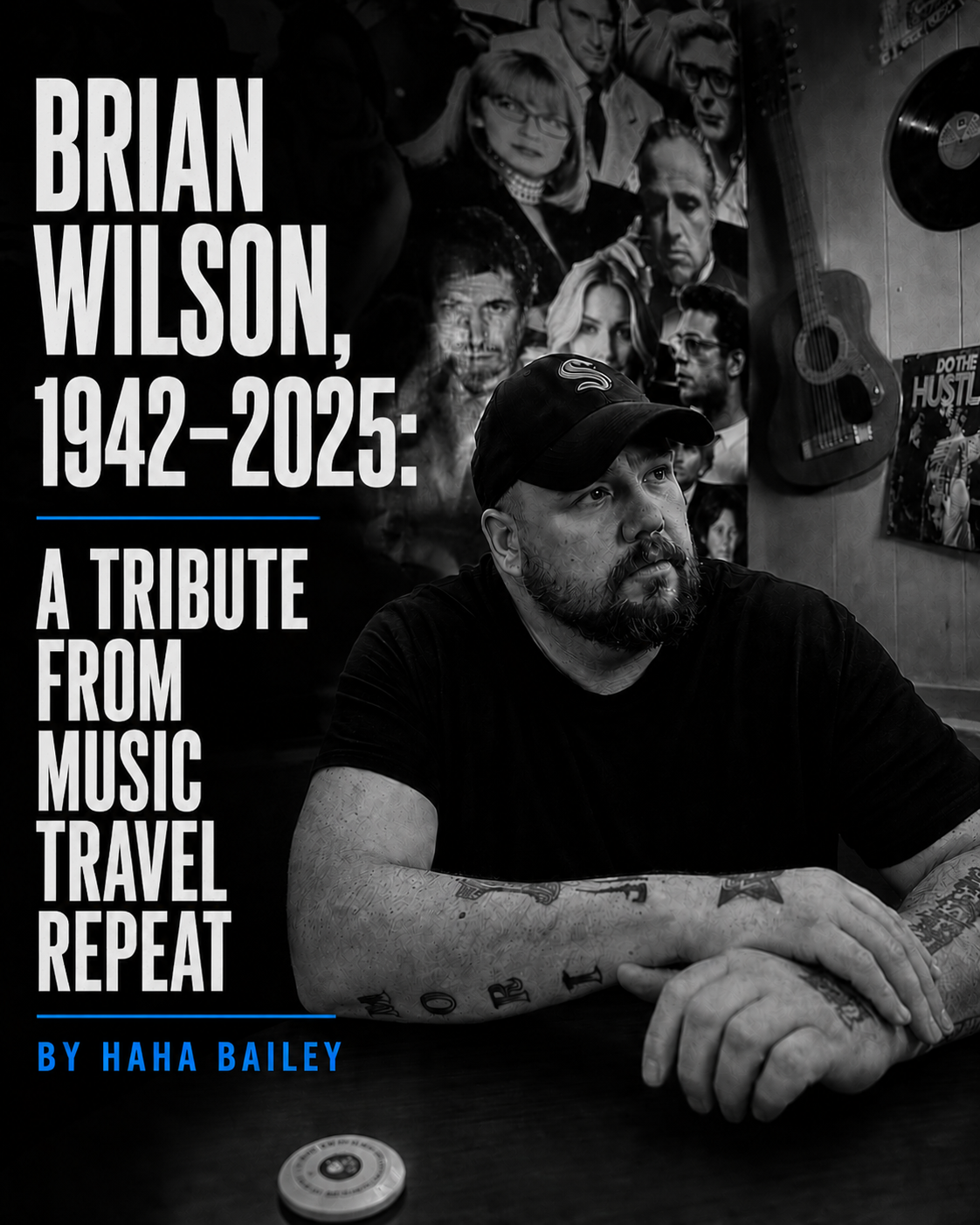
Brian Wilson, 1942–2025: A Tribute from Music Travel Repeat
A pilgrimage in words for the Beach Boys visionary who taught us that fragility could become harmony.
When Brian Wilson passed away at 82, it did not feel like the end of a life.
It felt like the dimming of a lighthouse.
Not the kind you visit on vacation, take a picture of, and forget before the next exit.
I mean the kind of lighthouse that stands there through fog and storm, guiding restless ships it will never meet, keeping people alive without ever knowing their names.
Brian Wilson was that kind of lighthouse.
For America, yes.
For music, absolutely.
But for me, sitting in the quiet of a house in Tijuana, listening to the sounds of life continuing outside my window, it felt more personal than history.
Street vendors shouted.
Children laughed.
Dogs barked like the world had not changed.
And maybe the world had not changed for them.
But inside, I carried the strange ache of knowing that one of the first men who taught me how to feel through sound was gone.
Brian Wilson was not just a musician.
He was a survivor.
A prophet of harmony.
A man who carried genius and grief in the same shaking hands.
His music raised me.
His story shaped me.
And Music Travel Repeat, the life I have built chasing songs across cities, airports, arenas, and long roads, owes more to Brian Wilson than I can ever repay.
So this is not an obituary.
The world already has those.
This is a thank-you note.
A road map.
A pilgrimage in words.
A long-form Music Travel Repeat tribute to Brian Wilson, the Beach Boys visionary who taught so many of us that music could be more than sound.
It could be shelter.
It could be memory.
It could be medicine.
It could be survival with a melody.
More Than an Obituary
What made Brian Wilson different was not just his gift for melody.
Plenty of people write melodies.
Plenty of people write hits.
Plenty of people figure out how to make a radio feel like summer.
Brian did something deeper.
He made fragility sing.
You can hear it in the tremble of his voice.
In the way his harmonies stretched toward something almost too beautiful to hold.
In the almost-hesitant reach of that falsetto, as if even he was not always sure his voice would carry him all the way there.
And somehow, that uncertainty became the magic.
Brian Wilson taught the world that beauty does not come from certainty.
It comes from courage.
That is why his music often felt like prayer.
Not polished, perfect worship.
Confessional worship.
The sound of a man kneeling at an altar he was not entirely sure would hold him, but singing anyway.
Maybe that is why so many of us clung to him.
Because in Brian’s trembling, we found our own steadiness.
In his longing, we found our belonging.
In his sadness, we heard permission.
When I first learned of his passing, I thought about the millions of radios that carried his songs across decades.
Radios in diners.
Radios in garages.
Radios in minivans crawling down the interstate on sticky July afternoons.
Radios in kitchens where somebody was making coffee and trying not to cry.
His music lived in ordinary places.
That is part of what made it holy.
It did not stay trapped in concert halls or record collections.
It rode shotgun.
It waited in the background of childhood.
It slipped between baseball games and traffic reports.
It shaped memories before we even knew memories were being made.
I wondered how many people sat in silence that day, holding a grief they could not quite explain, because a man they had never met somehow taught them how to love, how to ache, and how to hope.
For me, Brian’s songs were never background noise.
They were instruction manuals.
I did not have the vocabulary for heartbreak as a child, but I had God Only Knows.
I did not know how to name loneliness, but In My Room gave it shape.
I did not understand longing, but Wouldn’t It Be Nice let me sing it before I could live it.
That is the strange mercy of music.
Once it teaches you how to feel, it keeps teaching you.
At ten, Brian’s songs were lullabies.
At twenty, they were soundtracks for reckless road trips.
At forty, they became mirrors, reflecting back fragile truths I did not always want to say out loud.
That is why losing him felt less like losing an artist and more like losing a lifelong companion.
Like a friend who had always sat in the passenger seat quietly stepped out at a rest stop, waved goodbye, and trusted me to keep driving.
The road still stretches on.
But it feels emptier now.
Brian Wilson and the Fragile Courage of Harmony
Brian Wilson’s music was built on harmony, but not the shallow kind.
Not just pretty voices stacked on top of each other.
Not just the Beach Boys sounding clean and golden and California-bright.
Brian understood something deeper.
Harmony is what happens when difference is brave enough to stand near difference.
One voice alone can be beautiful.
But layered with another?
Then another?
Then another?
It becomes shelter.
It becomes family.
It becomes something larger than the people singing it.
That is what Brian gave us.
He took fragile voices and made them hold each other.
He took ache and made it glow.
He took loneliness and taught it to blend.
That mattered to a kid like me.
A kid who often felt like he was sitting slightly outside the room where everyone else knew the rules.
A kid who cared too much.
A kid who heard sadness in happy songs and hope in sad ones.
Brian Wilson made me feel less strange for feeling everything.
His harmonies said:
Even your note belongs here.
Even your tremble has a place.
Even your crack can become part of the song.
That lesson never left me.
It followed me into airports.
Into arenas.
Into hotel rooms.
Into the pit.
Into Music Travel Repeat.
Because the whole foundation of this place is harmony in a different form.
Music.
Travel.
Memory.
Grief.
Joy.
Connection.
Repeat.
Different notes.
One song.
The Soundtrack of My Childhood in an Astro Van
Maryland summers were sticky.
They smelled like sunscreen, crab mallets, boardwalk fries, and hot cloth seats.
They sounded like cicadas in the trees and radios fighting static.
My dad was not always a man of words.
But he was a man of radios.
He had a way of rolling down the windows of our Astro van and letting the outside world blend with whatever song came through the speakers.
One afternoon, we were crossing the Bay Bridge on our way to Ocean City when God Only Knows came on.
I can still feel that moment.
The seat belt pressing into my chest.
My sisters fighting over Doritos.
The water stretching out on both sides of us.
The sun bouncing off the bay like shattered glass.
Then that song began.
It did not sound like the other songs on the radio.
It sounded eternal.
The harmonies folded into each other like hands clasping.
Brian’s vision rose through the speakers, fragile and somehow sure, and even as a kid, I knew the whole van had changed.
I did not know the language for it yet.
But I understood something in my body.
Music could hold emotions too heavy for a child to carry alone.
Looking back, that Astro van was more than a vehicle.
It was a rolling cathedral.
We did not talk much as a family.
Not about the things that mattered, anyway.
But music filled the spaces where words fell short.
My dad did not always know how to say what movies told us fathers were supposed to say.
So he reached for the dial.
He turned it until something familiar came through.
And he let the melody do the talking.
That is where Brian Wilson found me first.
Not in a record store.
Not in a music class.
Not in some carefully curated discovery moment.
He found me in the backseat of a van crossing Maryland water, teaching me that a song could become a memory before you even understood what memory was.
The Astro van became a jukebox of formation.
Wouldn’t It Be Nice as we pulled into a McDonald’s parking lot after a long drive.
Surfer Girl playing softly while traffic crawled and the air conditioner groaned against summer.
Don’t Worry Baby humming through static while thunderstorms broke across the Chesapeake Bay.
Those songs were training me.
Quietly.
Patiently.
They were teaching me to attach music to place.
To let harmonies become anchors.
To understand that a song, a road, and a feeling can intertwine until they can never be separated again.
That is Music Travel Repeat before it had a name.
The song.
The place.
The memory.
Repeat.
Long before I stood in a pit.
Long before I guarded stages in silence.
Long before I moved to Tijuana trying to rebuild a life from broken pieces.
I was that boy pressed against a seat belt, staring at water and sky, learning that songs could hold me when nothing else could.
Maybe that is why I still chase concerts the way I do.
Because every arena, every airport terminal, every late-night drive feels like another version of that van.
Cramped.
Noisy.
Imperfect.
Holy.
Lessons in Harmony
Once Brian Wilson cracked the door open, I started listening differently.
Songs stopped being background.
They became testimony.
The Beatles taught me loneliness could be sacred.
The Moody Blues made melancholy feel orchestral.
The Velvet Underground whispered that simplicity could still feel infinite.
But Brian opened the door.
He taught me that music was not just entertainment.
It was emotional architecture.
A room you could enter when the world outside felt too loud.
The first thing Brian showed me was that harmony is not just musical.
It is human.
When voices blended in his songs, they sounded like family.
Not perfect family.
Not the greeting-card kind.
The real kind.
The kind with tension and tenderness.
Distance and longing.
Love and ache sharing the same backseat.
That mattered because I did not always know where I belonged.
But in those harmonies, I heard a promise.
Life was not meant to be sung alone.
Maybe the goal was not to be the loudest voice in the room.
Maybe the goal was to find where your voice belonged inside something bigger.
That lesson shaped everything.
It shaped the way I write.
It shaped the way I listen.
It shaped the way I stand in a crowd of strangers at a concert and understand that we are not really strangers once the chorus starts.
That is harmony.
Not sameness.
Difference stitched together until it feels like love.
Brian also taught me that perfection is overrated.
The cracks matter.
The tremble matters.
The vulnerable note matters.
To this day, every time I write for Music Travel Repeat, I remember that.
I do not need every sentence to be polished until it loses its pulse.
I need it to tremble honestly.
I need it to sound like the truth in my chest.
That is what connects.
That is what saves.
Brian Wilson did not teach me to chase perfect art.
He taught me to chase honest art.
And honest art is almost always a little shaky.
Thank God for that.
Pet Sounds and the Courage to Break the Mold
By the time I was old enough to understand the story of Pet Sounds, it felt less like music history and more like a blueprint.
Brian Wilson had the easy road available.
Surf songs.
Cars.
Sunshine.
Screaming fans.
A formula that worked.
A machine that wanted more of the same.
He could have stayed there.
He could have kept giving people what they already knew how to love.
But something in him ached for more.
So he risked it.
He stepped away from the safe lane and made something stranger, deeper, more vulnerable, more orchestral, more wounded, more alive.
Pet Sounds was not just an album.
It was a confession disguised as a revolution.
Gone were the easy postcards.
In their place came songs about love, doubt, longing, innocence, loss, and the terrifying beauty of being human.
Some people did not understand it at first.
That is usually how it goes when somebody tells the truth too early.
But time has a way of catching up to courage.
For me, Pet Sounds became proof that safe does not save people.
Vulnerability does.
Truth does.
Risk does.
That album taught me that longing has value.
That ache is not something to hide.
It is something to sing.
It taught me that sometimes the bravest thing you can do is make the thing no one asked for because it is the thing your soul cannot stop building.
That lesson followed me into Music Travel Repeat.
Because safe would be easy.
Safe would be writing basic concert reviews.
Here was the setlist.
Here was the venue.
Here was the merch table.
Here is whether the parking was annoying.
And listen, Google might like some of that.
But my soul does not.
Safe would be telling you about the show without telling you why I cried during the third song.
Safe would be writing about airports without admitting that airplane windows have become confession booths for me.
Safe would be talking about artists without letting you see the mirror they hold up to my own life.
But Brian would not let me stay safe.
His ghost is too stubborn for that.
Every time I try to sand the edges down, Brian Wilson whispers through the static:
Make your Pet Sounds anyway.
Tell the truth anyway.
Risk being misunderstood.
Risk being too much.
Risk the vulnerable note.
Because if it is true, it is worth it.
How Brian Wilson Shaped Music Travel Repeat
Music Travel Repeat is not just a blog.
At least, not to me.
It is a harmony.
Each essay is a voice.
One about concerts.
One about airports.
One about wrestling rings.
One about heartbreak.
One about fathers.
One about silence.
One about the pit.
One about the strange mercy of a song finding you when nothing else can.
Alone, they are stories.
Together, I hope they become music.
That is Brian’s influence.
He did with sound what I try to do with memory.
He layered instruments, harmonies, strange textures, fragile confessions, and unexpected beauty until the result felt bigger than the pieces.
I try to do the same thing with road trips and grief.
With airport noodles.
With hotel pillows at 3 a.m.
With late-night drives and songs that cut too close.
With the ache of missing people who are still alive.
With the relief of standing in a crowd and realizing your loneliness is not as original as it tried to tell you.
That is Music Travel Repeat.
Not content.
Confession.
Survival dressed as storytelling.
Brian showed me that personal can become universal if you are brave enough to risk it.
He did not write God Only Knows as a slogan.
He wrote from somewhere fragile.
And the world found itself inside it.
That is what I hope happens every time I type Catch you in the chaos at the end of an essay.
It is my falsetto.
My trembling note.
My way of saying:
I do not know whether this will matter to anyone else, but it is the truest thing I can give you tonight.
The Stages That Never Clapped
There are ticket stubs I keep not because of the shows I saw, but because of the ones I never did.
The most haunting of those is Montgomery Gentry.
I had planned the trip.
Flights.
Hotel.
Seat near the front.
It was supposed to be one of those nights where music met memory and gave me another little piece of myself back.
Then Troy Gentry’s helicopter crashed.
I still remember standing outside the arena, ticket in hand, unable to walk inside because there was no concert to attend.
That silence was deafening.
It taught me something about the fragility of music travel:
No matter how well you plan, some stages will never clap.
That is a hard lesson.
But it is also one of the lessons that built Music Travel Repeat.
Because music is not only the songs we hear.
It is also the silence we are left with when the songs do not come.
I did not realize it at the time, but standing there felt like standing at the edge of a cliff I never planned to face.
The anticipation was still alive inside me.
The joy.
The adrenaline.
The childlike giddiness that comes before the lights drop.
But once the news settled in, all that anticipation had nowhere to go.
It just sat in my chest like a caged bird.
That is what silence does.
It does not leave an empty space.
It leaves pressure.
Questions.
A weight that refuses to explain itself.
I remember holding that ticket like proof that something sacred had been stolen.
And in that silence, Brian Wilson came back to me.
Not through a song.
Through the memory of his absences.
The years he stepped away.
The years fans waited.
The times the music paused because the man carrying it was fighting storms nobody else could see.
I used to think those gaps were footnotes in his story.
Now I know better.
The silences are part of the song.
The cancellations.
The retreats.
The stages that never clapped.
The empty spaces where music was supposed to be.
They all teach us something.
They teach us to honor the fragile courage of every artist who steps into the light.
They teach us to savor the shows that do happen.
They teach us to clap harder when the band makes it to the stage.
They teach us not to assume there will always be another encore.
That is why I write about grief as much as joy.
Because the road includes both.
The arena and the empty parking lot.
The chorus and the silence.
The ticket scanned and the ticket that never gets used.
All of it belongs.
Brian Wilson, Silence, and Survival
Brian Wilson knew silence.
Not just the peaceful kind.
The heavy kind.
The kind that swallows rooms.
The kind that pulls people away from the stage.
The kind that makes the world wonder if the song is over.
His mental health struggles and long retreats from public life were not side notes to his legacy.
They were part of the cost.
Part of the truth.
Part of the human being behind the harmonies.
As a kid, I thought musicians were superheroes.
Untouchable.
Unbreakable.
Built to perform.
Brian shattered that illusion in the most honest way.
He reminded us that even geniuses carry cracks.
Even prophets of sound can drown in the noise of their own minds.
That scared me.
But it comforted me too.
Because if Brian Wilson could retreat into silence and still return, then maybe silence did not have to mean failure.
Maybe it could be an interlude.
A breath before the next chorus.
A rehearsal for survival.
I have had my own retreats into silence.
Seasons where I did not pick up the phone.
Seasons where I could not bring myself to write.
Seasons where I hid behind the work of protecting others because it was easier than protecting myself.
In those stretches, I thought of Brian.
I thought of him away from the stage, away from the noise, fighting his way through the rooms inside his own mind.
And I thought about the courage it takes to come back.
Not dramatically.
Not perfectly.
Just back.
One foot.
One note.
One breath.
One fragile return.
That is why I clap harder now when artists step back into the light after years away.
Because I know it is not just performance.
It is defiance.
It is someone telling the silence:
You did not win.
Not tonight.
Airports, Grief, and Why I Still Cry on Airplanes
There is a reason I wrote a whole essay about why I still cry on airplanes.
Altitude strips me bare.
In the stillness of a night flight, when the cabin hums and the seat belt light glows, something in me unravels.
I have cried on planes after heartbreaks.
After losses.
After triumphs too big to understand.
After concerts.
After goodbyes.
After realizing I survived something I never thought I would survive.
And more often than not, Brian Wilson’s music was somewhere near me.
Caroline, No over the Rockies.
Don’t Talk (Put Your Head on My Shoulder) descending into Baltimore.
God Only Knows somewhere above a dark stretch of America, when the engines hummed like a choir and I could not hold myself together anymore.
Flying has always felt like surrender.
You are strapped into a seat.
Trusting strangers in the cockpit.
Trusting machines to hold together against physics.
Trusting the sky to cradle you even when storms are waiting below.
Maybe that is why I cry there.
It is one of the only places where my control has to sit down and shut up.
There is nowhere to pace.
Nowhere to perform.
Nowhere to pretend you are fine.
Just you, the window, the clouds, and whatever song you were brave or foolish enough to press play on.
That is when Brian shows up.
His songs are not background noise on flights.
They are companions.
They remind me that fragility is not failure.
That trembling can be holy.
That tears are not weakness.
Sometimes they are just harmony leaving the body.
Airports are cathedrals to me.
Not because they are peaceful.
They are not.
They are loud and overpriced and full of people pretending they are not emotional.
But they are thresholds.
Hellos and goodbyes pressed into tile floors.
Hugs at gates.
Loneliness under fluorescent lights.
People leaving.
People returning.
People trying not to fall apart near charging stations.
Add Brian Wilson’s music to that setting, and the whole place becomes sacramental.
Planes are confession booths.
Music is the hymn.
And sometimes the most honest prayer you will ever pray is the one you cry into your sleeve at thirty thousand feet.
Executive Protection and Backstage Silence
As an executive protection agent, I live much of my life in the shadows.
Guarding stages so others can shine.
Watching exits.
Reading body language.
Making sure chaos does not spill too far into beauty.
People do not realize how much of protection is silence.
Not the movie kind.
Not the dramatic kind with car chases and earpieces screaming in your ear.
The real job is quieter.
It is standing at the edge of the room while everyone else looks at the stage.
It is noticing the person who does not fit before anyone else does.
It is blending into the curtain while thousands of people scream for somebody you are making sure they can safely love.
That work has always made me feel connected to Brian Wilson in a strange way.
He spent so much of his genius behind the scenes.
In studios.
In arrangements.
In details casual listeners might never notice but would absolutely feel if they were missing.
His fingerprints were all over the music, even when he was not the one standing in the brightest light.
That is protection work too.
Invisible fingerprints.
Unseen scaffolding.
Quiet labor that makes beauty possible.
There is a strange holiness in doing your best work where no one can see it.
The wrestler steps through the curtain.
The artist walks onto the stage.
The lights find them.
The crowd erupts.
My job is to stay outside that circle.
Brian understood that kind of sacred hiddenness.
He knew the power of arranging from the background.
Of trusting others to carry something he heard first in his own head.
Of building beauty without always needing to stand in the center of it.
That comforts me.
Because most people will never notice the men in black at the edge of the crowd.
Most people will never think about the studio hours that birthed a harmony.
Most people clap for what they can see.
But Brian Wilson taught me the hidden matters.
The invisible carries weight.
Silence, when offered in service of others, can be one of the most sacred sounds of all.
Brian Wilson’s Legacy Beyond Surfboards and Sunsets
To remember Brian Wilson only as the man who wrote surf songs is to flatten a mountain into a postcard.
Yes, there were surfboards.
Yes, there were cars.
Yes, there was California sunshine.
Those things mattered.
They were real.
But they were never the whole picture.
They were the doorway.
Not the house.
The house was vulnerability.
The house was Pet Sounds.
The house was Smile.
The house was every fragile note that let us know we were not listening to perfection.
We were listening to survival.
Brian Wilson’s true legacy is not just melody.
It is honesty.
He proved that pop music could ache.
That joy could carry shadows.
That imperfection could be beautiful.
That a love song could tremble.
That a harmony could hold grief.
That a man could stand at the edge of his own mind and still dare to sing.
That is the Brian Wilson I carry.
Not just the sunny Beach Boys postcard.
The diary.
The prayer.
The fragile, holy evidence that music can keep a person alive.
His legacy is not measured only in records sold or awards won.
It is measured in the invisible ways he stitched himself into people’s lives.
In fathers who rolled down van windows and let harmonies raise their children.
In couples who danced to God Only Knows, knowing it was not a perfect love song but a real one.
In lonely teenagers who pressed headphones to their ears and heard, maybe for the first time, that they were not as strange as they feared.
That is legacy.
Not just what you leave on charts.
What you leave in hearts.
Carrying Brian Wilson Into Music Travel Repeat
Every playlist I build owes something to Brian Wilson.
Every Backseat Benedictions entry.
Every tour diary.
Every confession typed on a hotel pillow at 3 a.m.
Every essay where I try to arrange grief, gratitude, memory, humor, and survival into something another person might recognize.
Brian taught me that art is not just performance.
It is lifeline.
That belief is the foundation of Music Travel Repeat.
I did not set out to build something so confessional.
I thought maybe I was just documenting concerts.
A few road stories.
A few playlists.
A few artist pages.
But the more I wrote, the more I realized I was not describing events.
I was arranging harmonies.
I was stacking grief and gratitude the way Brian stacked voices.
I was layering heartbreak with humor, memory with melody, silence with sound.
That is when I understood:
Music Travel Repeat is my own version of Pet Sounds.
Not because I would ever compare my little corner of the internet to Brian Wilson’s genius.
Let’s not get ridiculous.
I know my lane.
But in spirit?
In risk?
In confession?
Yes.
Music Travel Repeat is me taking the safe formulas — concert reviews, travel notes, playlists, artist stories — and breaking them open until something honest spills out.
Brian’s fingerprints are everywhere.
When I curate a playlist, I do not just pick songs that sound good together.
I think about flow.
Sequence.
Story.
The ache of one song preparing the heart for the mercy of the next.
That is Brian.
When I write travel diaries, I do not just name cities and miles.
I layer details.
The taste of airport noodles at midnight.
The sound of suitcase wheels on tile.
The silence of a hotel hallway after a show lets out.
The way a song can follow you from a venue into the shower and refuse to leave.
That is Brian too.
Small textures making the whole thing breathe.
And when I confess — when I write about crying on airplanes, or walking away from a life that no longer fit, or sitting in a lonely room wondering whether I am tired or just lonely — I do it the way Brian sang.
Fragile.
Trembling.
Imperfect.
Because that is where the connection lives.
A Life in Playlists
Brian Wilson taught me that the right sequence of songs can change a heart.
That transitions matter.
That flow matters.
That the journey matters as much as the destination.
That is why playlists matter so much to Music Travel Repeat.
A playlist is not just a list.
Not when it is built honestly.
A playlist is a journal entry written in other people’s voices.
It is a road map.
A prayer book.
A confession disguised as curation.
When I build Backseat Benedictions, I am not just asking which songs belong together.
I am asking:
What is this ache trying to say?
Where does the listener need to be broken?
Where do they need to breathe?
Where does the grief turn?
Where does the hope come back in?
That is sequencing.
That is soul work.
Brian taught me that.
He showed me that music is not only about the individual song, but about what happens when songs stand next to each other with intention.
One song can break you.
The next can hold you.
The next can remind you that you are not done yet.
That is why I treat playlists like they matter.
Because they do.
There have been nights when playlists were the only thing keeping me together.
When I was too numb to pray.
Too tired to call a friend.
Too broken to write.
I built playlists.
I lined up songs like bricks and made shelters out of sound.
That is what Brian Wilson gave me.
Not just songs.
A way to survive through arrangement.
Road Trips as Rituals
When I hit the road — boots laced, bag packed, GPS pointed toward the next venue — I feel Brian with me.
Sometimes in the songs.
Sometimes in the silence between them.
His music taught me to listen with my whole life.
Every city becomes a harmony.
Every stage becomes a sanctuary.
Every encore becomes a reminder that we are not alone.
The older I get, the more I understand road trips are not just geography.
They are liturgy.
Gas stations become altars.
Playlists become prayer books.
Diner signs at midnight become stained glass.
Long stretches of highway become the silence where you hear yourself more clearly than you wanted to.
Brian’s music taught me to treat those miles as more than filler.
He showed me that transitions matter.
The drive is not just the thing before the show.
The drive is the overture.
The show is the chorus.
The late-night ride home is the reprise.
That is why I cannot drive without music.
That is why every road trip feels incomplete without a soundtrack.
Because the journey itself is the song.
The notes are the places and people strung along the way.
Crossing the Bay Bridge as a child with God Only Knows in the van.
Driving through desert with a playlist built from old wounds and new hope.
Pulling over at a truck stop because a lyric hit too hard and I needed a minute before becoming a functioning adult again.
Those moments are Music Travel Repeat.
Not just the concerts.
The miles.
Not just the destination.
The detour.
Not just the applause.
The silence after it.
Brian Wilson still lives there for me.
In the rest stops.
In the static between radio stations.
In the quiet stretch of road where the tires hum and the heart finally tells the truth.
Pack Your Bags. Grab Your Ticket. Let’s Go.
Brian Wilson may no longer walk this earth, but his voice remains.
His harmonies still echo in arenas, boardwalks, bedrooms, airport terminals, and headphones pressed against tear-streaked faces on late-night flights.
He was the boy who dreamed in harmonies.
The man who wrestled with silence.
The artist who showed us that brokenness could still sound like grace.
Music Travel Repeat will keep carrying his song.
Through playlists.
Through travel stories.
Through concert essays.
Through the fragile beauty of connection.
Because Brian Wilson did not just write music.
He gave us a way to live inside it.
So here is to carrying him forward.
To rolling down the windows and turning the volume up.
To crying on airplanes and not apologizing for it.
To clapping until our hands ache.
To treating every stage, clapped or silent, as sacred ground.
To building our own Pet Sounds, not necessarily in studios, not necessarily with instruments, but in lives lived vulnerably.
In stories told honestly.
In harmonies stitched from chaos.
The truth is, music does not die.
It multiplies.
It hides in the cracks of memory and waits for the right moment to surface.
Sometimes in the middle of a crowded pit.
Sometimes in the hush of a plane cabin.
Sometimes in an empty kitchen where the only sound is your own breath.
Sometimes in a childhood van crossing a bridge while your family does not know they are becoming part of your origin story.
That is Brian’s gift.
He taught us songs are living things.
When we sing them, we are not just repeating notes.
We are resurrecting moments.
Carrying echoes.
Stitching the past into the present.
So we keep going.
We keep traveling.
Repeating.
Singing.
Confessing.
We keep building playlists like prayer books.
We keep treating road trips like rituals.
We keep listening for the silence that makes harmony possible.
Not because life is easy.
Because it is hard.
Not because music erases pain.
Because it teaches us how to carry it.
That was Brian Wilson’s lesson.
That is the foundation of Music Travel Repeat.
Some artists do not just write songs.
They teach you how to feel.
Brian Wilson did that for me.
And as long as the harmonies keep finding us, as long as someone somewhere presses play and feels less alone, as long as a kid in the backseat of a van hears God Only Knows and realizes music can hold what words cannot, Brian is still here.
Not in body.
In harmony.
Not in person.
In presence.
Not in surfboards and sunsets alone.
In vulnerability.
In courage.
In grace.
So here is to Brian Wilson.
The lighthouse that dimmed but never went out.
The harmonies that saved us.
The trembling voice that taught us survival.
The road is waiting.
The music is calling.
And the harmony is not finished yet.
Pack your bags.
Grab your ticket.
Let’s go.
Catch you in the chaos,
Haha Bailey
About Music Travel Repeat & Haha Bailey
Haha Bailey is the creator of Music Travel Repeat, a music and travel storytelling platform built around concerts, road trips, healing playlists, artist stories, and the songs that quietly keep people alive.

His writing lives somewhere between the stage lights, the airport window, the childhood radio, and the long drive home. In Brian Wilson, 1942–2025: A Tribute from Music Travel Repeat, Haha reflects on the Beach Boys visionary whose harmonies taught him that fragility could become beauty, silence could still carry music, and vulnerability could become a form of survival.
When he is not writing, chasing shows, building The Venue Ledger, or protecting chaos from the background, he is usually somewhere on the road with a playlist, a memory, and one more reason to keep singing.