Music Travel Repeat - The Restless, The Hopeful & The Broken
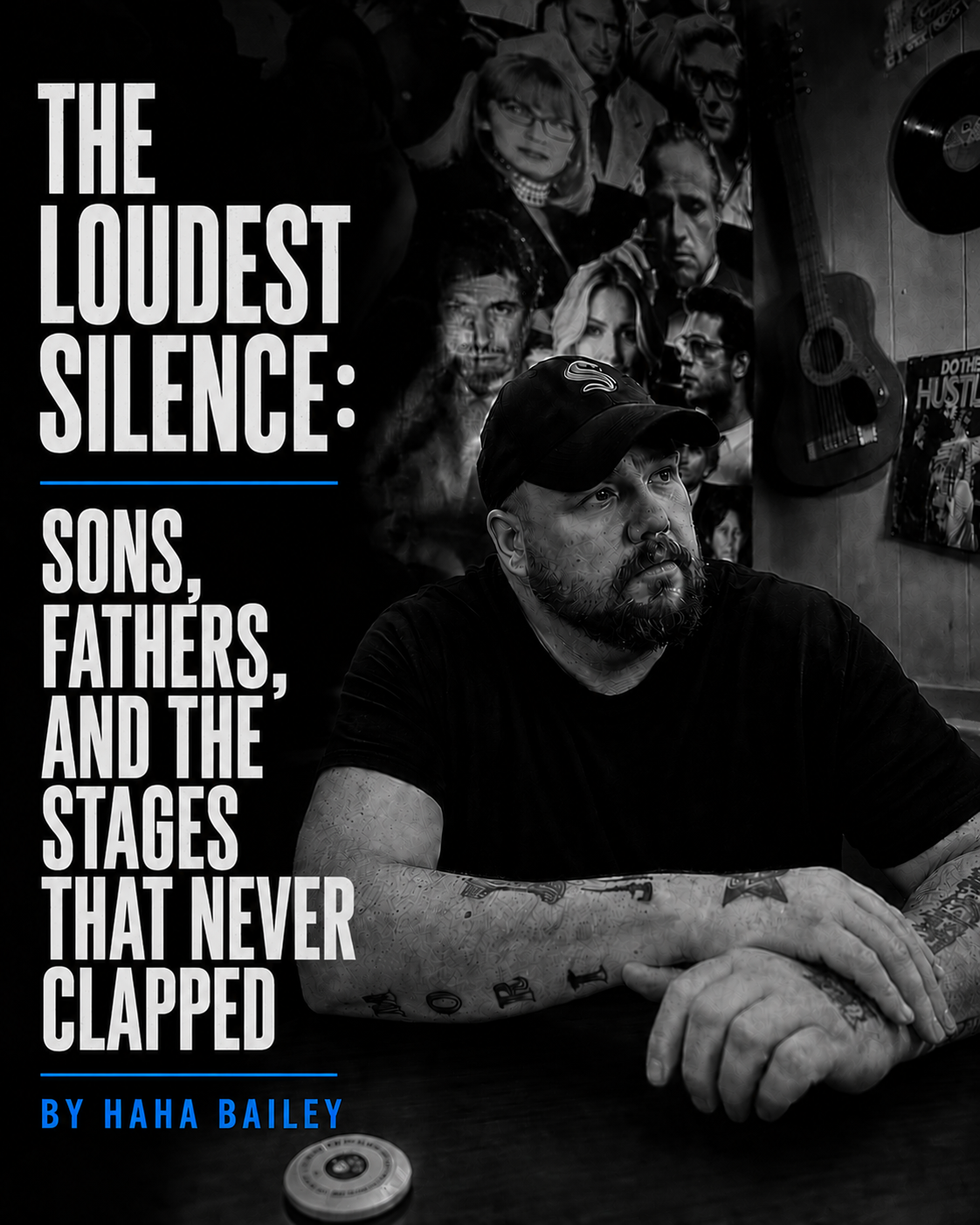
The Loudest Silence: Sons, Fathers, and the Stages That Never Clapped
A Music Travel Repeat essay about father wounds, backstage silence, wrestling, music, and learning to stop performing for ghosts.
Backstage has its own kind of gravity.
It pulls everything inward.
The noise.
The nerves.
The hope.
The ghosts.
Out front, the crowd is restless. Stomping. Chanting. Waiting to erupt at the first guitar note, the first entrance theme, the first glimpse of the person they came to see.
But behind the curtain, it is different.
The air gets heavier back there.
Not bad.
Not always tense.
Just honest.
Like the room knows something sacred is about to happen and refuses to pretend otherwise.
I have spent enough nights backstage to know the difference between a performer getting ready and a performer trying to survive the last few seconds before becoming someone else.
There is a difference between a wrestler checking his wrist tape and a wrestler checking his soul.
There is a difference between a singer adjusting in-ear monitors and a singer silently begging that their voice holds up one more night.
There is a stillness before performance that reveals more truth than the chaos ever could.
Most people never see that part.
They see the entrance.
The pyro.
The walkout.
The spotlight.
The roar.
I see the flicker before it.
The flicker of boyhood in a grown man’s eyes.
The flicker of vulnerability in a body built like stone.
The flicker of prayer in a mouth that has not spoken to God in years.
Those are the moments that do not make television.
They do not make highlight reels.
They do not make social media clips.
They are too quiet.
Too human.
Too close to the truth.
And for me, they are the most sacred.
Because that is where the real story lives.
The Curtain Is A Mirror
I once heard someone say the curtain is not just fabric.
It is a mirror.
On one side, you are whoever you have always been.
A son still waiting for his dad to show up.
A daughter hoping to be enough.
A child carrying lines of worthiness you have rehearsed since grade school.
On the other side, you become the character.
The gimmick.
The artist.
The athlete.
The amplified version of yourself that is often easier to live inside than the quieter truth.
But right there, in the heartbeat between sides, the ache shows.
That is where the silence of a father echoes loudest.
I have seen it in the way some men pace like caged animals, as if motion itself might shake off the emptiness.
I have seen it in the way others sit stone-still, staring at the floor like concrete has answers.
I have seen it in the way performers search the crowd before they ever step out, scanning rows of strangers for one familiar face that is not there.
The curtain does not lie.
If you stand backstage long enough, you start to hear the breathing.
Not the crowd’s roar.
Not the stage manager calling cues.
Not radios crackling.
The performers themselves.
The quick inhale of someone carrying too much expectation.
The long exhale of a man trying to settle nerves that are not really about performance.
They are about hope.
The hope that someone, somewhere, might finally be proud.
One wrestler, moments before walking out, once turned to me and said:
“I’m not nervous about the match. I’m nervous about the silence after.”
I knew exactly what he meant.
Because some silences are louder than any crowd.
Performing For Ghosts
It is a strange thing, chasing shadows.
You would think a sold-out arena would be enough.
Thousands of people screaming your name.
Hands raised.
Voices cracking.
A whole room pouring itself into one moment just for you.
But for a lot of performers — wrestlers, musicians, artists, athletes, anyone who has ever stepped into the light — the applause does not always land where it should.
Because there is one voice missing.
The voice that shaped your earliest memory of worth.
The voice that could have been the first to say you were strong, gifted, loved, or enough.
The voice of a father who either never learned how to say it or never cared to try.
That is the cruel part.
You can be surrounded by thousands and still feel unseen.
You can be deafened by applause and still hear the silence.
Because some of us have been performing for ghosts our entire lives.
The first stage was not an arena.
It was the living room.
A makeshift wrestling match with couch pillows.
A hairbrush held like a microphone.
A backyard game.
A report card placed carefully on the kitchen table.
But the audience was always smaller than we admitted.
One man in a recliner.
One man behind a newspaper.
One man watching the television instead of us.
One man we hoped would look up.
Some of us never got that.
So we learned the painful lesson early:
If applause does not come from where you need it most, it does not matter how loud it is.
I have seen men bleed for approval that never came.
I have seen women sing until their throats shredded, then walk offstage to silence in their own homes.
The world can cheer you until you cannot hear yourself think, but when you step into the quiet of a hotel room or a bus bunk, the ghosts come back.
They remind you of the gap between the roar of the crowd and the one silence that matters most.
That is why some performers do not really perform for the people in front of them.
Not completely.
They perform for the ones who are not there.
The guitarist writing albums to a father he never names.
The wrestler punishing his body because somewhere inside him is still a boy waiting at a Little League field.
The singer pouring every ounce of grief into a three-minute song because saying it directly would break them.
And me?
I built a life around protection and storytelling because I once wanted to be protected and acknowledged myself.
Ghosts have a way of steering entire lives.
Vegas And The Laughter That Wasn’t Laughter
Vegas is loud by nature.
Neon bleeding into desert sky.
Slot machines humming at all hours.
Taxi horns.
Street barkers.
Tourists chasing luck they will never catch.
But backstage in Vegas, silence has a different weight.
It presses in on you.
Crowds the room with everything left unsaid.
I will never forget that night.
The crowd had been white-hot before the main event. Restless. Hungry. Ready for spectacle.
And he delivered.
The kind of match that makes a room lose its mind.
The pop shook the arena.
You could feel it in your bones.
But noise fades fast.
The pyro died down.
The theme music cut off.
He came back through the curtain dripping sweat, chest heaving, body still buzzing from adrenaline.
People clapped him on the back.
Agents.
Crew.
Other wrestlers.
A couple guys hugged him because what he had just pulled off was not easy.
Then he sat on an equipment crate, away from the congratulations, and his face changed.
“He wouldn’t care,” he said, voice flat. “My dad. He never watched. Not once.”
Then he laughed.
Not the kind of laugh that makes your ribs ache.
Not the kind shared with friends when the world feels light.
This was hollow.
Practiced.
A reflex learned years ago and never unlearned.
It was not humor.
It was armor.
Men learn early that when pain overstays its welcome, you dress it in sarcasm, toughness, or jokes.
Anything but vulnerability.
But sitting there in Vegas, his mask slipped for a second.
Just long enough for me to see the boy inside.
The one who had once carried a report card to a kitchen table and waited for praise that never came.
He did not need me to say, “You were amazing.”
He did not need a motivational speech.
He needed a time machine.
He needed to be a kid again and see his father in the stands.
Just once.
Clapping.
Eyes bright.
Saying, “I’m proud of you, son.”
But no one gets a time machine.
So I sat with him.
That is something this work has taught me.
Sometimes people do not need advice.
They need someone who does not flinch when the mask comes off.
We did not talk much after that.
He caught his breath.
Packed his bag.
Walked toward the locker room.
By the time he reached the door, the mask was back.
Joking.
Laughing.
Playing the part everyone expected.
But for those few minutes, he was just a son again.
And I have never forgotten it.
The Ache Music And Wrestling Can’t Fully Heal
There is a particular ache that never fully leaves.
It does not scream like a broken bone.
It does not bleed like an open wound.
It lingers.
It follows people across tour buses, hotel rooms, locker rooms, arenas, venues, and years.
It can be buried for a while under schedules, applause, adrenaline, and noise.
But it always finds its way back when the room gets quiet.
I have seen that ache in wrestlers unlacing boots after the match.
I have seen it in musicians staring at the floor after walking offstage.
I have seen it in the way a grown man, still sweating from the lights, goes completely quiet when his phone does not buzz with the message he has been waiting for his whole life.
This ache is father-shaped.
And the hard truth is that neither music nor wrestling can erase it completely.
For years, I wanted to believe applause could heal me.
I thought if enough people clapped, respected me, needed me, or told me I mattered, it would fill the silence left by the one voice I wanted most.
For a moment, it works.
There is something intoxicating about being seen by strangers.
It feels like sunlight after years in shadow.
You soak it in because your skin is starving.
But applause is a mirage.
It disappears when the crowd goes home.
It fades before your body cools from performance.
And once it is gone, you are left thirsty again.
Sometimes thirstier than before.
That is the cruel trick.
Applause reminds you how badly you wanted approval in the first place.
So why do we keep coming back to music and wrestling?
Because even if they do not cure, they comfort.
They remind us we are not alone in the ache.
A wrestler can step into the ring and, for twenty minutes, become the hero he needed as a boy.
A musician can pour a lifetime of silence into one chorus and hear a room sing it back.
The ache does not vanish.
But for a moment, it loses.
Sometimes that is enough to keep breathing.
The Silence Some Sons Carry
There is a silence some sons carry that even music cannot break.
Even wrestling, with all its violence and poetry, cannot fully reach it.
It is the silence you hear when a man sits in the corner of a locker room after giving the performance of his life, sweat dripping off his face, eyes far away.
It is the silence when a guitar player leaves the stage to deafening applause and walks into a dressing room so quiet the fluorescent lights sound loud.
That silence is not exhaustion.
It is not nerves.
It is absence.
The sound of years without affirmation.
The sound of wanting one sentence from a father who never said it.
People think the ache only shows up in big moments.
It does not.
It follows you home.
It shows up at dinner tables.
Holidays.
Father’s Day posts.
Store aisles full of cards that say the things you never heard.
It shows up when you accomplish something you should be proud of and feel nothing.
It shows up when you scroll through contacts at midnight and realize there is no number that can fill that specific void.
When you grow up without affirmation, invisibility becomes your shadow.
You start believing you are only worth what you produce.
You hustle harder than everyone else, not always because you love the grind, but because you are trying to become undeniable.
You want to create something so big that even silence has to notice.
But silence does not clap.
Silence does not text back.
Silence does not show up in the stands.
Silence does not call to say, “I’m proud of you.”
And so you can become extraordinary in the eyes of the world while still feeling invisible in the one relationship that mattered most.
That is the silence some sons carry.
And if you do not name it, it will name you.
My Own Silence
I have spent years writing about other people’s silence because, if I am honest, it feels safer than writing about my own.
It is easier to tell the story of a wrestler sitting on a crate in Vegas than to admit I have sat on my own version of that crate more times than I can count.
It is easier to point at the musician scrolling for a text that will never come than to admit I have done the same thing, standing in an empty airport terminal, pretending the silence did not sting.
But the truth is, I carry my own silence everywhere I go.
My silence does not announce itself.
It does not throw tantrums.
It does not demand attention.
It slips in quietly, like fog on a morning you did not know would be cold.
As a boy, I learned quickly that emotions were not always safe to express.
Vulnerability felt like weakness.
So I dressed my silence in toughness.
I told myself not needing anyone was strength.
I told myself keeping things bottled up was what men did.
But every time I swallowed my need for affirmation, I was feeding the silence.
Every time I acted like I did not care, the silence grew louder.
By adulthood, it was not background noise anymore.
It was the soundtrack.
Airports are where I notice it most.
Maybe because airports are already lonely places.
Crowds moving in every direction.
Everyone between destinations.
No one really home.
I have stood in terminals after long trips, suitcase in hand, body tired, heart more tired, checking my phone.
Messages from clients.
Friends.
Coworkers.
But not the one I wanted.
So I would board another plane.
Take another job.
Stand in another hallway.
Protect another room.
Because movement felt like proof.
If I kept flying, working, performing, maybe I could outrun the quiet.
Spoiler:
You cannot.
For years, I told myself respect was enough.
If people respected me for being dependable, for protecting them, for handling chaos when no one else could, then maybe I did not need love.
Maybe respect could stand in for affirmation.
It cannot.
Respect is transactional.
You earn it by doing.
Love is different.
Love stays when you fail.
Love holds your face in its hands and says, “I’m proud of you just for being you.”
I settled for respect because it was easier to get than love.
I mistook silence for strength because strength was easier to fake than vulnerability.
But deep down, I knew the truth.
The silence hurt because I wanted more.
I wanted words my father rarely gave.
I wanted closeness.
I wanted forgiveness.
I wanted presence.
And I have had to admit something hard:
Some of the distance was not only his doing.
I played a part in the silence too.
I did not have the tools then.
I did not know how to ask for what I needed without shame.
I did not know how to build a bridge instead of another wall.
So silence piled up until it felt permanent.
That is one of the harder truths in this essay.
Not blame.
Not revenge.
Just honesty.
Because honesty is the only antidote I trust.
The Boys Who Work Behind The Curtain
The road is full of sons like me.
We are everywhere, though you may not notice us.
The ones in black shirts blending into shadows.
The ones with laminates around our necks instead of spotlights on our faces.
The ones rolling cords, carrying cases, holding doors, driving through the night, guarding the edge of the chaos so someone else can shine.
On paper, the jobs look ordinary.
Security.
Crew.
Tour manager.
Driver.
Stagehand.
Protector.
But underneath, many of us are carrying the same question:
Would he be proud of me?
Did I do enough?
Am I enough?
That question lingers like smoke in the lungs.
From the outside, it looks like hustle.
Overtime.
Extra shifts.
Long hours.
Missed meals.
First in.
Last out.
But the truth is, some of us are not only hustling for paychecks.
We are hustling for validation.
We want to be noticed.
Not by the crowd.
Not even by the artists.
By the father figure who never saw us in the first place.
Every time we overdeliver, every time we take on the task no one asked us to take, what we are really saying is:
Please see me.
Please tell me I am enough.
For some of us, overextending became a language.
The danger is, if you do not name that, it eats you alive.
You build an identity so tied to overwork that you forget who you are without it.
You burn out chasing respect and mistake it for love.
You let your body crumble because rest feels too close to invisibility.
I have seen it end badly.
Burnout.
Addiction.
Marriages breaking under unspoken ache.
Men disappearing inside work because stopping would force them to feel.
That is the risk of being one of the boys behind the curtain.
If you do not face the ache, the ache faces you.
But there is another way.
We do not have to keep performing for ghosts.
We can learn to notice ourselves.
We can offer each other the affirmation our fathers never gave.
We can say, “Good job,” and mean it.
We can remind each other that unseen does not mean unworthy.
The boys behind the curtain carry more than cases and cables.
They carry silence.
Longing.
Questions.
But they also carry resilience.
Grit.
A strange faith that says:
Even if no one claps, I will keep showing up anyway.
And maybe that is holy too.
Learning To Clap In Empty Rooms
One of the hardest lessons I have had to learn is this:
Sometimes you have to be your own crowd.
When the room is empty.
When no one is looking.
When the people you thought would show up never walk through the door.
That is where you find out whether you have learned how to clap for yourself.
It sounds simple.
It is not.
Everything in us wants applause to come from somewhere else.
A father.
A coach.
A boss.
A crowd.
A partner.
A room full of people who do not know our middle name but make us feel like a god for twenty minutes.
Self-applause feels fake at first.
Hollow.
Like you are trying to trick yourself into believing something you do not.
But if you never learn to clap in empty rooms, you will keep chasing crowded ones for the rest of your life.
And none of them will be enough.
The first time I tried it, I laughed at myself.
I had just finished writing something late at night.
No audience.
No deadline.
No one waiting to read it.
Just me, my laptop, and a heart that felt like it might split open if I did not put the words somewhere.
When I finished, I sat back, stared at the screen, and clapped once.
Two hands meeting in a dark room.
It sounded ridiculous.
It also sounded holy.
Because for once, I was not waiting for someone else to tell me I did a good job.
I was telling myself.
Empty rooms are honest.
There is no one to perform for.
No crowd to manipulate.
No father to finally earn approval from.
Just you.
The work.
The mirror.
If you can learn to clap there, you can carry that strength anywhere.
There is a difference between arrogance and affirmation.
Arrogance says, “I am better than everyone else.”
Affirmation says, “I am proud of myself, even if no one else says it.”
Sons raised on silence need that affirmation.
Because waiting forever for someone else to give it can cost you your whole life.
Sometimes the bravest sound a son can make is two hands coming together in the quiet, reminding himself:
I am here.
I am enough.
I deserve the sound of my own applause.
Becoming The Man You Needed
There is something sacred about becoming the man you once needed.
It does not happen all at once.
It sneaks up in small, ordinary moments.
You catch yourself saying something kind to a stranger and realize:
That is what I always wanted to hear.
You sit with a friend in grief and realize:
I am giving them what I never got.
It is humbling.
It is heartbreaking.
Because you cannot go back and give it to your younger self.
But maybe you can carry him with you.
Maybe you can become for others the voice, embrace, safety, and steadiness you always needed.
When I protect wrestlers backstage, I know I am doing more than managing logistics.
Yes, I am there to keep order.
To watch for threats.
To make sure chaos does not spill too far.
But under the surface, I know I am also holding space.
Space to be seen.
Space to be human.
Space to not have it all together.
I know what it feels like to carry grief you cannot name.
I know what it feels like to perform your heart out and still wonder whether you are enough.
So I try, quietly and consistently, to be the presence I once wished for.
Not flashy.
Not loud.
Just steady.
Just there.
For years, I cursed the ache.
I tried to numb it, outrun it, distract myself from it.
Then I started asking a different question.
Not, “Why do I carry this ache?”
But, “What is this ache teaching me?”
The answer was simple.
It was teaching me how to love others better.
Because when you have lived without something, you know exactly how much it matters.
You know the sharp edge of its absence.
And that makes you fierce about giving it away.
Maybe I will never become a father in the traditional sense.
But I have learned fatherhood is not only biology.
Sometimes it is presence.
Protection.
Affirmation.
Safety.
Every time I encourage someone, every time I create calm, every time I show up, I am practicing a form of fatherhood.
Passing on presence instead of silence.
That matters.
Because if we do not face the silence, we pass it on.
If we do not learn to clap in empty rooms, we raise others inside our quiet desperation.
If we do not become the people we needed, the ache multiplies.
But when we choose differently, the cycle cracks.
It may not erase the ache in us.
But it can keep the ache from infecting someone else.
That is worth everything.
Why Wrestling And Music Save Us
I have thought a lot about why I keep coming back to wrestling and music.
On the surface, they look different.
One is bodies hitting canvas.
Headlocks.
High spots.
Pyro cracking across the night.
The other is guitars crying.
Voices breaking.
Lyrics landing in the chest like they were written by someone who broke into your diary.
But underneath, they are the same.
Both are rituals of survival.
Both are confessions disguised as performance.
Both are places where people rewrite stories they never got to finish at home.
That is why wrestling and music save us.
Every son who carries silence has a story inside him.
A story that says:
You will never be enough.
You will never be seen.
You will never make him proud.
Wrestling and music let us challenge that story in real time.
With sweat.
Sound.
Sacrifice.
A wrestler can tell a whole story without saying a word:
I survived.
I fought back.
I refuse to stay down.
A musician can stand at a microphone and sing the sentence someone in the crowd has been afraid to say for years.
And when the crowd rises, it is not just entertainment.
It is affirmation.
We see you.
We hear you.
We believe you.
That is why arenas and venues feel like churches to me.
The lights dim like stained glass.
The crowd rises like a congregation.
The ring or stage becomes an altar where people bring pain and offer it up.
Not in isolation.
In solidarity.
The silence of fathers cuts deep.
It says:
You are not worth my attention.
You are not worthy of my pride.
But wrestling and music push back.
When a crowd rises for a wrestler, it says:
You are worth watching.
When a venue sings a lyric back to a musician, it says:
Your story matters.
When strangers lock eyes in the pit and nod, it says:
You are not alone.
It is not a perfect replacement.
It is not the same as hearing the words from the one man you wanted.
But sometimes it is enough to keep going.
Wrestling saves us in the body.
Music saves us in the soul.
Together, they remind us of what silence tried to erase:
We are worthy of being seen.
Worthy of being heard.
Worthy of being loved.
Even if our fathers never said it.
The Loudest Sound Of All
I do not know whether this piece is a confession, a testimony, or a prayer.
Maybe it is all three.
Maybe that is what writing really is.
An attempt to turn ache into something that feels a little less lonely.
When I started this reflection, I thought I was telling stories about wrestlers and musicians.
Sons who never heard the words they needed.
Fathers who never clapped.
Stages that never answered.
But as the words came, I realized I was writing my own story in every line.
The silence I described is not just theirs.
It is mine.
And if you are still here, reading this, maybe it is yours too.
The silence of fathers does not end just because we grow up.
It echoes.
It follows us into adulthood like an unpaid debt.
It shows up when we accomplish something we should be proud of and feel nothing.
It shows up when we look at our reflection and wonder whether we are only valuable when producing, performing, or proving.
It shows up when we scroll through phone contacts at midnight and realize no one can fill that specific void.
The echo is loud.
But here is what I am learning:
Silence does not get the final word unless we hand it the microphone.
I do not want revenge.
I do not want to prove anyone wrong.
I do not want to shame my father for what he rarely gave.
I want healing.
I want closeness where distance has lived.
Forgiveness where failure has lingered.
Presence where silence has sat too long.
And even if I never get the moment I wish for, I want to live in a way that says I tried.
I named the ache.
I admitted the silence.
I did not let it rot inside me until it poisoned everything else.
That is what this writing is for.
It is my way of saying:
I will not keep carrying this alone.
If you are carrying silence too, hear me:
You do not have to keep performing for ghosts.
You do not have to wait forever for a clap that may never come.
You do not have to break your body or spirit just to prove you are worthy.
You are worthy already.
You are seen already.
You can become the person you needed.
You can give yourself what was withheld.
You can clap in empty rooms and let that sound echo louder than the silence ever did.
These days, I look for the small sacred acts.
A wrestler exhaling backstage because he knows he is safe.
A musician smiling when someone says their story mattered.
A crew member hearing “thank you” for the first time in months.
Me, whispering “good job” at midnight in a hotel mirror.
Those moments do not look like much.
But they are holy.
They are how I fight back.
So maybe the loudest sound in all of this is not the roar of an arena.
Not pyro.
Not an encore.
Not a guitar screaming into the rafters.
Maybe the loudest sound is two hands clapping in an empty room.
A son finally learning to affirm himself.
A man finally learning to say:
I am enough.
Because the silence of our fathers may follow us.
But it does not have to own us.
We can clap for ourselves.
We can clap for each other.
We can turn the stages that never clapped into stages that saved us.
And maybe that is the loudest sound of all.
Pack your bags.
Grab your tickets.
Let’s go.
Catch you in the chaos,
Haha Bailey

About the Author
His writing lives somewhere between the stage lights and the shadows behind them — the place where performers become human again, songs turn into survival, and silence starts telling the truth. In The Loudest Silence: Sons, Fathers, and the Stages That Never Clapped, Haha writes about father wounds, wrestling, music, backstage vulnerability, and the hard healing of learning to stop performing for ghosts.
When he is not writing, chasing shows, building The Venue Ledger, or protecting chaos from the background, he is usually somewhere near a curtain, a hallway, a song, or a memory that still has something to say.