Music Travel Repeat - The Restless, The Hopeful & The Broken
Executive Protection: The Invisible Job Reality
The quiet work before the noise, the calm behind the chaos, and why real protection is almost never seen.
I live in the part of the night most people never notice.
Before the lights come up.
Before the music hits.
Before the crowd roars.
There is a hush before a concert that feels like the whole room is holding its breath.
Not silence, exactly.
Something heavier.
The kind of stillness that tells you something is about to happen.
Most people miss it.
They are finding their seats.
Buying drinks.
Laughing too loud because they are excited.
Texting friends.
Checking tickets.
Looking toward the stage.
I am already working.
Not moving much.
Not talking much.
Just watching.
Reading the room.
Feeling the energy before it turns into something else.
That is executive protection.
And when executive protection is done right, you usually never notice it at all.
That is the invisible job reality.
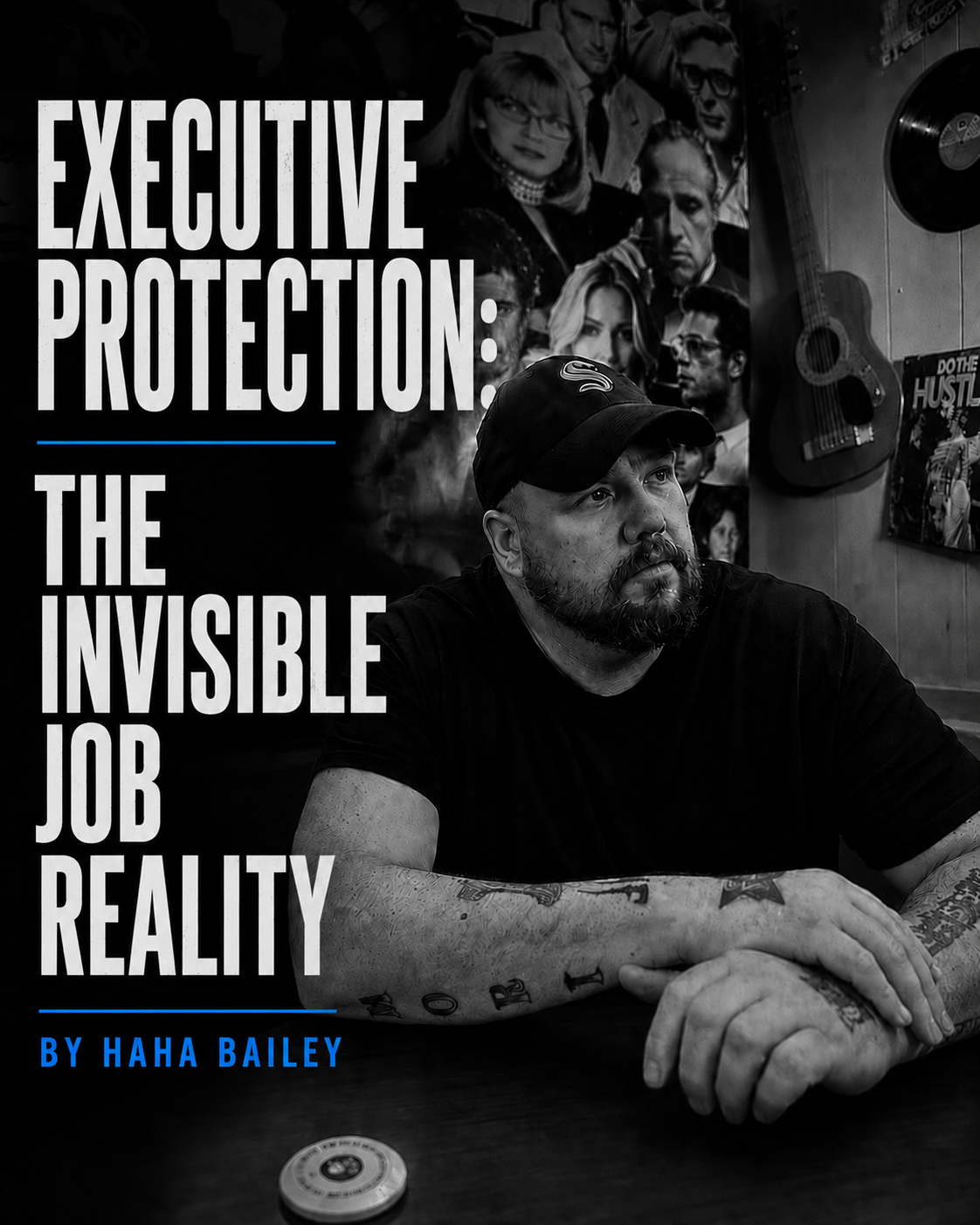
The best protection work is not loud.
It is not dramatic.
It does not need a spotlight.
It stands quietly at the edge of the noise, making sure the storm passes without breaking anything that matters.
What People Think Executive Protection Is
Let’s clear something up early.
Executive protection is not standing with your arms crossed, trying to look tough.
It is not shoving people out of the way.
It is not barking orders.
It is not being aggressive, loud, or intimidating.
And it is definitely not the movies.
Most of the time, real executive protection looks like nothing.
A person leaning against a wall.
Someone blending into a crowd.
A quiet presence near a hallway, loading dock, stage entrance, green room, locker room, or hotel lobby.
Someone who looks like they belong wherever they are standing.
That is not an accident.
That is the job.
If you notice us for the wrong reasons, something has probably already gone wrong.
Because good executive protection does not fight for attention.
It removes friction.
It lowers the temperature.
It gives artists, wrestlers, venues, and guests the space to do what they came to do without being distracted by safety, logistics, or chaos.
The goal is not to be seen.
The goal is for the night to work.
What Executive Protection Actually Is
Executive protection is prevention, not reaction.
That sentence matters.
Because most people picture protection as something physical.
A confrontation.
A removal.
A dramatic moment.
A person stepping in when things go sideways.
But the truth is, if we are doing the work right, most situations never get that far.
Executive protection is about reading people before they act.
Noticing energy shifts before they escalate.
Solving problems before they become visible.
Making quiet decisions so someone else can stay focused.
My job is not to be important.
My job is to make sure your moment goes exactly the way it is supposed to.
For an artist, that may mean walking from the green room to the stage without thinking about safety.
For a wrestler, it may mean trusting the hallway is clear when adrenaline is already high.
For a venue, it may mean the night ends with cheers instead of sirens.
For a fan, it may mean losing yourself in the music without ever needing to know who helped keep the room steady.
Most of the work happens before anything ever starts.
Routes planned.
Exits memorized.
Blind spots covered.
Patterns learned.
Staff checked in with.
Access points understood.
Movement anticipated.
That work does not photograph well.
It does not get applause.
But it is often the reason the night works.
Executive Protection Is Not About Ego
This part needs to be said plainly.
Executive protection is not a power role.
It is a service role.
You are not there to dominate the room.
You are there to support the room.
You are not there to make people afraid of you.
You are there to make the right people feel safe.
The second someone in protection needs to become the center of attention, something is already off.
Real protection is built on humility.
It is restraint.
It is discipline.
It is knowing when to move and when to disappear.
It is knowing when a conversation is better than confrontation.
A reposition better than a removal.
A quiet redirect better than a public scene.
The strongest people in this work are not the ones trying to prove they are strong.
They are the ones who know how to hold back.
Restraint is strength.
Control is strength.
Patience is strength.
Anyone can escalate.
Not everyone can de-escalate.
That difference is everything.
Why Looking Tough Can Get People Hurt
Here is something fans do not always realize, and venues sometimes learn the hard way.
The moment protection becomes aggressive or overly visible, the energy changes.
Crowds feel it.
Artists feel it.
Staff feels it.
The room tightens.
People start acting differently when they feel watched instead of supported.
Fans get defensive.
Artists feel boxed in.
Crew gets frustrated.
Small situations suddenly get bigger because someone brought ego into a room that needed calm.
Good executive protection avoids that.
We do not posture.
We do not flex authority just because we can.
We do not create tension just so we can be seen solving it.
Most of the job is de-escalation before escalation ever becomes necessary.
That restraint is learned.
It is trained.
It is earned through experience.
And it matters because safety without friction is the whole point.
Why Fans Rarely Notice Real Protection
Fans are not supposed to notice us.
That is not an insult.
That is the standard.
Fans came for the music.
They came for the match.
They came to scream lyrics, hold hands, lose their voices, cry during the slow song, jump in the pit, and forget the rest of the world for a few hours.
My job is to protect that experience without touching it.
That means not embarrassing fans unless there is no other choice.
Not escalating situations that can be handled quietly.
Not making artists feel boxed in.
Not turning a joyful night into a tense one.
The goal is safety without friction.
That is harder than it sounds.
Because concerts are emotional environments.
People are excited.
Vulnerable.
Distracted.
Sometimes drunk.
Sometimes overwhelmed.
Sometimes carrying a whole year of pain into one night of music.
That is not a flaw.
That is the point of live music.
The room is supposed to feel alive.
The protection around that room should not kill the feeling.
It should help preserve it.
The Trust No One Sees Backstage
The real work often happens backstage.
In hallways.
Locker rooms.
Green rooms.
Loading docks.
Hotel corridors.
Under lights that never dim and on floors that smell like concrete, sweat, old cables, and coffee that has been sitting too long.
Backstage trust does not come from speeches.
It comes from repetition.
Showing up early.
Leaving last.
Standing where you said you would stand.
Knowing the layout before someone asks.
Remembering preferences.
Respecting boundaries.
Not panicking when something feels off.
Artists do not need a lecture.
They need steadiness.
The nod before stepping out.
The relaxed shoulders when they see you near the exit.
The fact that they do not have to ask whether something is handled.
That is the currency of this job.
Trust.
Built quietly.
Protected carefully.
Never abused.
Because access is not a trophy.
Access is responsibility.
Backstage access.
Personal access.
Private moments.
Conversations no one else hears.
Stress no one else sees.
Discretion is not optional.
If you cannot keep quiet, you do not belong in this work.
What happens backstage stays backstage.
Not because it is dramatic.
Because it is respectful.
What the Job Actually Looks Like Hour to Hour
Most people imagine executive protection as a highlight reel.
That is not reality.
Reality looks like standing in the same place for hours.
Watching the same hallway until it blurs.
Mentally tracking who belongs and who does not.
Reading posture, tone, movement, and energy.
Making adjustments so subtle no one notices.
Checking routes.
Checking exits.
Watching the door.
Watching the person watching the door.
Communicating without making it obvious.
Staying ready without looking tense.
It is repetition.
And repetition is where mistakes happen if you lose discipline.
You do not get to check out because nothing happened yet.
You do not get to relax because the crowd seems fine.
You do not get to assume tonight will be like last night.
Complacency is the enemy.
The best nights are the ones where nothing memorable happens from a safety standpoint.
No incidents.
No emergencies.
No stories.
Just a smooth night that ends quietly.
That is success.
Why Nothing Happened Means the Job Worked
Most jobs measure success by what did happen.
Executive protection often measures success by what did not.
No altercations.
No crowd surges.
No backstage chaos.
No medical emergency that could have been prevented.
No artist left exposed.
No venue reputation damaged.
No moment ruined.
When nothing happens, the job was done right.
That can mess with your head if you need applause.
If you need validation.
If you need someone to say your name.
This job will starve that part of you.
If you are okay with that, you may last.
If you are not, you will either burn out or become the problem.
There is a specific kind of pride that comes from doing work no one sees.
Not ego.
Not attention.
Quiet satisfaction.
Knowing you showed up prepared.
Knowing you handled what needed handling.
Knowing you kept things steady when it mattered.
That kind of pride lasts longer than praise.
The Mental Inventory You’re Always Running
During a show, there is always a checklist running in the back of your mind.
Where is everyone supposed to be right now?
Who has access?
What changed since the last check?
What is normal for this room?
What feels off?
Who has been lingering too long?
Who is drinking too fast?
Who is agitated but has not acted yet?
Which exit is congested?
Which staff member is overwhelmed?
Which hallway needs attention?
You are not panicking.
You are calculating.
That calculation does not look exciting.
It looks like standing still.
It looks like nothing.
But it is constant.
And when you are responsible for someone else’s safety, you do not get to miss steps.
The moment you look busy, you may already be behind.
That is one of the strange truths of executive protection.
The calmer it looks, the more work may be happening underneath.
The Emotional Weight No One Prepares You For
Executive protection is not just physical.
It is not just tactical.
It is emotional.
You carry responsibility quietly.
You absorb tension so others can stay loose.
You stay alert while everyone else gets to let go.
You carry the weight of “what if” so other people do not have to.
That weight adds up.
Some nights, you do not realize how much you have carried until it is over.
Until the lights come up.
Until the adrenaline fades.
Until the artist is gone, the crowd is out, the radios quiet down, and the building starts to feel like a building again instead of a living organism.
Then it hits you.
Not fear.
Not regret.
Fatigue.
The kind that settles into your bones.
You learn how to live with it.
You learn how to manage it.
You learn how to keep your humanity intact while still seeing the things other people miss.
Because this job follows you home.
You sit with your back to the wall.
You notice exits automatically.
You read rooms without meaning to.
It is not paranoia.
It is conditioning.
Useful at work.
Exhausting everywhere else.
The Grind No One Sees
Executive protection looks calm because it has to.
What people do not see is the grind underneath the calm.
This work eats hours first.
Then sleep.
Then pieces of your personal life if you are not careful.
Most days do not start or end at reasonable times.
Airports blur together.
Hotels start to feel the same.
You learn which shoes will not wreck your feet after twelve hours on concrete.
You learn how to function on bad sleep without letting it show.
You learn how to miss things quietly.
Birthdays.
Dinners.
Holidays.
Moments that do not wait for your schedule to clear.
That is not a complaint.
It is the math of the job.
When you commit to being responsible for other people’s safety, your time stops being fully your own.
There is no glamour in the physical side either.
It is standing more than walking.
Waiting more than moving.
Holding posture even when your back aches.
Loading docks in bad weather.
Concrete floors that do not forgive.
Late nights followed by early mornings.
You do not usually get hurt dramatically.
You get worn down slowly.
And still, you show up.
Because showing up is the job.
Backstage Is Not Chaos
People imagine backstage as wild.
Loud.
Disorganized.
Full of egos, adrenaline, and last-minute panic.
Sometimes that is true.
Most of the time, it is not.
Good backstage environments run on rhythm.
Quiet coordination.
People who know their roles and respect everyone else’s.
Executive protection fits into that rhythm or it ruins it.
That matters.
Because protection that disrupts the environment is not protection.
It is liability.
Artists notice immediately if someone is trying to play hero.
Crew notices even faster if someone slows things down.
Venues feel it if someone does not understand the space.
Backstage trust is earned fast or not at all.
You do not force it.
You earn it.
And once that trust exists, everything runs smoother.
Artists feel supported.
Venues feel confident.
Fans feel safe.
No drama.
No headlines.
No stories.
Just a night that works.
Why Artists Need Executive Protection
Artists live in a strange space.
They are visible.
Vulnerable.
Expected to perform emotionally while being physically exposed.
They are tired.
Focused.
Pulled in multiple directions.
Often moving through unfamiliar spaces while everyone else thinks they know them.
Good executive protection lets artists stop thinking about everything except their work.
It does not control them.
It does not hover.
It does not steal their space.
It creates room.
Room to breathe.
Room to move.
Room to perform.
Room to be present.
The right protection does not make an artist’s life harder.
It makes the pressure around them lighter.
That is the goal.
Not fear.
Focus.
Executive protection is not about treating artists like they are untouchable.
It is about understanding that when someone is responsible for giving a room their energy, someone else needs to be responsible for protecting the path around them.
Why Venues Should Care Who They Hire
Venues do not just manage crowds.
They manage risk.
One mistake can follow a room for years.
One bad decision can damage relationships with artists, managers, promoters, staff, fans, and the community.
Executive protection is part of that ecosystem.
It is not just about protecting artists.
It is about protecting the venue itself.
Smooth movement.
Clear communication.
Respect for staff.
Understanding the building.
Knowing the difference between a room that is alive and a room that is about to turn.
Someone who treats a venue like a battleground instead of a workplace is a problem.
Someone who ignores venue procedures is a problem.
Someone who disrespects staff is a problem.
Someone who creates tension just by walking into the room is a problem.
Venues remember who made their job easier.
Who respected the building.
Who followed protocols.
Who did not create liability.
Those people get called back.
The others do not.
It is that simple.
What Artists and Venues Should Look For
Most people assume hiring executive protection is about size, strength, or credentials alone.
Those things can matter.
Training matters.
Experience matters.
But behavior matters more.
Artists and venues should look for calm under pressure.
Clear communication.
Respect for boundaries.
Situational awareness.
Reliability.
Discretion.
Someone who listens.
Someone who asks smart questions.
Someone who understands the flow of an environment.
Someone who does not need to be the loudest person in the room.
Someone who knows when silence is the right move.
You can tell a lot in the first five minutes.
Does the person listen?
Do they interrupt?
Do they respect space?
Do they ask about the building, the staff, the schedule, the movement, the pressure points?
Someone who ignores small details will miss big ones.
Someone who talks too much will talk at the wrong time.
Someone who brags about confrontations is telling on themselves.
Good protection professionals do not sell fear.
They sell calm.
Red Flags When Hiring Executive Protection
If you are an artist, manager, promoter, or venue operator, pay attention to red flags.
Someone who talks too much about themselves.
Someone who brags about fights.
Someone who treats staff like obstacles.
Someone who ignores procedures.
Someone who wants to be seen.
Someone who posts too much access.
Someone who turns private work into public content.
Someone who needs everyone to know they are in charge.
Those traits do not equal confidence.
They equal instability.
Ego has no place here.
Ego gets people hurt.
Ego ignores warnings.
Ego escalates unnecessarily.
Ego refuses help.
Ego creates problems just to solve them.
The best protection professionals I have ever worked with are forgettable in the best way.
They do not need recognition.
They do not need authority announced.
They let the work speak for itself.
Prepared Is Not the Same as Paranoid
There is a fine line in this work.
Prepared means aware, adaptable, and calm.
Paranoid means jumpy, rigid, and reactive.
Prepared people reduce risk.
Paranoid people create it.
You do not want someone who sees danger everywhere.
You want someone who understands behavior, probability, movement, and context.
Fear-driven protection is sloppy.
Experience-driven protection is quiet.
That difference matters.
A wrestling show is not a concert.
A theater is not a festival.
A club is not an arena.
A private appearance is not a stadium.
One-size-fits-all protection fails because every environment has its own rhythm.
Good agents learn the space.
They learn the culture.
They learn the people.
They do not impose a template.
They build a plan.
Communication Is the Real Skill
The most important skill in executive protection is not physical.
It is communication.
Clear.
Calm.
Timely.
Knowing when to speak.
Knowing when silence is better.
Knowing how to say no without escalating.
Knowing how to redirect without humiliating.
Knowing how to work with venue staff instead of around them.
Knowing how to share the right information with the right people at the right time.
That skill keeps nights intact.
You can be strong and still be useless if you cannot communicate.
You can have credentials and still be dangerous if your tone creates conflict.
This work is built on relationships.
Trust with artists.
Trust with crew.
Trust with venues.
Trust with staff.
Trust with managers.
Trust with the people beside you who need to know that if things change, you will not panic.
You will communicate.
You will adjust.
You will handle it.
For Fans Reading This
If you are a fan reading this, you may be wondering why any of this matters to you.
You came for the music.
You came for the show.
You came to feel something for a few hours and forget the rest of the world.
That is exactly why this work matters.
Because the reason you get to lose yourself in a chorus, scream the lyrics, cry during the slow song, hold someone’s hand, jump in the pit, or carry one night through a hard year is because someone helped keep the night intact.
Not just me.
Not just security.
An entire invisible network of people.
Venue staff.
Production.
Medics.
Stagehands.
Managers.
Security.
Protection.
People whose job is to protect the experience without interrupting it.
You do not owe them applause.
You do not owe them attention.
But it is worth knowing they exist.
The world does not run on spotlight alone.
It runs on people who care enough to stand quietly at the edge and make sure the magic does not break.
When you say a show felt safe, that was not accidental.
When you say the energy felt right, that was not accidental.
When you say you could finally relax, that was not accidental.
That was planning.
Restraint.
Communication.
People watching rooms so you did not have to.
For Artists Reading This
If you are an artist, here is the honest truth.
You do not need protection because you are special.
You need protection because you are you.
Tired.
Focused.
Visible.
Exposed.
Moving through unfamiliar rooms while people want access to you.
Good executive protection lets you stop thinking about everything except your work.
It creates space without stealing space.
It gives you movement without making you feel managed.
It supports without suffocating.
You should not feel boxed in by the people protecting you.
You should feel steadier because they are there.
If protection is making your life harder instead of easier, something is wrong.
The right person will respect your craft, your privacy, your routines, your people, and your room.
They will not need to announce themselves.
You will just know they are where they are supposed to be.
For Venues Reading This
If you run or manage a venue, you already know how thin the margins can be.
One bad night can undo years of trust.
Executive protection is not about fear.
It is about continuity.
Nights ending cleanly.
Artists wanting to return.
Fans feeling safe enough to come back.
Staff feeling supported.
Your reputation staying intact.
The right protection respects your space.
Your staff.
Your protocols.
Your culture.
They understand they are stepping into your building, not taking it over.
They help the night move smoother.
They do not create unnecessary tension.
They do not freelance their ego.
They understand that venue safety is not about domination.
It is about stewardship.
What Working With Me Actually Looks Like
I am direct.
Calm.
Prepared.
I learn your environment.
I respect your staff.
I do not freelance my ego.
I communicate clearly.
I follow protocol.
I adapt when plans change.
If nothing happens, that means it worked.
If something does happen, it gets handled quietly, efficiently, and without drama.
That is it.
No showboating.
No unnecessary scenes.
No turning someone else’s night into my personal highlight reel.
I take this work seriously because I have seen what happens when it is done poorly.
I have seen nights go sideways.
I have seen egos create problems.
I have seen venues suffer because someone treated protection like performance.
I have also seen what happens when it is done right.
Joy.
Relief.
A clean ending.
A memory that stays whole.
That is worth protecting.
Why I Still Do This Work
People ask why I stay in executive protection.
The answer is simple.
Because when it works, people get to be fully present.
Artists get to perform without fear.
Fans get to lose themselves in music safely.
Venues get to protect their rooms, their staff, and their reputation.
Nights end with memories instead of trauma.
That matters.
Even if no one ever knows your name.
This work is not for everyone.
It is for people who value responsibility over recognition.
People who understand strength does not need to announce itself.
People who are comfortable being unseen.
People who can stand quietly at the edge of the noise and know the role still matters.
I write about executive protection because silence can make work like this disappear.
And while I do not need recognition, I do believe understanding matters.
Not to glorify the job.
Not to elevate myself.
But to remind people that care does not always look loud.
Sometimes it looks like someone standing still in the right place, at the right time, doing the job well enough that no one notices.
The Quiet Truth at the Center of Executive Protection
You do not have to be seen to matter.
You do not have to be loud to be strong.
You do not have to be fearless to carry responsibility.
Most of the people holding this world together will never trend.
Never go viral.
Never be thanked publicly.
They will just keep showing up.
And honestly, that is enough.
Executive protection is not about power.
It is about care.
Care for people.
Care for moments.
Care for rooms where something meaningful is supposed to happen.
Care for nights that deserve to stay whole.
That is the job.
That is the reality.
That is why I am still here.
Standing quietly at the edge of the noise.
Watching the room.
Reading the energy.
Carrying the “what if” so someone else can carry the song.
Need a steady person in your corner?
You can learn more about my executive protection services here.
Catch you in the chaos,
Haha Bailey
About the Author
Haha Bailey is the creator of Music Travel Repeat, where concerts, road trips, artist stories, emotional essays, and the quiet work behind live events all meet.

With two decades of experience in private security, event operations, and executive protection, Haha writes from the edge of the noise — the place most fans never see but every good night depends on. In Executive Protection: The Invisible Job Reality, he pulls back the curtain on the calm, preparation, restraint, and responsibility required to protect artists, venues, wrestlers, performers, and the moments people came to feel.
When he is not writing, chasing shows, building The Venue Ledger, or protecting chaos from the background, he is usually somewhere near a stage, a hallway, an airport gate, or a playlist that explains the whole thing better than he can.