Music Travel Repeat → Backseat Benedictions: Music For A Road Trip → Vol. 11
Backseat Benedictions: Music For A Road Trip | Vol. 11 — The Ones Who Came Back Edition
A quiet little community meets here every Friday. There’s room for you, I promise.
There’s a certain kind of night that only belongs to comebacks.
The air feels thicker, the sky hums like it’s waiting for a second verse, and even the porch light flickers as if to say, “You again?”
When I heard that The Format was releasing new music for the first time in twenty years, something in me un-clenched. I bought tickets before the pre-sale timer even finished blinking. Two seats, side by side — one for me, one for GQ. Because some stories deserve a sequel.
The Format taught me that confession can sound like harmony, that forgiveness has a tempo, and that love—real, patient, porch-light love—always finds its way back to the doorstep. This volume is for the ones who thought their best verses were behind them.
U.C.L.A
It’s late enough for the world to sound like water.
Out beyond the railing, the desert hums under its own breath, and a moth keeps circling the porch bulb like it’s trying to remember how to land. The wood beneath my feet still creaks the same way it did when I used to sneak cloves and bad decisions when I was in college.
On the table sits my phone—screen open, ticket confirmation glowing like a second chance:
THE FORMAT w. Phantom Planet & Limbeck
The Castro Theatre | San Francisco, California - SOLD OUT
But not to me.
I thumb the corner of the printout, half expecting it to fade if I stare too long. Twenty years. Two decades since Interventions and Lullabies. Two decades since I first heard On Your Porch and mistook guilt for romance.
Back then, her name was Caitlin.
She was a twin—brighter, quicker, the kind of smart that makes you want to invent a new word for it. I was twenty, maybe twenty-one, full of noise and muscle memory and all the wrong kinds of certainty. She loved with quiet precision; I loved like an alarm clock. Loud, repetitive, impossible to ignore.
Looking back, I can admit it: I was terrified.
- Of losing control.
- Of being seen.
- Of the kind of softness that couldn’t be faked.
So I did what frightened people do—I turned love into strategy.
I became the jealous one, the checking-in-too-often one, the “where were you?” one.
Every time she looked at me with patience instead of anger, I mistook it for victory.
It took years to understand that patience was the saddest kind of goodbye.
When On Your Porch came out, I told her it was our song.
She smiled, but not the way you want someone to smile when you hand them a love song. It was the kind of smile that already knew it would hurt later.
“You and your metaphors,” she said,
and I laughed like I didn’t hear the distance hiding in her tone.
I wish I’d listened closer.
The candle on the porch tonight is almost gone—one stubborn wick fighting through a pool of wax that looks like melted memories. I’m older now, softer around the edges, harder in the right places. I’ve spent years protecting people for a living—wrestlers, musicians, strangers who needed a calm presence when everything around them was chaos. Funny how you can learn to guard everyone but yourself.
The Format disappeared right around the time Caitlin did.
I remember hearing the rumors—side projects, breakups, life happening—and thinking, yeah, I get it. Sometimes silence is the only way to survive the noise.
When they announced their return, I didn’t even realize how much I missed them until the lump in my throat answered for me.
It’s strange—how a song can hold your younger self hostage until you finally grow into the apology it deserves.
The first night I played On Your Porch after all these years, I was sitting right here.
Same chair. Different man.
The intro strummed through the speakers like a ghost tapping on the door.
I remember closing my eyes and seeing it all: Caitlin’s hair twisted up in a pencil, the way she used to mouth lyrics before they hit her lungs, the chipped teal nail polish she swore brought her luck on exam days.
I could smell her house again—cheap carpet cleaner, burnt popcorn, the faint scent of her vanilla lotion.
I could see my old reflection in the window: a boy pretending he wasn’t scared of tenderness.
And somewhere between the first and second verse, I caught myself whispering,
“You deserved better.”
It wasn’t dramatic. No tears, no cinematic thunderstorm. Just a sentence that had been waiting twenty years to exhale.
The clock on the wall clicks past midnight.
Across the street, someone’s sprinkler sputters on.
I imagine Caitlin somewhere
- maybe married
- maybe teaching
- maybe listening to this same song
and smiling at how different we both turned out.
I like to think she forgave me quietly, the way people do when they realize youth is just trial and error dressed up as destiny.
Tonight, I let that thought sit beside me like an old friend.
The air tastes like citrus and dust, and the moon is doing that thing where it looks tired but still shows up anyway.
I take a sip of cold coffee, hit repeat, and whisper to no one:
“I’m sorry for the boy I was, but I’m proud of the man who learned from him.”
The song ends.
The porch holds its breath.
And just like that, the night keeps playing.
The moth is still here, reckless and loyal, tapping the bulb like it’s the only star left awake.
Out past the railing, headlights move along the desert road in slow, tired lines—each one a tiny airplane, taxiing across the horizon.
I’ve spent half my adult life watching lights like that.
Usually from behind tinted glass or a checkpoint queue, a bodyguard’s badge lanyard swinging against my chest.
Most weeks it’s four, sometimes five flights—San Diego before sunrise, Houston by lunch, Chicago by night. You learn the sound of jet engines the way farmers learn the rain: not by pitch, but by promise.
Up there, thirty-some-thousand feet over everything, I always feel suspended between who I was and who I’m trying to be.
That’s when the old ghosts catch the signal. Caitlin, the kid I used to be, the mistakes that somehow got frequent-flier status.
I picture her sometimes at the end of a terminal, book in hand, looking up every time the automatic doors sigh open—half-expecting me to walk through and finally say the words I never managed: I’m sorry I treated you like proof instead of a person.
But tonight I’m grounded.
The flights can wait. The porch has clearance.
Inside, my phone buzzes once: an email from logistics—new advance detail for next week’s run. I flip it face down.
For now, this is my checkpoint.
I think about GQ, steady in her world of state codes and shift briefings. Law enforcement, state level—no need to name which. She’s got a way of carrying silence that isn’t empty; it’s disciplined. When we meet after long runs apart, she doesn’t ask how many miles or how many clients. She just looks at me long enough to count the hours I didn’t sleep.
That’s what trust looks like when both of you live on radios.
The Format hums low from the speaker. I reach for the volume and leave it right where it is—the perfect level for thinking.
I remember the first time I heard On Your Porch in an airport lounge. I was younger, greener in the job, reading threat assessments between flights. The line “I couldn't even look at him for fear I'd have to say goodbye” hit me harder than any turbulence. I didn’t know yet that guilt could have melody, or that you could love someone and still be bad at keeping them safe.
Caitlin’s face showed up uninvited, and the years between us folded like boarding passes in an old coat pocket.
Airports teach you odd lessons.
You learn that connection is fragile
- it depends on timing
- on patience
- on believing the plane will actually arrive.
Relationships aren’t much different.
For a long time, I confused control with care. I wanted to be the gate agent, the one scanning tickets, deciding who boarded and when.
Caitlin deserved someone who’d sit beside her, not someone who’d block the aisle.
I sip the coffee that’s gone lukewarm, watch a trail of planes climb out of the western dark, and think about how many lives are being rearranged in those little cabins
- new starts
- last chances
- half-spoken goodbyes.
In another window seat somewhere, a version of me is still rehearsing apologies.
When the wind shifts, it smells faintly of jet fuel and jasmine—an impossible combination that somehow fits. I close my eyes and let the scent write its own flashbacks: security checkpoints, backstage corridors, the weight of a client’s safety resting in my open palm. It’s strange, protecting someone else’s tomorrow while still learning how to protect your own peace.
The candle gutters, then steadies. That tiny flicker feels like every landing light I’ve ever followed home.
I unlock my phone again. THE FORMAT - The Castro Theatre - San Francisco , CA — SOLD OUT.
Not to me.
Two seats. One for me, one for GQ.
She doesn’t even know the full story behind this band yet. She just smiled when I told her, “You’ll like them.”
And I think she will. Because she already knows the rhythm of regret turned into redemption; we’ve both lived it in different uniforms.
That show’s going to be my test flight—the proof that a man can circle the same memory for decades and finally land it without crashing.
The playlist grows under my thumb: Backseat Benedictions | Vol. 11 — The Ones Who Came Back.
Each song feels like a departure gate that never closed.
I scroll, press play, and let the night fill with returning voices.
The first chord from the speaker is a heartbeat I didn’t know I was holding.
The night leans in; the candle bends low.
I thumb the volume down just enough that the crickets keep their verse.
🎵 1. The Format — On Your Porch
“I was on your porch; the smoke sank into my skin…”
Nate Ruess’s voice slides in like an apology written in pencil.
Every syllable lands somewhere between memory and mercy.
I think about all the porches I’ve stood on since—motels, arenas, safe houses, hotel balconies—each one a substitute altar.
This song isn’t just nostalgia; it’s navigation.
It teaches me how to land the plane without the crash.
🎵 2. Yellowcard — Childhood Eyes
“You and I, we were never done.”
The violin cuts through the warm air like sunrise through cabin blinds.
Ryan Key still sounds like youth refusing to apologize for existing.
I picture the runways I’ve watched blur beneath me: all those takeoffs, all those almost-homes.
The song reminds me that returning doesn’t mean rewinding—it just means you finally know which direction to face when you say thank you.
🎵 3. The Gaslight Anthem — Positive Charge
“I need a spark in the dark tonight.”
I’ve worked enough dark rooms to know how valuable a spark is.
Brian Fallon’s voice carries that tired kind of hope—the one that still shows up even when the paperwork says don’t bother.
Every chorus feels like an after-action report that ends with “Made it out alive.”
I nod along, tapping my boot against the porch rail like I’m clearing airspace for the next departure.
🎵 4. Sum 41 — Landmines
“I got tired of exploding, so I started rebuilding.”
I laugh softly.
That line could have been my debrief summary for an entire decade.
All those flights, all those cities, all that adrenaline hiding the ache.
Deryck’s rasp feels earned—older, steadier, still stubborn.
I breathe with the beat and feel the old detonations settle into dust.
🎵 5. Blink-182 — One More Time
“Do I have to die to hear you miss me?”
It hits like sudden turbulence: the reminder that friendship, like flight, only looks effortless from the ground.
Tom and Mark harmonize like brothers who finally learned how to land in the same place.
I tilt my head back, watch a jet blink across the stars, and think of every partnership that only survived because someone finally said I was wrong.
🎵 6. The Postal Service — Such Great Heights
“They will see us waving from such great heights…”
Ben Gibbard’s voice sounds like the inside of an airport at 3 a.m.—fluorescent, hopeful, a little lonely.
Every soft beat feels like a pulse beneath the terminal floor, the promise that distance can still hum like connection. This is another great band introduced to me via Caitlin.
I’ve heard this song in coffee shops from Boston to Baja, but tonight it lands different.
The synths shimmer against the desert air and I realize: the view was never the problem.
It was forgetting to wave back.
The track fades; the insects resume their chorus.
I glance at my phone—no alerts, no new flight changes.
The stillness feels earned.
🎵 7. Armor for Sleep — Whatever, Who Cares
“Every ending deserves a lazy shrug before sunrise.”
The song drifts out of the speaker like cabin air at cruising altitude—thin but steady.
I can see my reflection in the porch window, half here, half somewhere between gates B12 and C9.
Once, I wore apathy like a badge: easier to smirk than to feel.
Now the shrug feels softer, more like surrender than sarcasm.
Sometimes the only way to survive the flight is to stop fighting the turbulence.
🎵 8. My Chemical Romance — Foundations of Decay
“We all fall down, but we rise again to play.”
Gerard Way still sounds like a preacher who lost his church but kept the sermon.
The guitars snarl, the drums confess.
In the flicker of the candle, I can almost see every black-hooded teenager I used to protect at shows, their eyeliner like war paint, their hearts wide open.
We didn’t know it then, but falling apart together was its own kind of worship.
The bass thunders, and I feel my ribs answer back: still here.
🎵 9. Matchbox Twenty — Wild Dogs (Running in a Slow Dream)
“We ran fast, but we learned to breathe slow.”
Rob Thomas’s voice hits like the first sip of coffee after a red-eye.
There’s patience in it, the kind that only comes after years of chasing everything that wouldn’t stay.
I tap the rim of my mug and grin.
Breathing slow isn’t weakness—it’s altitude control.
You can only stay airborne if you learn how to pace your joy.
🎵 10. Taking Back Sunday — S’old
“Same old scars, brand new reasons.”
Adam Lazzara still sings like every syllable is a balancing act between faith and fury.
I nod along, thinking of the marks that never really fade—just change their meaning.
I used to hide them under long sleeves and professionalism.
Now I let them breathe; they’re proof of flight paths survived.
🎵 11. Brand New — I Am a Nightmare
“Maybe monsters just needed mirrors.”
The candle gutter-flames at the lyric, like it knows I’ve met that mirror.
In my world, reflection often comes in windows—hotel glass, airplane portals, black SUV tint.
You catch yourself in them between jobs, between personas, and realize you’re both the guard and the guarded.
This song makes peace with that duality: a man can be both protector and penitent and still deserve another takeoff.
🎵 12. Bright Eyes — Miracle of Life
“Hold your breath for the smallest hope.”
Conor Oberst’s tremor carries across the porch and into the sky.
Somewhere out there a red-eye crosses above Baja, maybe one of mine tomorrow, maybe just a reminder that hope travels light.
I lean back, exhale slowly, and let the lyric settle. Yet another band Caitlin introduced me to.
Miracles aren’t loud; they’re the seconds when you finally stop measuring distance by miles and start measuring it by grace.
The playlist hums into its short pause between tracks, that hush right before the next drum count.
The porch feels larger than it did an hour ago—like the stillness stretched to fit every city I’ve flown through.
I check my phone again: no new assignments, no calls.
Just the faint reflection of my own face, candlelight in my eyes, the same man who’s logged a hundred thousand air miles and still somehow ended up back on this exact slab of wood.
Tomorrow I’ll board again.
But tonight the runway is made of crickets and cool air and the hum of a playlist called The Ones Who Came Back.
I set the mug down, whisper to the night, “I’ll be ready for the next leg,” and press play.
The sky’s gone ink-black now, the kind of darkness that makes light look deliberate.
The candle has burned down to a shallow glow, wax pooling like a map of every place I’ve ever left.
The playlist keeps rolling; the hum of each new song feels like the cabin pressure changing.
🎵 13. Staind — Here and Now
“No more ghosts at the table.”
Aaron Lewis’s voice carries the weight of presence—the courage to stay.
I’ve spent years sitting at tables full of shadows: colleagues, memories, mistakes.
This song feels like pulling up a chair in the daylight and finally introducing them to each other.
The porch creaks under me; I stay anyway.
🎵 14. The Used — Giving Up
“Maybe surrender was the plan all along.”
The guitars still bite, but the bite is human now.
Bert’s scream is less rebellion and more release.
I smile because I understand it—letting go doesn’t mean failure; it means the mission changed.
In my world, you survive by knowing when to lower the weapon.
🎵 15. Jimmy Eat World — Something Loud
“Don’t it feel like something loud could fix us?”
Every time I hear Jim Adkins sing, I can smell Arizona asphalt and coffee that’s been reheated one too many times.
The desert night hums along; it’s our shared hometown lullaby.
This is the sound of everything familiar still finding new ways to wake me up.
🎵 16. Dashboard Confessional — Here’s to Moving On
“I’m still the same fool, just better at admitting it.”
Chris Carrabba sounds older, softer, less apologetic.
I nod; that’s me too—still learning, still hopeful, still loud about it.
The strings rise, and I feel the years folding into gratitude.
Moving on, it turns out, isn’t about distance. It’s about dignity.
🎵 17. The All-American Rejects — Me vs. the World
“Turns out I was the only opponent.”
The porch breeze picks up, pushing the flame sideways.
Tyson Ritter’s voice grins through the ache; it’s self-awareness disguised as a pop song.
For a decade I thought the world was fighting me.
Turns out it was just the echo of my own stubbornness bouncing off departure gates.
🎵 18. Third Eye Blind — Dust Storm
“Everything I loved was covered in it, and I loved it still.”
The rhythm feels like a slow drive through nowhere New Mexico at sunrise.
Dust doesn’t erase—it preserves.
The particles carry proof that something once moved here.
I watch the candle smoke curl upward and think maybe that’s what forgiveness is: sediment that finally settles.
🎵 19. Creed — Torn (Live 2025)
“Back in my arms again, somehow.”
The crowd roar on the recording bleeds into the night, and for a moment the porch becomes an arena.
I close my eyes and feel thousands of strangers singing the same line for different reasons.
That’s what redemption sounds like: unity through imperfection.
Scott Stapp’s voice cracks on the last note, and it’s beautiful because it dares to.
The track fades, leaving only crickets, the whisper of jet streams high above, and the faint hum of the speaker cooling down.
I breathe in the quiet and realize I’m not waiting for anything anymore.
The next song will come when it’s ready; so will the people, the chances, the healing.
The flame trembles one last time, smaller but steady.
The night holds its breath, ready for whatever forgiveness looks like when it finally knocks.
The playlist scrolls on.
The candle’s flame is a stub of gold barely holding the dark at bay.
I lean back, the wood cool against my shoulders, and let the final six songs breathe through the night.
🎵 20. Eve 6 — Black Nova
“We burned out beautifully.”
Max Collins still writes like he’s laughing at gravity.
Every synth pulse feels like a heartbeat that refused to stop at burnout.
I think of all the tours, all the overnight flights, the thousand small endings that never killed the spark.
Burnout, I’ve learned, is just light learning new directions.
🎵 21. Monsters of Folk — Ahead of the Curve
“We were never lost, just a little ahead of the curve.”
Jim James, Conor Oberst, M. Ward, and Mike Mogis sound like four ghosts trading stories in a diner at closing time.
Their harmonies carry the dust of every highway I’ve ever chased, the echo of every gate I’ve walked through half-asleep.
This one feels like grace in denim—humble, human, unhurried.
It reminds me that maybe we weren’t broken back then, just learning lessons the long way around.
Sometimes being ahead of the curve just means your heart showed up early.
🎵 22. The Swell Season — The People We Used To Be
“Maybe love was just a mirror, showing who we hoped to see.”
Glen Hansard and Markéta Irglová sing like they’re remembering the same ache from different rooms.
The piano is soft but certain — the kind of melody that doesn’t ask for forgiveness, it just offers understanding.
Their voices meet in that fragile space between apology and acceptance, and I can feel every ghost in me lean closer to listen.
This song doesn’t mourn the past; it blesses it for surviving.
Because the truth is, we’re all still learning how to be kind to the people we used to be.
🎵 23. Good Charlotte — I Don’t Work Here Anymore
“I packed my heart, I quit the fight, I walked away.”
Benji and Joel sound older now—measured, mellow, but still honest enough to hurt.
This song feels like stepping back into an old life, looking around, and realizing the walls don’t fit anymore.
It’s not about revenge or running; it’s about release.
Every chorus lands like a letter returned to sender—no hard feelings, just finality.
I nod along and think, Yeah… me neither. I don’t work here anymore either.
🎵 24. The Early November — Make It Happen
“I’m tired of maybe.”
Ace Enders’s voice cracks and steadies again.
That’s courage—the tremble and the persistence in the same breath.
I used to live on maybe: maybe next time, maybe when things calm down.
Now I just want yes. And if the answer’s no, I want it quickly so I can start packing for what’s next.
🎵 25. Simple Plan — The Antidote
“The cure was always connection.”
Pierre’s voice lifts, bright and unashamed, like it’s never been embarrassed by hope.
After hours of songs about loss, this one feels like daylight sneaking under the door.
Connection—that’s the medicine that stuck.
Even alone, I can feel the whole world humming back.
I Love This Damn Porch
The playlist ends. Silence folds itself neatly over the porch.
Out beyond the fence, a plane climbs, its lights threading the stars.
For a moment, I imagine Caitlin sitting across from me again—same notebook, same steady gaze.
No anger now, no unfinished argument.
“I did the best I could back then,” I tell her.
“I know,” she says, her voice half wind, half memory.
“You’re doing better now.”
I nod. “Trying to.”
She smiles, small and sure, and fades into the candle’s final flicker.
The door behind me opens just enough for a line of light.
GQ steps out, off-duty but still composed, hair pulled back, eyes scanning the night the way I do crowds.
She leans against the railing beside me.
“Still awake?” she asks.
“Always,” I answer.
She glances at the speaker, sees the playlist title glowing: The Ones Who Came Back.
“You?” I ask.
She shrugs. “Same.”
We stand like that for a while—no words, just breath syncing to the crickets.
I think about the tickets waiting in my email, about The Format taking the stage after two decades, about what it means to see something you loved return stronger than before.
When GQ slides her hand into mine, it feels like the encore I never knew I’d earned.
No stage lights, no applause—just the soft percussion of two people who made it through their own noise.
The candle dies quietly.
The darkness doesn’t feel empty.
It feels full.
A Final Benediction
The candle is gone, but the wood still holds the heat.
Morning isn’t loud yet; it’s the quiet kind that sneaks up behind you and lays a soft hand on your shoulder.
I can see the horizon turning from ink to ember, that small proof that even the longest night can’t talk the sun out of showing up.
The speaker sits silent, its light blinking like a heartbeat between sets.
I let it rest.
Some silences deserve to be kept.
In the distance a plane lifts off—small, silver, certain.
It’s probably headed toward the same sky that’s carried me a thousand times.
Every takeoff I’ve ever watched has looked the same: a machine straining against gravity until surrender turns into flight.
I used to think that was strength.
Now I know it’s faith.
I think about The Format taking the stage again—twenty years later, older, maybe still unsure of how their own words sound in new voices.
I’ll be there with GQ beside me, the crowd rising as the first note of On Your Porch breaks open the dark.
She’ll squeeze my hand, and for once I won’t flinch from the light.
Because this is what coming back really means:
not pretending it never hurt, not erasing the parts that went wrong.
It means looking the past in the eye and saying, thank you for teaching me how to land.
Caitlin’s ghost will be somewhere in the rafters that night.
I’ll sing every word anyway.
Not to rewrite history—just to honor the boy who finally learned how to tell the truth in key.
The sun clears the edge of the desert now.
The porch boards glow like a runway.
I whisper a small prayer for every person still waiting to come home to themselves.
The song that saves you might be old, the apology might be late, but the sky always leaves room for another departure.
Here’s to the bands that came back.
Here’s to the hearts that finally did too.
Here’s to you, wherever you’re boarding next—
May the next landing feel like forgiveness.
Catch you in the chaos.
Haha
Written By Haha Bailey
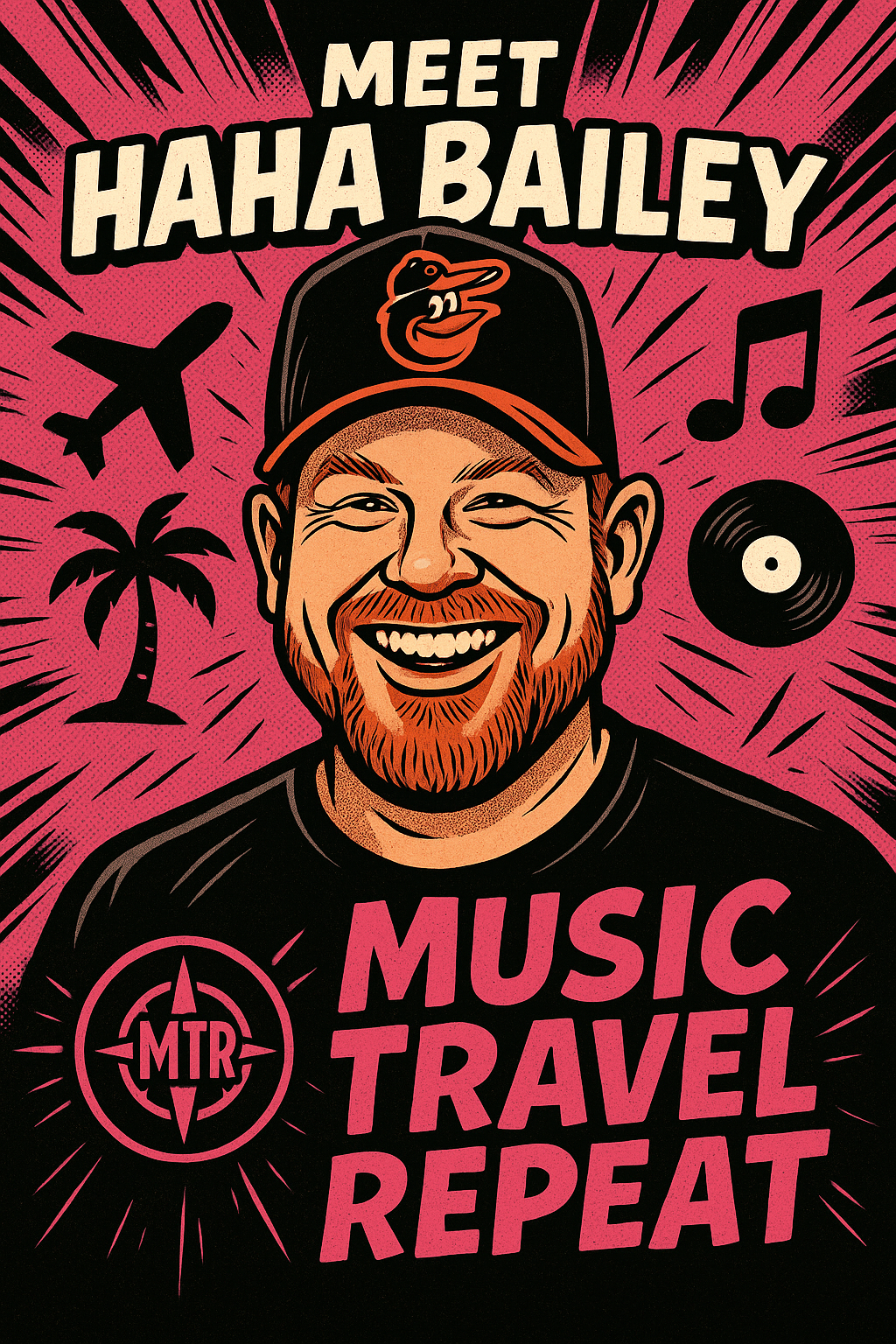
Haha Bailey is a lifelong traveler, executive-protection agent, and the quiet voice behind Music Travel Repeat. He writes from hotel rooms, airport gates, and front porches about the strange holiness of music, memory, and second chances on The Restless, The Hopeful, and The Broken. When he’s not in the air, he’s usually chasing the next song that makes the world feel smaller and the heart feel bigger.
Subscribe to the Backseat Benedictions: Music For A Road Trip
Music For A Road Trip : 625 Songs & Counting!
- Backseat Benedictions: Music For A Road Trip | Vol. 1 - The Ones We Let Go of
- Backseat Benedictions: Music For A Road Trip | Vol. 2 — The Ones Who Lost the Map, Not the Will
- Backseat Benedictions: Music For A Road Trip | Vol. 3 — The Goodbyes We Whispered
- Backseat Benedictions: Music For A Road Trip | Vol. 4 — The Ones Who Taught Us How To Love
- Backseat Benedictions: Music For A Road Trip | Rewind Vol. 1 — The First Four Volumes, Revisited
- Backseat Benedictions: Music For A Road Trip | Vol. 5 — Bury the Past in the Desert
- Backseat Benedictions: Music For A Road Trip | Vol. 6 — The Ones Who Call Maryland Home
- Backseat Benedictions: Music For A Road Trip | Vol. 7 — The Darkness We Survive
- Backseat Benedictions: Music For A Road Trip | Vol. 8 — The Battles We Carry
- Backseat Benedictions: Music For A Road Trip | Rewind Vol. 2 — Eight Volumes, One Road Back
- Backseat Benedictions: Music For A Road Trip | Vol. 9 — The Ones Who Made It Their Own Edition
- Backseat Benedictions: Music For A Road Trip | Vol. 10 - The Ones Who Refused To Be Just One Thing
- Backseat Benedictions: Music For A Road Trip | Vol. 11 — The Ones Who Came Back
- Backseat Benedictions: Music For A Road Trip | Vol. 12 - The Ones Who Couldn't Say It Any Other Way
- Backseat Benedictions: Music For A Road Trip | Vol. 13 - The Ones We Had to Learn to Live Without
- Backseat Benedictions: Music For A Road Trip | Vol. 14 -The Ones Who Paved The Way For Others
- Backseat Benedictions: Music For A Road Trip | Vol. 15 - The Ones Who Grew Up When No One Was Watching
- Backseat Benedictions: Music For A Road Trip | Vol.16 - Goodbye For Now D
- Backseat Benedictions: Music For A Road Trip | Vol. 17 — The Days That Still Count
- $50,000 in Free Concert Tickets & Music for the Road (425 Songs)
- Backseat Benedictions: Music For A Road Trip | Vol.18 — The Ones Who Love Again
- Backseat Benedictions: Music For A Road Trip | Vol. 19 - The Ones Who Miss When Time Felt Infinite
- Backseat Benedictions: Music For A Road Trip | Vol.20 - The Ones Who Are Close Enough To Feel It
- Backseat Benedictions: Music For A Road Trip | Vol.21 - The Ones Who Lived Fast & Still Miss Home
- Backseat Benedictions: Music For A Road Trip | Vol.22 - Home Is The Reason
- Backseat Benedictions: Music For A Road Trip | Vol.23 - The Ones Who Learned To Exhale
- Backseat Benedictions: Music For A Road Trip | Vol. 24 - The Ones Who Throw Stones From Soft Chairs
- Backseat Benedictions: Music For A Road Trip | Vol. 25 - The Soundtrack Of Our Lives