Music Travel Repeat! › The Restless The Hopeful The Broken ›
GQ - The Heartbeat Behind The Chaos
There are moments in life when words don’t just describe—they become lifelines. This entry is one of those.
Most of what I’ve written in The Restless, The Hopeful & The Broken has circled around music, travel, and survival. They’ve been the lenses through which I’ve tried to make sense of my story. They’ve been safe scaffolding—metaphors I can lean on when the truth feels too raw to name outright. But this?
- This isn’t about metaphors
- This isn’t about hiding the truth in song lyrics or in miles driven on highways that never quite deliver you home
- This one is bare
- This one is about GQ.
She is not just a chapter in my story; she is the thread that holds the whole book together when the binding comes undone. And believe me—it has come undone more than once.
GQ is the heartbeat I didn’t know I needed. The quiet rhythm steadying me when the noise inside my chest threatened to drown itself out. She is living proof that love doesn’t need to show up with trumpets blaring or fireworks cracking across the sky. Sometimes love walks into your story like a slow-burn song—one you don’t recognize at first, but once it takes root, you can’t imagine life without it on the playlist.
I think back to the first nights I wrote for Music Travel Repeat. I was sitting in airports, scribbling in notebooks, or typing on my phone between boarding calls.
- I wrote about survival because that’s what I understood
- I wrote about music because it was the one thing that hadn’t betrayed me
- I wrote about travel because it felt like movement was the only thing separating me from suffocation
And through all of it, I never realized I was writing toward her. That every story of searching, every confession of chaos, was leading to the one person who would stand at the intersection of all three—music, travel, and survival—and prove that love belongs there too.
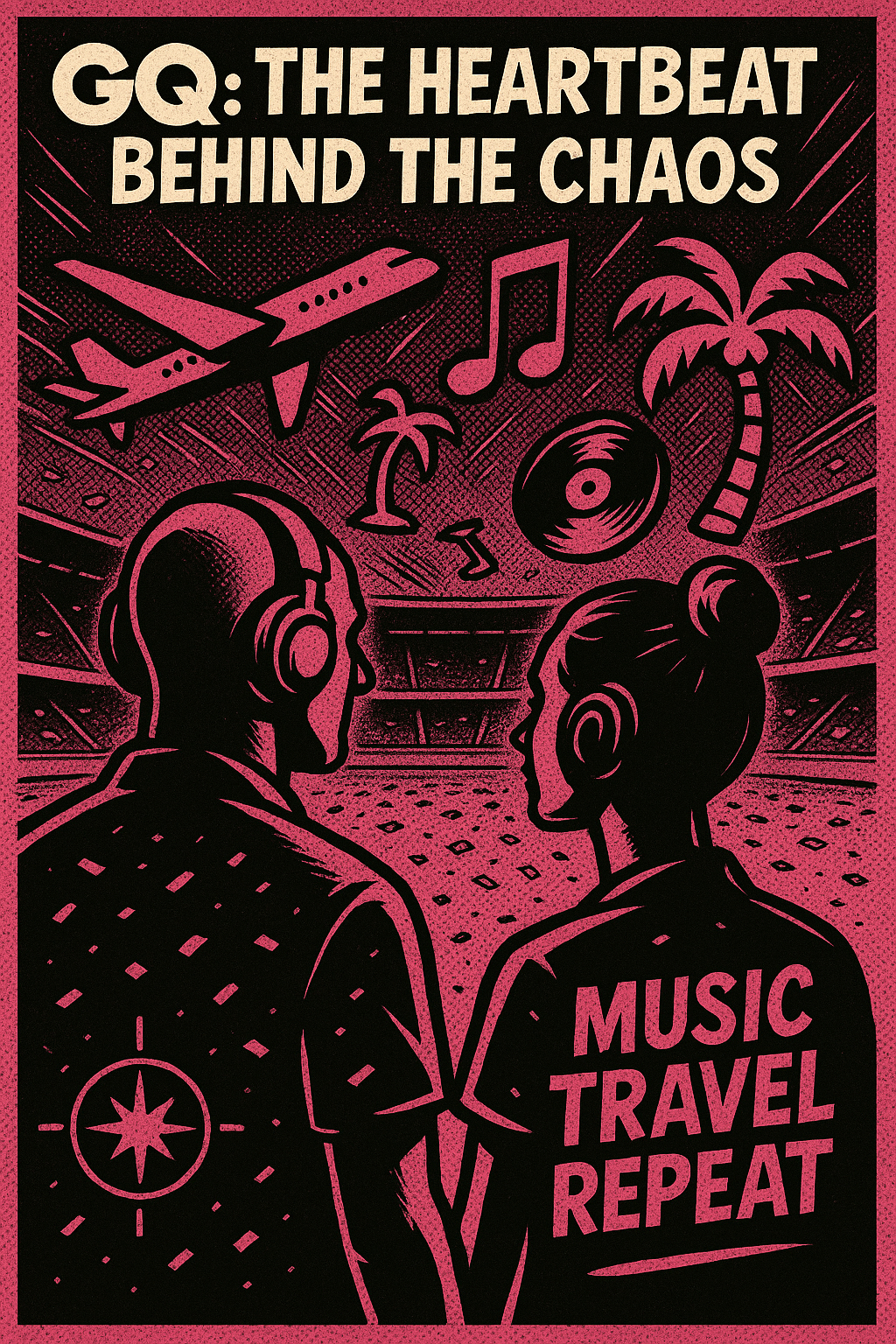
With GQ, it isn’t about rescuing me. She’s not some Hollywood savior swooping in to pull me out of the fire. The truth is, I was already burned. The smoke had long settled in my lungs. What she did was something quieter, more sacred
- she sat in the ashes with me
- she didn’t hand me platitudes
- she didn’t tell me to cheer up or move on
- she looked at the mess and didn’t flinch
- she stayed.
And staying is everything.
Because when the lights fade after the encore, when the road gets long and the motel room is dim, when the crowd is gone and the silence is deafening—that’s when you see who someone really is. That’s when you discover if love is just a costume worn on stage or if it has roots deep enough to withstand the off-key, unfiltered parts of life. With GQ, I never had to wonder. Her love has never been performance. It’s presence.
Sometimes I catch myself replaying the story of how she came into my life, not because I want to rewrite it, but because I can’t help marveling at the timing. I met her
- in the middle of vows that were crumbling
- promises that were breaking
- a version of myself that was disappearing
She didn’t barge in. She didn’t demand a role. She simply stood there with a kind of quiet strength that made me believe real still existed in a world I had convinced myself was fake.
That kind of presence doesn’t just happen. It’s chosen, moment after moment
- to be honest when lying would be easier
- to be loyal when walking away would cost nothing
- to be real when the world is begging for masks
And I didn’t even realize back then that her realness would be the very thing that saved me later—not from circumstances, but from myself.
I used to think survival meant running. I thought it meant working more hours, catching more flights, adding more shows to the calendar. I thought the answer was always one more airport, one more crowd, one more pit where I could scream my lungs out until the grief blurred into static. But GQ taught me something different: survival isn’t about noise; it’s about rhythm. It’s about finding someone who reminds you to breathe when you forget. It’s about discovering that rest can be holy, that stillness doesn’t equal weakness, that sometimes the bravest thing you can do is sit still and let love find you.
She has become my rhythm. My reminder that chaos doesn’t always win. My proof that even when the storm takes down the scaffolding, there can still be music humming underneath it all.
And maybe that’s why I needed to write this entry. Because as much as Music Travel Repeat has been about music and travel and survival, at its core it’s always been about connection. And the deepest connection I’ve ever known isn’t found in the pit, or the terminal, or the late-night hotel balcony—it’s found in her.
Writing this scares me, if I’m honest. It feels like leaving the safety of metaphor and stepping barefoot onto holy ground. But she deserves it.
- She deserves her own chapter, not tucked away as a side note or disguised in someone else’s lyrics
- She deserves her name sung through the story
- She deserves to be seen the way she has always seen me
not as a bodyguard, not as a broken man, not as the one who failed at marriage, but simply as myself.
So let this be her entry. Let this be the place where the noise finally pauses long enough for me to say it clearly: GQ is the heartbeat behind the chaos. She is the steady rhythm inside the restless song of my life. She is the one who stayed when the road threatened to swallow me whole.
And if you’ve ever doubted that love can survive the wreckage, if you’ve ever wondered whether you’re too broken, too tired, too scarred to be worthy of something steady, let this entry stand as proof. It doesn’t have to be fireworks. It doesn’t have to be flawless. Sometimes love shows up quietly, in the middle of the mess, and changes everything.
The First Note – How GQ Entered My Life
I knew GQ when my life still wore the disguise of “married man.” From the outside, it probably looked stable. A house. A routine. Smiles in public that felt like photographs—posed, polished, perfectly timed. But on the inside, I was living in cardboard walls during hurricane season, holding my breath as the wind ripped through the seams.
And there she was. Not sweeping in like a savior. Not sneaking in like a secret. She was simply present—working alongside me, showing up to the same spaces where my wife also stood, somehow existing in the same storm but not being consumed by it.
She was friends with my ex-wife, and that’s a truth I never run from. Life is complicated like that
- messy
- tangled
- full of overlapping circles that don’t always make sense when you sketch them out on paper
But the irony still stings: the woman my wife trusted as a friend became the very woman she later accused of betrayal. And here’s what most people never understood—back then, GQ was the only one encouraging me to keep trying. She reminded me of my vows when even I was too exhausted to remember them.
I think about the moments burned into memory—conversations where she looked at me and said, “It matters. Effort matters. Don’t give up yet.” She wasn’t rooting for herself; she was rooting for the marriage I was still clinging to with bleeding hands. Who does that? Who stands in front of a crumbling wall and tells the man trying to hold it up, “You’re strong enough to give it another push”—even knowing the wall might still collapse?
That’s who GQ was. That’s who she still is. Real.
The contrast between her and my wife couldn’t have been sharper. My wife cared about appearances
- about the way people perceived us
- about how convincing the smiles looked in photographs
- about how polished the performance was when others were watching.
But GQ?
- she didn’t know how to be fake
- she didn’t bother dressing her words in costumes or fluff
- she spoke plain
- she spoke direct
And when you’re drowning in surface-level niceties, honesty is oxygen.
I remember once—simple as a Tuesday afternoon—when I was unraveling quietly inside. My marriage was in one of its cycles of cold shoulders and silent punishments. GQ looked at me across the room and said, “You okay?” Two words. That’s it. No one else had asked me that in months.
- not my wife
- not my family
- no one
And when I opened my mouth to say “I’m fine,” she didn’t let me. She tilted her head, narrowed her eyes the way truth-tellers do, and just waited. That silence said more than a paragraph ever could: Don’t lie to me. Don’t fake it. I can handle the real.
I didn’t tell her everything then. I couldn’t. Marriage was sacred to me, and the struggles inside it weren’t hers to carry. But I never forgot that moment. That someone noticed. That someone saw.
The thing about seeds is you don’t notice them the day they’re planted. They disappear into dirt, swallowed by silence. But later—sometimes years later—you see the green pushing through the cracks, and you realize something has been alive all along. That’s how GQ entered my story. Not as fire. Not as flood. As a seed.
- She planted herself in truth
- She planted herself in loyalty
- She planted herself in friendship that didn’t demand or manipulate or angle for more
And those seeds lay hidden while I stumbled through the collapse of something I had once promised to protect.
Looking back, I realize now that she was the only person in those years who consistently pointed me toward honesty.
- My wife wanted rehearsals. GQ wanted reality
- My wife wanted image. GQ wanted truth
- My wife wanted to be seen as perfect. GQ was unafraid to be seen as flawed
and that authenticity made her radiant.
The irony, of course, is that years later, people would accuse me of crossing lines that never existed. They whispered
- about affairs
- about betrayal
- about shadows behind closed doors
But the truth is simpler, less scandalous, more sacred: she stood beside me, not in front of me, not behind me. And she pointed me back to the vows I had already been holding with shaking hands.
The older I get, the more I see how rare that is. How rare it is for someone to look at a man drowning and not toss him temptation disguised as escape, but instead throw him a rope made of truth.
That rope saved me. Not because it pulled me out of the marriage—that collapse happened on its own—but because it reminded me I wasn’t invisible. It reminded me there was still good in people. That not everyone would use my cracks as leverage. That some people still believed effort mattered, even if the walls crumbled anyway.
When people ask me now, “When did you know GQ was different?” I think back to those early days
- not the concerts
- not the airports
- not the hotel balconies years later
I think back to those simple, almost forgettable exchanges in rooms where I felt unseen. I think back to her loyalty not to me, but to the truth itself. That’s when I knew. That’s when the first note of her song entered the soundtrack of my life.
It would be years before I recognized it fully. Years before the melody grew louder than the static. But the first note was there. Soft. Steady. Real.
And it changed everything.
Love in the Middle of the Noise
By the time GQ and I found each other again, my marriage had already collapsed. On paper, the vows still existed. Somewhere in a drawer, a certificate still carried our names, as if ink could preserve what hearts had long since abandoned. But the truth was that the marriage had ended long before the signatures dried. The performances had grown stale. The silences between us had become louder than any fight. The home no longer existed. I already moved out. I was already granted the divorce.
And in that silence—when everything in me wanted to disappear—she was there.
Not barging in. Not demanding attention. Just there. Present in the way only someone real knows how to be.
We started small, like most things worth keeping do. A concert here, a coffee there. I remember the first show we went to together—not because the band changed my life, but because the way she sang along did. She didn’t just mouth the words like people do when they’re worried about how they look. She sang with her whole chest, her whole being, off-key in the best way. It was messy, unpolished, and completely alive. And for a man who had spent years standing beside someone who never let herself lose control, it was holy ground.
The lineup that night was Pop Evil, The Word Alive & Avoid.
Music had always been my refuge, but with GQ it became more than that. It became a window into freedom I didn’t know I was still allowed to have. I had been conditioned to believe love required performance
- to keep smiling when I was dying inside
- to clap at the right moments
- to rehearse affection until it felt like muscle memory
But with her, the rules didn’t apply. With her, the noise wasn’t something to hide from—it was something to dance inside of.
- We laughed at the wrong times
- We lost our voices screaming lyrics
- We stood in crowds pressed shoulder to shoulder
and instead of suffocating, I felt like I could breathe again. Love with her didn’t quiet the noise—it revealed the melody that had been hiding inside it all along.
Travel was the same way. For years, vacations had been about escape. I would book tickets not to arrive anywhere meaningful, but simply to get away from where I was. My suitcase was less about adventure and more about survival. Another hotel, another fake smile, another set of keys handed across a desk. I was moving, but I was never arriving.
With GQ, the motion shifted. Suddenly a 6 a.m. flight wasn’t a burden—it was a chance to hold coffee in one hand and her hand in the other while we waited at the gate. Long desert highways weren’t stretches of emptiness anymore—they were backdrops for singing duets badly, for rolling the windows down and letting the wind tangle our hair while the stereo buzzed with static. Even the broken vending machines in budget motels became inside jokes that we still laugh about now.
- It wasn’t the places that changed
- It was the presence
- It was her.
I can still see the image burned into my memory: one night, somewhere between states, we stopped at a tiny roadside diner. Neon buzzing, half the letters in the sign burned out. We sat in a cracked leather booth with pie we didn’t need and coffee that tasted like burnt dreams. And yet, it felt sacred. Because for the first time, I wasn’t running. I wasn’t hiding. I was simply… there. With her. And somehow, that was enough.
That’s when I realized travel doesn’t become holy because of where you land. It becomes holy
- because of who sits next to you when the plane hits turbulence
- because of who laughs with you when the GPS reroutes
- because of who makes a stale bag of chips from a vending machine taste like communion bread.
GQ did that for me. She made every mile matter—not because of what was at the end of the road, but because of what was beside me during the journey.
And here’s the thing no one tells you: love doesn’t erase the noise of life.
- The bills still pile up
- The past still lingers
- The crowds still press in
- The storms still roll through
But real love doesn’t run from the noise. Real love teaches you how to find the melody within it.
With her, I discovered that laughter could be a weapon against despair. That singing loudly and badly could heal wounds silence had carved. That showing up messy was still showing up—and sometimes that’s what love asks of you, not perfection but presence.
Love in the middle of the noise isn’t about grand gestures.
- It’s about her sliding her hand into mine in the middle of a chorus
- It’s about her leaning against me on a late-night flight when the cabin hum feels like a lullaby
- It’s about realizing that I don’t have to keep searching for escape routes, because I’m not running anymore.
With GQ, the noise doesn’t scare me. It becomes music. It becomes the soundtrack of survival turned into something greater: life.
And I know this much now—if you’re lucky enough to find someone who can stand with you in the chaos and teach you to hear the melody, you hold on. You hold on with everything you’ve got.
Because that’s not just love. That’s redemption.
The Protector Meets the One Who Protects Him
Protection has always been my language. It’s the one constant thread woven through every season of my life. Long before executive protection became a paycheck, it was instinct. Growing up, I learned quickly that the world doesn’t hand out safety
- you carve it out of the chaos
- you stand your ground
- you become a wall for the ones who can’t build their own.
Later, that instinct became my job. Wrestling arenas. Concert venues. Hotels where anonymity was a luxury no celebrity could afford. I became the shadow in the corner
- the one who sees what no one else sees
- who notices the twitch in a stranger’s hand
- who calculates exits while everyone else is staring at the stage lights
I learned to live in hypervigilance, to carry my body like armor, to be invisible until the moment I wasn’t.
And in that world, strength is currency. Vulnerability? Liability. You stand tall. You don’t flinch. You never let anyone see the crack in the shield. I got good at it—so good, in fact, that most people assumed I didn’t have a soft spot left to protect.
But here’s the irony that almost undid me: you can guard the world and still come home unguarded. You can protect everyone else while your own soul bleeds in silence. And when the lights go down, when the crowd disperses, when you hang up the earpiece and fold the suit in the closet, no one is there to watch your back.
That’s where GQ comes in.
She protects me—but not in the ways anyone else would notice.
- She’s not scanning the crowd for threats
- She’s not mapping out the exits
- She protects me from myself
From the exhaustion of always being “the strong one.” From the temptation to disappear into silence and convince myself it’s noble. From the lies that say I’ll always be too broken, too restless, too hard to love.
Her protection doesn’t come with force—it comes with presence.
Like the mornings when I’ve only slept three hours after a job. My body is heavy, my mind is buzzing with details I can’t shut off. And she walks in, slides a plate in front of me—eggs, toast, coffee. No speeches, no pity.
- Just presence
- Just nourishment
- Just love in a form I can touch
That plate of food says what I won’t say out loud: I see you. You don’t have to earn rest. You don’t have to apologize for being human.
Or the way she takes my hand in crowded places. Crowds don’t scare me—I’ve trained too long to be undone by strangers—but sometimes they overwhelm me.
- the press of bodies
- the rising volume
- the hum of a thousand small threats competing for attention
And then her hand slides into mine. Simple. Steady. Suddenly I’m not scanning anymore. Suddenly I’m reminded that I don’t always have to be the watchtower. Sometimes it’s enough to be a man in love, holding his girl’s hand in the middle of the chaos.
Then there are the nights. The nights are the hardest. When the old voices in my head get loud. When mistakes from years ago crawl out of the dark corners. When silence feels like judgment. That’s when she whispers truth. Sometimes it’s a sentence. Sometimes just my name. And somehow it’s enough to drown out a thousand lies.
What most people don’t see is how fiercely she fights for me when others try to rewrite my story.
- when people throw around accusations
- when the easy narrative paints me as the villain because the truth is too complicated
GQ never lets those lies stick. She speaks truth even when her voice shakes. She reminds me that silence might have been my survival tactic, but it doesn’t have to be my identity.
Her protection is fierce, but it’s never controlling. She doesn’t demand I take the armor off; she makes me believe I don’t need it with her. That’s the difference. That’s the sacred part. She doesn’t pry open the walls I’ve built. She sits beside them until I realize they can come down.
I used to believe protection was about standing between someone and their enemies. But GQ has taught me protection can also look like standing
- between someone and their despair
- between someone and their self-doubt
- between someone and the shadows of their own past.
There was one night—I don’t even know if she remembers it—when I came to her apartment after a job. I was wired and worn out. I couldn’t sleep. I couldn’t stop replaying the night, the faces, the what-ifs that haunt you after you’ve been responsible for someone else’s life. I sat on the edge of the bed, staring into the dark, hands shaking from adrenaline that had nowhere to go.
- She didn’t tell me to calm down
- She didn’t ask me to explain
- She just wrapped herself around me from behind, her cheek against my back, and breathed slow until my breathing matched hers
That’s what protection feels like when love is the one offering it—not words, not fixes, just presence until peace arrives.
With GQ, I’ve discovered a truth I wish I’d known years ago: even protectors need protecting. Even guardians need someone who says, “You don’t have to hold it all alone.”
And maybe that’s the greatest irony of my story—that the man who built his identity around keeping others safe found salvation in a woman who made him safe enough to finally rest.
The Story They Tried to Tell
When my marriage ended, the story that spread wasn’t about truth. It was about convenience. And in the world we live in, convenience often wins louder applause than reality ever will.
My ex-wife tried to convince anyone who would listen that GQ and I had been having an affair. That I had betrayed her
- that the collapse of our marriage could be pinned neatly on scandal
- whispered about over coffee or wine
- consumed like gossip passed down in a chain
That version of events was easier than the truth, because truth is complicated, messy, unflattering. And she didn’t want complicated. She wanted a villain.
And so she pointed to GQ.
It was, in some ways, the easiest play she could make. Here was this woman
- who had been close to us
- who had shared the same circles
- who had sat across the table as both colleague and friend
People believed it, not because it was true, but because it made sense to the part of us that craves tidy explanations.
But the truth was far different—and far more heartbreaking.
There was no affair.
- not once
- not in thought
- not in word
- not in action
I guarded that covenant the way I guard a stage door, with vigilance and loyalty, even as the walls crumbled around me. I kept every ache, every disappointment, every night of silence inside those four walls. I never handed it to friends. I never vented to coworkers. I carried the weight alone because I believed marriage required it. I thought that silence was loyalty. That endurance, even without joy, was faithfulness.
Meanwhile, my ex-wife was crafting her own narrative. And when the marriage finally collapsed, it was easier for her to drape it all over GQ’s shoulders than to admit her own part.
- easier to say “He betrayed me” than to say “I pushed him away and couldn’t stop the cycle.”
- easier to lean on scandal than to look in the mirror.
And people believed her.
Because scandal is seductive. It spreads faster than silence. It’s easier to repeat a rumor than it is to sit with someone’s pain. Whispers have a way of growing legs and sprinting through communities, leaving truth to stumble behind, trying to catch up.
For a while, it worked. People looked at me with suspicion. Some looked at GQ with outright judgment. I could feel it
- in the sideways glances
- the hesitations
- the subtle pauses in conversations
And I stayed silent—not because I didn’t have words, but because silence felt like the only way to keep dignity in a world that had already stripped me of so much.
But silence comes with a cost.
- the cost of being misunderstood
- the cost of being painted in colors you didn’t choose
- the cost of watching the one person who had stood beside you in truth become the scapegoat in a story that was never hers to carry.
That part broke me more than the divorce itself. Watching GQ—this woman who had never once crossed a line, who had always pointed me back toward loyalty—become the target of lies designed to protect someone else’s image. That was a cruelty I still wrestle with.
But here’s what I know: lies don’t age well.
- they wrinkle
- they crack
- they lose their shine
And eventually, truth has a way of breathing again.
In the years since, people have come to see the truth for themselves. They’ve seen who GQ really is—the one who encouraged me to stay when I wanted to leave, the one who reminded me that vows mattered even when I was too exhausted to keep holding them. The irony that she was accused of breaking the marriage when, in reality, she was the only one fighting to hold it together—that irony is heavy, but it’s also holy. Because it reveals character.
And character always outlasts scandal.
Still, I’d be lying if I said it didn’t leave scars. To this day, when someone asks how long GQ and I have been together, I can feel the old accusation lingering in the air. I want to rush into explanations, to lay out the timeline, to prove the innocence we both lived. But I don’t anymore. Because proving isn’t the same as living. And the truth is—we lived it. We know it. That’s enough.
The world tried to make GQ a villain in a story she didn’t write. But her loyalty, her honesty, her refusal to play games—those things spoke louder than the lies. She didn’t defend herself with noise. She defended herself
- with presence
- with consistency
- with being the same person in private that she is in public
I learned something in that season: the stories people tell about you say more about them than they ever do about you. And the louder the lie, the more fragile the truth it’s trying to cover.
For my ex-wife, it was easier to tell the story of betrayal than to admit that her third marriage had collapsed under the same weight as the two before. Easier to paint me as unfaithful than to admit she’d been playing a role so long she no longer knew who she was without an audience.
But in the end, none of those lies changed reality. Reality was this: I never broke my vows. I carried them until they crushed me. And when the marriage ended, it wasn’t because of GQ. It was because I finally stopped pretending cardboard walls could hold up against a hurricane.
And GQ? She remained what she had always been—truth in a world that begged for illusions.
That’s the story I will tell. That’s the story that matters.
The Space Between Endings and Beginnings
It would be almost two full years after my divorce before GQ and I began going steady. Two years of space. Two years of silence between what was ending and what was beginning. And if I’ve learned anything, it’s that those years weren’t wasted—they were necessary.
We live in a world that loves speed. Quick fixes. Instant answers. Jumping from one thing into another, as if grief can be outrun or heartache can be covered with
- a new smile
- a new body in the passenger seat
- a new name on your phone
But there’s a cost to skipping the space.
- if you don’t sit in it
- if you don’t wrestle with it
- if you don’t let it break you and teach you
then you carry the old weight into the new love. And that’s not fair—to you or to the one who deserves a whole version of you, not a patched-up ghost.
I didn’t want to hand GQ my broken pieces and ask her to assemble them. That wasn’t her burden. Those years in between were for me—for learning who I was without the mask of marriage, without the constant performance of pretending everything was fine.
And make no mistake: they were hard years.
I had to grieve the marriage, even if people told me I shouldn’t. Even if some thought I should’ve just moved on, just thrown myself into the next chapter. The truth is, grieving wasn’t about her—it was about me. It was about grieving
- the man I thought I had to be to keep that marriage alive
- the man who stayed silent
- the man who swallowed his pain because speaking it felt like betrayal
- the man who sacrificed himself on the altar of appearances
only to discover that appearances can’t love you back.
I had to bury him.
And in those two years, I started to resurrect someone else—someone closer to the truth of who I really was.
- I started to remember what laughter felt like when it wasn’t forced
- I started to write again—not to polish an image, but to survive, to bleed on paper until the words made sense of the ache
- I started to build Music Travel Repeat not as a distraction, but as a lifeline
Those entries, those playlists, those long confessions—they were all part of the space. They were me, fumbling in the dark toward something that felt like freedom.
And through all of it, GQ stayed.
Not as a rebound. Not as a replacement. But as a steady presence who never rushed me, never pressured me, never demanded that I give her something before I was ready. She understood that healing has its own timetable, and love that lasts doesn’t come from shortcuts.
We talked. We laughed. We went to shows. But we kept it friendship. Intentional. Respectful. She gave me room to fall apart without trying to tape me back together. She gave me the grace of patience—the rarest gift in a world that demands urgency.
And then, almost two years later, something shifted. It wasn’t dramatic. No fireworks. No epiphany written in the sky. Just a quiet knowing. The kind of knowing that sneaks up on you after months of slow healing. I realized I didn’t just trust her with my laughter, or with my stories—I trusted her with my silence. I trusted her with the parts of me that still shook when I remembered the lies, the accusations, the nights when my chest felt hollow.
That’s when we chose each other. Not as an escape. Not as a way to erase what came before. But as a decision.
And that’s what makes this love different.
Because love born from desperation burns out quick. Love born from rebound collapses under its own weight. But love born from patience, from respect, from two years of steady presence—that’s a love that lasts. That’s a love that feels less like chance and more like providence.
When we finally let ourselves be serious, when we finally named what had always been growing between us, it felt less like falling and more like arriving. Like the end of a long journey, when you finally pull into the driveway and realize you’re home.
People sometimes ask, “Why wait? Why not just start right away?” And I smile, because
- the waiting was the gift
- the waiting gave us depth
- the waiting gave us clarity
- the waiting gave us a foundation that gossip and lies and storms couldn’t touch.
Those two years were the soil where the seeds she had planted years earlier finally broke through the surface. And when the first green appeared, when the first shoots pushed through the dirt, I knew. I knew this wasn’t desperation. This was devotion.
And here’s the truth I carry now: if you’re standing in the space between endings and beginnings
- don’t despise it
- don’t rush it
- don’t mistake it for wasted time
It might be the most sacred space you’ll ever stand in. Because it’s there—in the silence, in the grief, in the slow rebuilding—that you discover who you are. And when love comes again, you’ll be ready. Not perfect, not polished, but present.
That’s what those years gave me. That’s what made GQ and I possible.
Not scandal. Not shortcuts. Not desperation. But time. Sacred, painful, necessary time.
And when the dust settled, when my heart had healed enough to beat steady again, there she was—still real, still loyal, still waiting with open hands instead of clenched fists.
That’s when I chose her. That’s when we chose each other.
Not as an ending. Not as a rebound. But as a beginning.
Road Miles & Shared Dreams
The road has always been my cathedral.
I’ve knelt at its altar for as long as I can remember. Asphalt stretching out ahead of me like a prayer rug, the hum of tires beneath my feet singing hymns only restless souls understand. Exit signs became liturgy. Neon lights became stained glass. The rhythm of mile markers was a sermon I trusted more than any preacher.
But for years, those miles were lonely. I was moving, but I wasn’t arriving. I packed bags to escape, not to build. I booked vacation because silence at home was too heavy to bear, not because the destination mattered. The road became survival, not sanctuary.
And then came GQ.
With her, the miles shifted. The road didn’t feel like a way out anymore—it felt like a way in. A way into something steadier, something sacred. With her in the passenger seat, even the ugliest stretches of highway felt baptized. A desert rest stop at midnight could feel like a sanctuary. A sticky motel room with peeling wallpaper could feel like holy ground. Not because of the place, but because of the presence.
I remember one morning—an airport morning, the kind where your body is more exhaustion than flesh. The kind where your boarding pass feels like a chain instead of a ticket. I was on autopilot: bags checked, shoes off, laptop out, liquids in a plastic bag. And then she slid a coffee into my hand, grinned at me across the chaos of the security line, and suddenly even the airport hum felt bearable. The way she said “We got this” wasn’t just about the flight. It was about life. About us.
That’s what travel with her became—not escape, but arrival. Every flight wasn’t just about the next city; it was about the fact that she was beside me when the turbulence hit.
- We’ve shared desert highways with the windows down, shouting lyrics into the wind like it was our congregation
- We’ve crossed city skylines at night, headlights bouncing off the glass, talking about dreams too fragile to say out loud before but safe enough with her
- We’ve sat in parking lots with takeout boxes balanced between us, laughing until the food went cold, because sometimes laughter is the only map you need.
With GQ, even the detours matter.
- A wrong turn becomes an inside joke
- A delayed flight becomes a chance to wander an unfamiliar terminal, hand in hand, turning boredom into memory
- A roadside diner with stale pie and burnt coffee becomes a place we’ll remember long after five-star restaurants fade.
Because the destination isn’t the story anymore—the story is us. The story is building something together in the in-between moments.
We’ve dreamed in those places too. Big dreams about what life could look like years from now, and small dreams about tomorrow’s breakfast or the playlist for the drive ahead. We’ve dreamed about houses and stages and road trips we haven’t taken yet. And always, always, she’s the one protecting the dream in me that once felt too fragile to hold.
Because here’s the truth: there was a time I almost lost that dream. A time when the chaos of marriage unraveling, the lies whispered behind my back, the exhaustion of always performing had convinced me that dreaming was dangerous. I thought the only safe way to live was to survive one day at a time with no vision for tomorrow. But GQ reminded me that dreams aren’t weakness—they’re oxygen. And she treated mine as something worth protecting.
She’s the one who told me that Music Travel Repeat wasn’t just a blog—it was a home. A home for
- the restless
- the hopeful
- the broken
She reminded me that my words mattered, even when I wanted to delete every draft and convince myself no one cared. She’s the one who looks at me when I doubt and says, “This is bigger than you. Keep writing. Keep telling the truth.”
And that’s why the road feels different now.
It’s not just about me anymore. It’s about us.
- About weaving our stories together mile by mile, playlist by playlist
- About the way her laughter fills the car louder than the static when we lose signal
- About the way her head rests on my shoulder when the last flight of the day finally boards
- About the way even a cheap motel with broken vending machines can feel like home when we’re in it together.
With her, the miles aren’t empty. They’re full—of laughter, of music, of dreams whispered between sips of coffee and late-night choruses.
And if there’s anything I’ve learned, it’s this: love doesn’t erase the road. It doesn’t promise an easier journey. But the right love—the kind born of patience, of scars, of truth—it makes every mile matter.
Because every mile is ours.
The Restless, The Hopeful, The Broken – And the Loved
This series has always been about three kinds of people: the restless, the hopeful, and the broken.
The restless are the ones who can’t sit still. The ones chasing miles, chasing shows, chasing anything that feels like movement because sitting still feels too much like suffocation. I’ve been there. I’ve lived entire years with a suitcase half-packed on the floor, convincing myself that the next flight, the next concert, the next neon sign would finally quiet the noise inside.
The hopeful are the ones who refuse to quit. Even when life keeps handing them silence instead of applause, disappointment instead of encore. They’re the ones still looking out windows at midnight, still whispering prayers in the dark, still daring to believe that tomorrow could be better than today.
And the broken—God, the broken. They’re the ones who feel like survival itself is the encore. The ones who know what it’s like to sit in the ashes of what was supposed to be holy and wonder if they’ll ever feel whole again. The ones who’ve been lied about, left behind, misunderstood, mislabeled.
I’ve written about all three, because I’ve been all three.
But what I haven’t written enough about—until now—is the fourth. The ones who are loved.
Because love doesn’t cancel out restlessness. It doesn’t erase brokenness. It doesn’t guarantee hope will always burn steady. But it weaves through all of it.
- It holds the restless when their feet can’t stop moving
- It guards the broken when they’re too tired to get back up
- It fans the flame of hope when the night feels too long
That’s what GQ is to me. She’s the proof that love doesn’t demand performance. It doesn’t measure worth in perfection. It doesn’t vanish when things get hard—it digs deeper, steadier, stronger.
She is my bridge. Between the restless and the hopeful. Between the broken and the whole. Between the chaos I once lived in and the melody I now hear inside it.
I used to think my story would always be defined by survival.
- by how many shows I went to
- by how many flights I caught
- by how many scars I carried
But the truth is, survival isn’t the endgame. Love is. And not the kind of love you find in polished photos or rehearsed smiles. The kind you find in someone who doesn’t leave when the lights go down. The kind you find in someone who guards the guardian.
For me, that’s GQ. She is the one who turned noise into melody. The one who made the road feel like home. The one who didn’t force me to lay down my armor but made me believe I didn’t need it with her.
This entry belongs to her because she has been the heartbeat behind every mile, every lyric, every confession I’ve shared here. Without her, Music Travel Repeat would still exist—but it wouldn’t sound the same. It wouldn’t carry the same weight. It wouldn’t be anchored by the same steady hand.
If you’ve ever doubted whether love could survive the wreckage, let me tell you: it can. It doesn’t always arrive when you want it. It doesn’t always look how you expect. But sometimes, if you’re patient enough to sit in the space between endings and beginnings, it shows up quietly, in the middle of your mess, and it changes everything.
Final Reflection Epilogue
When I started writing The Restless, The Hopeful & The Broken, I thought I was writing to strangers. I thought I was writing for the ones out there who felt too tired to stand, too restless to sleep, too broken to pretend. And I was. But looking back, I realize now—I was also writing for me. For the younger version of myself who didn’t know if love like this was possible.
And maybe, in some strange way, I was writing toward her too. Toward GQ. Toward
- the one who would one day step into my story not as a savior, not as a scandal, but as a steady presence
- the one who would guard me when I was too tired to keep guarding myself
- the one who would laugh off-key in concert pits, hold my hand in crowded airports, and whisper truth when the lies screamed the loudest.
I’ve always ended these entries with a kind of benediction—for the restless, for the hopeful, for the broken. But today, let me add one more. For the loved.
- for the ones who stayed patient in the waiting
- for the ones who held out for something real in a world obsessed with performance
- for the ones who didn’t settle for survival but opened themselves to the possibility of love even after the storm.
If that’s you, if you’ve found the one who makes the noise into melody, cherish them. Guard them. Hold them with both hands. Because love like that is rare. Love like that is holy.
For me, her name is GQ. And this isn’t just her entry—it’s our entry. A reminder that sometimes the greatest encore isn’t found under stage lights or behind security barricades. Sometimes it’s found in the quiet of knowing you don’t have to face the chaos alone anymore.
Catch you in the chaos,
Haha Bailey
Next Post: Why I Finally Asked For A Divorce
Previous Post: James Taylor’s Wolf Trap Concert and the Father-Son Lessons I Didn’t Expect
PS. I live in Tijuana now. The border has become my threshold—a place where life feels both close and far, familiar and foreign, chaos and calm all at once. GQ lives in Phoenix, a city that feels like sun on skin and space to breathe. We’re not in the same zip code, but the miles don’t scare us. Not after everything we’ve walked through to get here.
If I ever marry again, there’s no question—she’s the one. GQ is the one. But there’s no rush. We’ve learned that love isn’t measured by speed, it’s measured by depth. We don’t need to sprint toward a ceremony to prove what’s already true in the quiet between us.
Part of why she feels like home to me is because of her confidence. My ex-wife carried insecurities that clung to
- every shadow
- every female friend
- every coworker
- every hallway I walked down became a battlefield of suspicion
years before GQ ever walked into our lives.
She couldn’t believe in me because she couldn’t believe in herself. But GQ is different. She watched me be faithful day in and day out. She saw me travel, saw me on the road, saw me in hotels more nights than I can count—and she knows the truth. She knows I kept my vows, even when it cost me pieces of myself. And because she saw it firsthand, she doesn’t question who I am now.
That’s the beauty of GQ.
- She isn’t threatened by the road, by the late nights, by the endless airports and hotel rooms that come with this life
- She’s not afraid of my restlessness, because she knows it doesn’t take me away from her—it always brings me back
- She trusts me not because I told her to, but because she witnessed it. She saw me choose loyalty when no one was watching.
And maybe that’s the greatest difference of all. With GQ, I’m not living under suspicion. I’m living under grace.
Written By Haha Bailey

When Haha Bailey writes, you can almost hear the hum of an idling van outside a venue. Music Travel Repeat is his way of processing the chaos he’s lived — from bodyguarding backstage to breaking open emotionally on the road. His essays aren’t about endings; they’re about learning to stay soft when the world tells you not to. Read The Restless, The Hopeful, and The Broken.
The Restless, The Hopeful, and The Broken
- Cardboard Cowboys & Life Bans From Walmart
- Seether In Seattle: A Musical Homecoming For The Restless Heart
- The Immortality Equation: Concerts + Connection = A Life Well-Lived (Now With Bonus Emotional Growth @ 30,000 Feet)
- Brian Wilson, 1942–2025: A Tribute from Music Travel Repeat
- Executive Protection: The Invisible Job Reality
- Letters To My Younger Self: What I Wish I Knew Before Hitting The Road
- The Loudest Silence : Sons, Fathers And The Stages That Never Clapped
- The Song That Undid Me
- Between Matches & Melodies: Make Little Moments
- Summer Of Loud 2025 & The Ego At The Gate: What Petco Park's Door Guy Got Dead Wrong
- Another Year Older: Notes From the Messy Middle
- Why I Don't Take Pictures with the Wrestlers
- Mr. Misunderstood: The Art Of Not Fitting In
- I Don't Know If I'm Tired Or Just Lonely
- Why I Still Cry on Airplanes (And Why That’s Okay)
- A Ska Revival with Less Than Jake, The Suicide Machines, Fishbone & Catbite in Phoenix, Arizona!
- The Desert Road to Redemption
- Chevelle in Pittsburgh — Loud Medicine for a Restless Week
- James Taylor’s Wolf Trap Concert and the Father-Son Lessons I Didn’t Expect
- GQ: The Heartbeat Behind The Chaos
- Why I Finally Asked For A Divorce
- Atreyu at The Nile: Blood, Banter, and the Beauty of Not Being on Duty
- Thanksgiving 2025