Music Travel Repeat → Unofficial Music Artist Biographies → The Deviel Wears Prada Band
The Devil Wears Prada Band: Where Grief Screams, And Hope Still Answers
I remember the way the sun was starting to fade behind the stadium walls — that golden hour lull that makes everything look like a memory before it’s even over.
It was Summer of Loud 2025: Gallagher Square at Petco Park - San Diego, California
We’d already gotten through TX2 and Alpha Wolf. The Amity Affliction had cracked something open in the crowd — and in me — but it wasn’t until The Devil Wears Prada walked out that I felt the shift. Not just in the setlist, but in the air itself. Like grief had shown up early. Like heaven had a front-row seat and wasn’t about to miss this one.
I was standing next to GQ and The Filipino Bombshell. We had come for chaos. For catharsis. For the kind of volume that doesn’t just shake your chest — it clears it out. But what we got… was something else entirely.
Because here’s the thing: we already knew.
The crash had already happened.
Daniel Williams — their original drummer, their backbone for years — had died just weeks before in a plane crash that also took the life of Dave Shapiro, the booking agent behind some of our favorite lineups. The internet had been flooded with tributes. His last Instagram post — that haunting caption from the cockpit: “I’m the (co)pilot now” — had already burned itself into our collective memory. And yet… when The Devil Wears Prada took the stage that night, it felt like Daniel was still there.
Their set wasn’t just music. It was mourning. It was memory. It was a raw and defiant celebration of the ones we lose but never let go of. And as the sun died behind Gallagher Square, I swear it felt like Daniel had one more show in him — and this was it.
Dear Love, Discord, and the First Fire
Before the tours.
Before the lineups.
Before the screaming strangers who knew every word… there was a group of kids from Dayton, Ohio, learning how to hurt out loud for the first time.
Dear Love: A Beautiful Discord wasn’t just a debut.
It was a flare in the dark.
The kind you shoot from the deck of a ship that’s still floating, but barely. The kind that doesn’t ask for rescue — just recognition.
Released in 2006, it didn’t arrive with polish.
It arrived with urgency.
And sometimes urgency is a better teacher than perfection ever could be.
You can hear the growing pains in every second of that record — but what makes it magic is that they didn’t try to hide it. The imperfections weren’t edited out. They were celebrated. Held up to the light like a cracked mirror, still reflecting something honest.
Songs like “Dogs Can Grow Beards All Over” and “Texas Is South” didn’t just introduce a band.
They introduced a worldview.
One where scripture and sarcasm shared the same breath.
Where breakdowns were holy.
Where melody and mayhem could coexist in the same four-minute prayer.
And what tied it all together wasn’t just the sound — it was the spirit.
A spirit of kids raised on belief, suddenly realizing that faith feels different when it’s filtered through distortion pedals and played for kids who don’t know if they believe anymore.
They recorded it with Joey Sturgis at The Foundation Recording Studio in Indiana, with hearts full of tension and eyes wide open. Not chasing radio play. Not aiming for market share. Just releasing something they knew might keep them — and someone else — alive.
And when it landed?
It didn’t explode.
It spread.
Like wildfire through the youth group underground.
Through burned CDs passed in school hallways.
Through late-night AIM links and first tattoos and the trembling hands of kids who needed something that didn’t lie to them.
The final track featured a guest spot from Cole Wallace of Gwen Stacy — but it wasn’t the feature that stuck. It was the feeling that you had just heard something sacred.
Not in a church.
But in a churn — of doubt, hope, rage, and love, all rolled into one beautiful discord.
This was the start.
The messy, imperfect, undeniable start.
Where identity was still being built, and belief hadn’t yet been bruised beyond recognition.
But you could already feel it:
This band wasn’t going to stay safe.
They were going to sacrifice.
Comfort, clarity, and clean narratives — all left on the altar in favor of something realer.
And for the ones of us who felt like our own faith was already cracking…
Dear Love wasn’t an answer.
It was a hand to hold while the questions started.
The title alone felt like a manifesto:
Dear Love: A Beautiful Discord.
A contradiction. A confession. A warning.
This wasn’t an album that tried to resolve anything.
It was an album that let everything exist.
The ache and the beauty.
The rage and the reverence.
The doubt and the devotion — side by side, like old friends who’d stopped pretending to agree.
You could feel how young they were.
But it wasn’t immaturity.
It was innocence with edge.
It was the kind of boldness that only exists before the world teaches you to flinch.
They didn’t sound like they were making music to climb a ladder — they sounded like they were building a shelter.
For themselves.
For the misfits in youth groups who clapped off-beat.
For the ones who cried during altar calls but still got high behind the church van.
For every kid who loved Jesus and still screamed into their pillow because they didn’t feel heard.
This record heard us.
There’s a hunger in Dear Love — the kind that only comes when you're not sure if anyone’s listening, but you have to speak anyway.
And when you speak through distortion, it comes out like thunder.
Like truth with a bloody nose.
Like someone praying with their fists clenched.
And still — somehow — it made room for gentleness.
Even the chaos had purpose.
Even the breakdowns had balance.
There were piano interludes tucked between the screams, like soft-spoken reminders that rage doesn’t cancel out tenderness. That you could grow up in a hardcore scene and still be sensitive, still feel everything, still weep without explanation.
For every track that thrashed, there was a lyric that lingered.
And it made you wonder if the real rebellion wasn’t in the noise… but in the honesty.
Because let’s be real — most people think they grow out of this kind of music.
That it belongs to basement shows and bad haircuts.
But Dear Love never asked for longevity.
It asked for truth in the moment.
And in 2006, for a thousand kids who felt unseen in their schools, unheard in their churches, and misunderstood in their own skin… this record spoke first.
It said:
We don’t have it all figured out either.
But we’re not going to shut up about it.
And the way they didn’t hide behind doctrine or genre tropes — the way they let sarcasm and scripture sit at the same dinner table — felt like permission.
To question.
To wrestle.
To exist somewhere in the middle of belief and breakdown.
That’s what this record gave us.
Not perfection.
But presence.
And in the years since, we’ve grown.
We’ve changed.
We’ve buried parts of ourselves and resurrected others.
But when Dear Love plays now, all these years later…
It still feels like home.
The messy, loud, beautiful kind.
The kind you run from — and then run back to when you’re bleeding.
Plagues, Myspace, and the Growing Pains of Faith-Fueled Fury
If Dear Love was the altar call, then Plagues was the flood.
By 2007, The Devil Wears Prada had figured out how to weaponize beauty and brutality into something unmistakably their own. This wasn’t a sophomore slump. This was a declaration.
Plagues came out swinging—spitting scripture and spitfire with tracks like “HTML Rulez D00d” and “Hey John, What’s Your Name Again?” The titles were cheeky. The breakdowns were biblical. And suddenly, these boys from Dayton weren’t just in the scene — they were helping shape it.
It wasn’t just the album that exploded. It was everything around it.
The Myspace page. The streaming singles. The late-night scrolls where kids in dark bedrooms found something they didn’t know they needed.
A reason to stay.
A sound that said, “You’re not alone.”
They were still labeled Christian metalcore — a box that fit until it didn’t. Because while faith was still present in the lyrics, something more complicated was starting to stir beneath the surface.
Their shows were growing. The crowds were bigger. Fuse and MTV2 started airing their videos. And for a while, it seemed like the dream was unfolding in real time.
But success has a way of bringing your shadows into the spotlight.
Fans wanted answers. What kind of Christians were they? Why the screaming? Why the chaos? Why the sudden shift in tone and message?
The band wasn’t walking away from their roots — they were wrestling with them.
And that wrestling made the music matter more.
You could feel it in the screams.
You could hear it in the tension between heaven and heartbreak.
They weren’t the clean-cut worship leaders the Christian festivals had hoped for. They were the soundtrack to a crisis of belief — and for many of us, that felt a whole lot more honest.
Meanwhile, Plagues was charting. Peaking at #57 on the Billboard 200. Outselling their debut by over 30,000 copies. Touring was relentless. Warped Tour. Ultimatour. Cornerstone again. All of it fueled by something louder than ambition: a desperate need to say something real before the world moved on.
And then, almost out of nowhere, they dropped a cover of Big Tymers’ “Still Fly” for Punk Goes Crunk — and somehow made it feel like a sermon in disguise.
That was the paradox of this band:
Heavy but hopeful.
Silly but sacred.
Wounded but willing.
They weren’t just playing shows — they were building altars for the angry, the doubting, the exhausted faithful.
And whether you prayed with hands lifted or fists clenched…
There was room for you in the crowd.
But Plagues wasn’t just a breakthrough — it was a burden.
Because with success comes pressure, and with pressure comes questions that don’t have clean answers.
They were still boys in vans, sleeping on floors, waking up in strange cities with stiff backs and calloused fingers — but now those boys had expectations tied to their names. Expectations to represent something. To live up to something. To be something. And no matter how loud the crowd screamed, those expectations whispered louder in the quiet.
What kind of Christians are you now?
That question followed them from venue to venue. From green rooms to forums. From youth group meet-and-greets to the anonymous comment sections of message boards still lost in the internet’s attic. It wasn’t asked with curiosity — it was asked with accusation. Like they were supposed to stay frozen in their first altar call. Like the world wasn’t moving. Like they weren’t growing. Like doubt wasn’t holy too.
And it hurt.
Because they never set out to be pastors. They just wanted to make music that meant something. That bled. That broke the silence. That sounded like the things most people were too afraid to say out loud.
But somewhere along the way, they became more than a band.
They became mirrors — and mirrors make people uncomfortable.
And then came Myspace.
You have to understand, back then it wasn’t just a website. It was a sanctuary. A digital church for the restless. And on any given night, someone scrolling through their friend requests could stumble into a song like “Don’t Dink and Drance” and feel seen for the first time in months.
It wasn’t just screaming — it was sanctuary.
You could put your heartbreak on display through a track called “HTML Rulez D00d” and no one would laugh at you. You could talk about sin and sarcasm in the same sentence and no one would ask you to choose between the two. The internet was messy, but it was honest. And so were they.
And that honesty is what made Plagues hit harder than just another metalcore record. It had teeth, yes. It had breakdowns. But it also had vulnerability. Behind every snarl was a question mark. Behind every guttural growl was a teenager wondering if God still listened when you cussed in your prayers.
They weren’t rebelling. They were reckoning.
And the fans — we followed them into that reckoning, because we were tired of easy answers too. Tired of being told that everything happens for a reason. Tired of being told to smile through our panic attacks. Tired of pretending the pit wasn’t our version of a confessional booth.
Plagues gave us permission to unravel.
Loudly. Publicly. Together.
And maybe that’s why it still holds so much weight today.
Not because it was perfect — but because it was present.
- Present in the dorm room where you first punched a hole in the drywall and didn’t know why.
- Present in the backseat of your first breakup.
- Present in the youth pastor’s borrowed van where someone dared to whisper, “I don’t know what I believe anymore.”
That’s what Plagues was.
Not a sermon.
A soundtrack for the ones who didn’t walk away from the church — but carried it in pieces in their backpack, trying to make sense of it later.
And somehow… Prada made that sound beautiful.
Even when it hurt.
With Roots Above, and Questions Below
There’s a strange ache that comes with growth.
Not the kind you feel in your bones — the kind that sits behind your ribs. Quiet. Persistent. Always asking, “What now?”
By 2009, The Devil Wears Prada had found themselves perched on the edge of something bigger. Plagues had kicked the doors open. But With Roots Above and Branches Below… that was the step into the unknown.
Gone were the awkward experiments of their debut. Gone, too, was the youthful certainty that had defined their earlier lyrics. What remained was heavier. Smarter. More self-aware. And more willing to linger in the dark without rushing to explain it away.
Mike Hranica promised something “heavier and more epic.”
Drummer Daniel Williams called it “crazier and wilder.”
Keyboardist James Baney said it would be “more mechanical.”
They were all right.
With Roots Above and Branches Below didn’t just raise the bar — it twisted it into a weapon.
From the moment “Sassafras” kicked in, it was clear: they weren’t kids anymore.
They were craftsmen.
Architects of emotion.
Engineers of volume.
And yet… for all its technical brilliance, this record felt deeply human.
“Dez Moines.”
“Danger: Wildman.”
“Assistant to the Regional Manager.”
The titles may have been playful, but the execution was precise. Ferocious. Emotionally grounded in a way that made you question whether the anger was holy… or just honest.
This was a band pulling no punches — not against the world, and certainly not against themselves.
The touring schedule was nonstop. Warped Tour. iMatter Festival. Dates with Underoath, Saosin, and A Day To Remember. It was a victory lap, yes — but it was also a survival test. A pressure cooker for identity. Because for every cheer from the crowd came a thousand whispered expectations.
Are you still Christian?
Are you going mainstream?
Why the sarcasm?
Why the breakdowns?
And underneath all of it, the band just kept going. Kept writing. Kept screaming.
Kept pushing forward, even as the road got lonelier.
Back home, the world was shifting. The internet was moving faster than their merch vans. Faith was getting more complicated. And their old audience — the ones who once praised them for singing about God — were starting to raise eyebrows at the ambiguity.
But maybe ambiguity is the holiest space of all.
The space where questions breathe.
Where songs don’t resolve.
Where wounds don’t need to be wrapped up in three-minute choruses.
Hranica, for his part, wasn’t interested in wrapping anything up neatly. In interviews, his answers were thoughtful. Reflective. Always half a step ahead of whatever box someone was trying to put them in.
And in the middle of it all, he ran a clothing company called Shipshape Roolz. A small brand that donated a portion of sales to cancer awareness charities — and sponsored other bands still trying to find their way.
Even then, you could feel the heart behind the chaos.
That’s what set The Devil Wears Prada apart in this era.
They weren’t just getting louder — they were getting clearer about what mattered.
And sometimes that clarity sounds like a scream.
The beauty of With Roots Above and Branches Below wasn’t just in the heaviness — it was in the hesitation. You could feel it in the pauses between riffs, the way Hranica let syllables hang in the air like doubt, like smoke that hadn’t yet cleared. This wasn’t just a louder record — it was a more aware one. They weren’t swinging at ghosts anymore. They were standing still, letting the weight of their past and the pull of their future press down on them like gravity.
And what came out of that pressure… was clarity wrapped in chaos.
- Every note on that album felt placed, not thrown.
- Every lyric felt wrestled with, not handed down.
- Every scream sounded less like rebellion and more like permission —
to ask more, to feel more, to become more than the sum of your stage presence.
Because let’s be real — by this point, the band wasn’t just battling the music industry or the limitations of the scene… they were battling themselves. The boyish faith that fueled their early work didn’t fit so neatly anymore. Life had gotten messier. Louder. More complicated. And if there’s one thing that’s true about growing up, it’s that clarity often comes after the falling apart.
And oh, they were falling apart in places we couldn’t yet see.
But instead of hiding that, they channeled it.
Into the architecture of every breakdown.
Into the hesitation before the second verse.
Into the crescendos that sounded more like confessions.
Tracks like “Big Wiggly Style” weren’t just scene staples — they were spiritual inventory. You could hear them letting go of who they were supposed to be and reaching — sometimes angrily, sometimes blindly — for who they might become.
And the fans?
We weren’t just listening. We were mirroring them.
Because we were growing too.
We were no longer the freshmen with oversized hoodies and undercooked theology.
We were the ones asking bigger questions.
- About love.
- About purpose.
- About whether God still heard us when the music stopped and the panic attacks started.
And when Roots came out, it met us there.
Not on Sunday morning, but on Saturday night — when we were exhausted, unsure, and secretly hoping that screaming into the void might echo something back.
What made this era so pivotal is that it marked the start of something sustainable. Not hype. Not trend-chasing. Longevity. You don’t get to album four without knowing what you're doing — and more importantly, without knowing why you’re doing it.
They toured relentlessly, but not like robots.
They weren’t just performing — they were processing.
You could see it in their posture.
- In the way Hranica stepped back from the mic at certain lines, almost like he needed the crowd to carry it with him.
- In the way Baney’s keys created space rather than filling it.
- In the way Daniel Williams hit the drums like they’d insulted someone he loved.
This wasn’t just heavy music.
It was holy in its honesty.
And maybe that’s why With Roots Above and Branches Below still feels like a line in the sand.
It was the sound of a band saying, “We’re still here — and we’re not sure what that means yet, but we’re willing to find out in front of you.”
And if you’ve ever felt lost, but still showed up anyway?
You already know… that’s enough.
Zombies, Thrones, and the Beautiful Collapse of Control
By the time 2010 rolled around, The Devil Wears Prada had done what many bands in the scene couldn’t — they had outlived the hype.
They had graduated from Myspace buzz to full-stage dominance, from late-night youth group gigs to national tours with giants. But with that elevation came something far more terrifying than failure: sustainability. The need to evolve. To outpace expectations. To stay relevant without losing yourself.
And somehow, they didn’t flinch.
Instead, they gave us Zombie — a five-track EP that sounded like it had been dragged up from the ashes of the apocalypse. Gone was the sarcastic wit of earlier album titles. Gone were the playful inside jokes. What remained was straight-up survival mode.
The Zombie EP wasn’t just a clever horror-themed concept. It was a glimpse into the future of the band: darker, tighter, more brutal — but also more controlled. Every growl, every chugging riff, every sudden tempo shift had a precision to it, like a blade being sharpened in real-time.
It was as if the band had looked at the chaos around them and said, “Let’s name it. Let’s face it. Let’s fight it.”
And the fans? We were right there with them.
Because whether you were fending off metaphorical zombies in your mind or just trying to make it through another depressive spiral, those five songs felt like a soundtrack to your collapse. But also, strangely, to your resurrection.
Zombie was primal.
It was sweat-soaked and fever-dream frantic — five songs that felt less like compositions and more like survival instincts, captured on tape.
But the brilliance of the Zombie EP wasn’t just the horror theme. It was the metaphor hiding underneath it.
It wasn’t about undead bodies clawing at the windows. It was about us.
Dragging ourselves through relationships that no longer loved us back.
Living in spiritual limbo.
Waking up tired in a life we swore we wanted.
It was about what it means to keep moving when every part of you has already shut down.
And they didn’t flinch. They leaned in.
Because The Devil Wears Prada has always had this uncanny ability to give you just enough distance from your own pain — by disguising it as something fantastical — and then, before you know it, you’re crying to a song about zombies because it suddenly feels like your own funeral.
That’s the magic.
They don’t just write songs.
They write mirrors.
And then… came Dead Throne.
The first time I heard it, it didn’t hit me like a record — it hit me like a revelation.
Heavy. Honest.
Unapologetically bruised.
Where Zombie was survival, Dead Throne was surrender.
To the questions.
To the disillusionment.
To the idols we pretend not to bow to but always seem to serve.
And let’s be honest — we all have our thrones.
The relationships we worship.
The status we protect.
The versions of ourselves we polish for public consumption, hoping no one sees the cracks underneath.
This album didn’t gently pull those thrones down.
It smashed them.
One track at a time.
There was no safe entry point. No friendly handshake at the door.
It opened the gates and let the wolves run wild.
And you could feel the internal war in every word.
In the growls that came from somewhere deeper than just lungs.
In the lyrics that didn’t sound like doctrine anymore, but like confessions muttered between therapy sessions.
This was not the sound of belief being shouted.
This was the sound of belief being interrogated.
And God, was it beautiful.
Not in the glittery, polished, mainstream way — but in the way a collapsed house can still feel like home when it’s the place you first learned to love.
And when Baney left shortly after… you could sense it was part of that same unraveling.
That slow, sacred letting go.
Not of purpose — but of performance.
Because by now, the band wasn’t just evolving — they were transforming.
Less interested in optics.
More invested in truth.
- Even when it stung.
- Even when it didn’t rhyme.
- Even when it made the merch table conversations a little more awkward.
They were done pretending.
And somehow, in that raw, exposed honesty…
We felt seen.
Because maybe we were ready to stop pretending too.
Released in 2011, it wasn’t just a career highlight — it was a spiritual reckoning.
This was no longer the band who cried out for deliverance. This was the band who had watched idols fall. Their lyrics were no longer reaching upward — they were digging downward, into the rot and ruin of identity, ego, addiction, and false gods.
Hranica called it a record about “anti-idolatry,” but that barely scratches the surface.
Dead Throne wasn’t just a critique of society — it was a confrontation with self.
And it hurt in all the right ways.
Musically, it was their most cohesive and crushing work yet. The production was fierce. The breakdowns were blistering. But what stood out most was the conviction. The clarity. You could feel that this wasn’t just art — it was therapy. It was confession.
And yet, even as they reached new creative heights, life behind the scenes began to fracture.
James Baney — the band’s original keyboardist — left in early 2012. The statement was short. Respectful. But the silence spoke volumes.
It was a reminder that bands are not machines. They’re relationships.
And sometimes, even when the music’s never been better… the people making it are quietly breaking.
Still, they pressed on.
Touring alongside Slipknot and Slayer. Taking the stage at Mayhem Festival. Holding their own in lineups where they once would’ve been an afterthought.
They even released a live CD/DVD, Dead and Alive, in June 2012 — a testament to the thunder they could summon on stage.
But for fans paying attention, something had shifted.
The light that used to shine through every song now flickered with a different hue.
Not gone.
Just changed.
And in many ways, Dead Throne marked the closing of one chapter — and the quiet beginning of another.
One where belief wasn’t shouted from rooftops… but whispered through clenched teeth.
Where healing didn’t come with hallelujahs… but with honesty.
Because sometimes the only way to make peace with your idols…
is to watch them burn.
V. 8:18 — When Faith Sounds Like Grief
There albums you scream to.
And there are albums you weep behind.
8:18 was both.
Released in 2013, this wasn’t the triumphant follow-up some fans expected after the critical punch of Dead Throne. It was something else entirely — something lonelier. Less theatrical. More tired. Not in execution, but in emotion.
From the very first listen, you could hear it in Mike Hranica’s voice.
The scream was still there. The growl still guttural. The production still pristine.
But beneath it all?
A sigh.
Like someone had spent years building spiritual architecture… only to sit quietly in the ruins and whisper, “Now what?”
The title — 8:18 — comes from Romans 8:18:
“I consider that our present sufferings are not worth comparing with the glory that will be revealed in us.”
But this time, the glory felt distant. Maybe even unreachable.
In interviews, Hranica didn’t sugarcoat it.
He called the album “darker than Dead Throne, more sad and miserable.”
He talked about loss. About self-doubt. About the difficulty of even getting through the writing process.
This wasn’t a man trying to deliver a message.
This was a man just trying to breathe.
Songs like “First Sight” and “Care More” didn’t scream salvation — they screamed surrender.
Not to God.
Not to sin.
Just to reality.
And maybe that’s why it hit so hard for fans who had grown up with the band.
Because by now, we weren’t kids anymore either.
We weren’t standing in youth group pits with freshly printed merch and unshaken faith.
We were older. More bruised.
We had buried friends. Lost churches. Walked out of relationships that once felt sacred.
We had learned that life isn’t just about the mountaintop.
It’s about what you do when the valley becomes home.
And in that valley, 8:18 played like a confession.
Not one begging forgiveness — but one just asking to be heard.
The departure of guitarist Chris Rubey during this era only deepened the fracture.
He didn’t leave with a bang — he stepped away to be a father. A reminder that life doesn’t pause for albums. That sometimes, growth means letting go.
Kyle Sipress stepped in. A former guitar tech turned full-fledged member.
It wasn’t just a replacement — it was a resurrection.
One built not on ego, but on loyalty.
On presence.
And as the dust settled, something profound emerged:
The Devil Wears Prada had survived not just the scene — but themselves.
Their own grief. Their own unraveling. Their own internal war between purpose and pressure.
Because 8:18 didn’t save us.
It sat with us.
In the guilt.
In the gray.
In the midnight questions that never get answered.
And in doing so, it became one of their most human records yet.
8:18 wasn’t a record that screamed for attention.
It was the kind of album that walked quietly into the room, collapsed on the floor, and didn’t ask to be noticed.
It simply was.
And if you were in the kind of season where you couldn’t fake a smile, you noticed it immediately.
The world was loud in 2013.
But 8:18 wasn’t interested in volume for volume’s sake.
It was interested in truth.
And sometimes, truth is quieter than we expect.
This was the sound of a band that had grown tired of shouting answers and had begun sitting with questions instead.
- Questions that didn’t resolve into choruses.
- Questions that didn’t care about your theology or your Spotify algorithms.
Questions like:
- What if I never get better?
- What if this ache is permanent?
- What if I believed the wrong things too long?
And the music didn’t interrupt.
It just held space.
You could hear the weight in every down-tempo turn.
The restraint.
The sigh between screams.
The sadness baked into every clean vocal.
It wasn’t defeat. It wasn’t bitterness.
It was grief.
Spiritual grief.
And if you’ve ever lost the God you thought you knew, you know what I’m talking about.
Because that’s what 8:18 gave us — not sermons, not salvation.
It gave us room.
- Room to fall apart.
- Room to wander.
- Room to lay our faith down on the floor like a busted cassette and say, “I don’t know how to fix this, but I can’t throw it away either.”
And that room was holy.
There’s a loneliness in this album that doesn’t get talked about enough.
Not just the loneliness of touring, or the slow bleed of friendships when your identity begins to shift.
But the loneliness of being in a band that came up on youth group stages… and now isn’t sure it belongs anywhere anymore.
That’s the ache behind “Care More.”
That’s the ache behind “In Heart.”
That’s the ache you feel in the empty spaces between the tracks — the parts where no one plays, and yet somehow, those are the parts that speak the loudest.
And while the fans clung to it, many didn’t fully understand it.
Some wanted another Zombie.
Another adrenaline high.
Another set of anthems to rage to in the pit.
But 8:18 wasn’t for the pit.
It was for the drive home.
For the nights when your hands trembled on the steering wheel and you couldn’t quite say why.
For the mornings when you woke up to another missed call from someone who used to pray with you, and now just talks about you.
This album didn’t try to rescue you from that pain.
It crawled in and sat with you.
It said, “Yeah, me too.”
And sometimes, that’s all we need.
Transit Blues, Space, and the Geography of Letting Go
By the time 2015 rolled around, The Devil Wears Prada had become something few bands from their scene ever get to be:
Alive.
Not just relevant. Not just surviving.
But awake in the wake of it all.
The lineup had shifted. The sound had evolved. The crowd had changed.
But the heart? The ache? The sacred noise they gave to the ones who still screamed with purpose?
That stayed.
And then they took a risk.
They went to space.
Literally.
Or metaphorically.
Or maybe both.
The Space EP was everything the Zombie EP wasn’t.
Where Zombie was chaotic, urgent, brutal — Space was spacious. Clean. Vast.
It wasn’t about undead monsters outside your window.
It was about the dead quiet inside your chest.
Songs like “Supernova” didn’t beg for violence — they whispered of emptiness.
Of drifting.
Of how terrifying it is to be alone in the vastness… even when that vastness is your own mind.
It was the sound of a band no longer screaming just to be heard.
But to understand.
And just as we were floating out there with them, unmoored, uncertain — they brought us back to Earth with Transit Blues.
If 8:18 was about internal grief, Transit Blues was about external displacement.
Movement without destination.
Arriving without ever unpacking.
Released in 2016, Transit Blues felt like a concept album for the emotionally uprooted.
For the ones who live in suitcases.
Who’ve had more goodbyes than grounding.
Who’ve learned to read airport signage like scripture.
And it was real.
Tracks like “To the Key of Evergreen” and “Daughter” don’t feel like songs — they feel like phone calls you never got to make. Like poems scribbled on boarding passes. Like the sound of growth that didn’t ask for permission.
There’s a line in “Worldwide” that doesn’t get enough credit:
“We’re not going home tonight / Just passing through this time.”
That’s the heartbeat of Transit Blues.
Just passing through.
No roots. No absolutes. No finish line.
And for a band who once staked their identity on spiritual certainty, this record was revolutionary in its restraint.
They weren’t preaching anymore.
They were pondering.
And that pondering bled into the lineup itself.
Drummer Daniel Williams — one of the last remaining original members — left the band during this season. It was quiet. Respectful. But, again, final.
In his place came Giuseppe Capolupo.
Not just a hired gun — a heartbeat.
A veteran of Haste the Day, Demise of Eros, Once Nothing.
Someone who understood not just rhythm… but resilience.
Capolupo’s presence wasn’t just sonic. It was stabilizing.
You could hear it in every fill. Every downbeat. Every space he let breathe.
And so Transit Blues became the most grown-up album in their catalog.
Not because it was polished.
But because it was earned.
It was the sound of a band who no longer needed to prove anything — only to feel everything.
There was no altar to scream at anymore.
Just long drives.
Late flights.
And the sacred act of showing up anyway.
The more you move, the more you lose.
That was the lesson pulsing through Transit Blues — a record made by men who had seen too many sunrises from airplane windows, who had sat too long with the ache of impermanence, who knew that even tour buses can feel like caskets if the silence between stops gets too loud.
By the time 2016 came around, The Devil Wears Prada weren’t the wide-eyed kids playing Christian festivals anymore.
They weren’t fighting to be understood.
They were trying to hold on to themselves.
And Transit Blues wasn’t about destinations.
It was about the in-between.
The nowhere.
The motel parking lots that smelled like last night’s argument.
The unfamiliar hotel ceilings you stare at when your brain refuses to sleep.
The airport terminals that blur together, not because they look the same — but because you no longer do.
This wasn’t about being lost.
This was about becoming someone new… and not knowing if there was a home for that version of you.
There was a weariness to this album.
Not a resignation — but an honesty.
Like the band had finally stopped trying to outrun their burnout and instead decided to document it.
Even the way the album sounded was different.
More deliberate.
More open.
More willing to pause.
To hold dissonance longer than was comfortable.
To stretch the moments between notes until they felt like a question mark left hanging mid-sentence.
And isn’t that what grief feels like?
Transit Blues is what happens when the road doesn’t lead you back to who you were — but instead introduces you to someone you’re not sure you like yet.
And in the middle of it all, Daniel Williams left.
It wasn’t dramatic.
It wasn’t messy.
But it mattered.
Because Daniel wasn’t just a drummer.
He was a piece of the band’s heartbeat.
His exit marked something deeper — the end of an era not defined by charts or critics, but by chemistry.
And yet, just like with so many endings… came the whisper of something new.
Giuseppe Capolupo entered the picture quietly — no fanfare, no spotlight.
But his presence was undeniable.
He didn’t play over the band.
He played under them.
Holding space. Building trust. Rebuilding rhythm where there had been rupture.
It was a slow healing.
And maybe that’s what Transit Blues was all along — a chronicle of slow healing.
The kind that doesn’t make headlines.
The kind that doesn’t come with closure.
The kind that happens in motion, in miles, in small decisions made in strange cities with strangers who will never know your name.
It wasn’t angry.
It was aching.
And if Zombie was the sound of the world ending,
Transit Blues was the sound of someone still showing up for their shift the next morning anyway.
That’s bravery.
That’s bandhood.
That’s becoming.
The Act, Color Decay, and the Beauty of Being Broken in Public
By 2019, The Devil Wears Prada weren’t just a band — they were survivors.
Not just of the scene.
Not just of the industry.
But of themselves.
And it showed.
Their seventh studio album, The Act, wasn’t the next logical step in their evolution — it was a risk. A soft, strange, beautifully jagged left turn.
Gone were the breakdowns-for-breakdowns’-sake. Gone was the urgency to cling to genre or expectation. What remained was rawness — vocals that cracked before they crescendoed, lyrics that felt journaled instead of performed, music that made space for the listener to breathe in the sorrow.
If previous albums were about fighting demons, The Act was about befriending them.
Hranica’s lyrics sounded less like statements and more like questions left unanswered.
And maybe that’s what made them land so hard.
We don’t need answers.
We need honesty.
Tracks like “Chemical” and “Please Say No” didn’t try to cover the scars with scripture.
They left them visible. Tender. Honest.
It was one of the first times the band allowed the silence between the screams to do just as much talking.
And somewhere between the release of The Act and the start of the pandemic, something beautiful happened:
Jonathan Gering and Giuseppe Capolupo became official members.
It wasn’t just a lineup change. It was a heart transplant.
Gering, who had long contributed on the periphery with keys and backing vocals, stepped fully into the creative core — writing, producing, shaping. Capolupo brought a backbone that didn’t just keep time — it told stories.
Together, they helped the band find not just a new sound — but a new soul.
And then came 2020.
The world shut down.
Tours were canceled.
The noise stopped.
But instead of going silent, the band leaned in.
On April 7, 2021, they announced ZII — a five-track follow-up to their 2010 Zombie EP.
But this wasn’t the same apocalypse.
Where Zombie was frantic and fast, ZII was frayed and fatigued.
Inspired by the pandemic. By isolation. By the hopelessness that settled in when we all realized normal might never return.
You could feel the difference in every riff.
This wasn’t about zombies.
This was about us.
We were the ones shambling through grocery stores, scrolling doom-filled headlines, wondering how many more days we could hold it together.
And somehow, they captured that feeling in five devastating songs.
And then, as if all the grief, all the growth, all the bruised poetry of the last decade had been building to something, they gave us Color Decay.
Released on September 16, 2022 — Color Decay wasn’t a metalcore record.
It was a memoir in motion.
It was delicate. It was distressed. It was drenched in a sadness so specific it felt like your own.
Songs like “Watchtower” and “Time” carried the DNA of old Prada — but they were slower to bleed.
Tracks like “Salt” and “Cancer” felt more like emotional open letters than tracks engineered for headbanging.
This wasn’t music to escape through.
This was music to grieve with.
And through it all, the band became something rare in heavy music:
Emotionally fluent.
No longer hiding behind growls. No longer leaning on brutality to distract from the message.
Now, the screams felt more earned.
Because we’d heard the whisper.
We’d sat in the quiet.
We’d felt the cost of vulnerability.
And that vulnerability wasn’t just sonic.
It was personal.
In a 2020 episode of their podcast, The Prada Pod, the band revealed that bassist Andy Trick had quietly stepped away.
No drama. No explosion. Just evolution.
He was replaced by Mason Nagy — a former touring bassist turned full-time member.
Another reminder that loyalty and longevity still matter in an industry that often chews up both.
And for a brief, shining moment, it felt like the band had finally found peace — not just with their lineup, or their sound, but with themselves.
They weren’t chasing relevance anymore.
They were documenting survival.
Until May 22, 2025.
There’s a particular kind of courage in falling apart in front of people.
Not in a social media way — not curated chaos, not aesthetic breakdowns posted for likes. But real unraveling. The kind where you’re not trying to be poetic, you’re just trying to breathe. And maybe hold a melody while you do it.
That’s what The Act gave us.
This wasn’t a pivot. It wasn’t some desperate reinvention. It was the sound of a band stepping away from the formulas they helped create and saying, “Let’s try honesty instead.”
Not the kind that roars. The kind that whispers.
That trembles.
That bleeds, but doesn’t ask for applause.
You could feel it in “Chemical,” the way it wrapped around your ribs and refused to let go.
You could hear it in “Lines of Your Hands,” where every note felt like an apology someone was too afraid to say out loud.
There was a sadness beneath the distortion — not performative, not packaged — but lived-in.
Like they weren’t just writing music anymore.
They were writing through it.
And it wasn’t just the songs.
It was who they were becoming.
Somewhere along the way, The Devil Wears Prada stopped being a band that chased momentum and started becoming a band that documented emotion.
They weren’t here to be your Friday night soundtrack.
They were here to sit with you on your worst Tuesday.
And that shift?
It matters.
Because in a genre built on noise and bravado
- They chose intimacy.
- They chose restraint.
- They chose space.
- They chose sadness without solution.
And when the world shut down in 2020, it was like the rest of us finally caught up to where they’d already been.
Isolated. Tired. Fraying at the seams.
So when ZII dropped — the sequel to Zombie, a decade later — it didn’t feel like nostalgia.
It felt like now.
It felt like the five stages of pandemic grief set to post-hardcore.
Hopelessness never sounded so polished. So precise. So personal.
And then came Color Decay.
A record that felt more like a journal entry than a release.
Muted in places. Broken in tone.
Like it had been recorded during a therapy session and someone just forgot to hit stop.
There was no grand narrative. No redemption arc.
Just pieces. Fragments.
The ache of almost healing.
Tracks like “Cancer” didn’t dress pain up. They let it sit there.
Ugly. Quiet. Still loved.
“Time” felt like a prayer from someone who wasn’t sure if God still picked up.
And in the background of it all, Gering and Capolupo became more than just bandmates.
They became anchors.
You could feel their fingerprints all over this season — not dominating, but supporting.
Like scaffolding for a building mid-collapse, trusting that the rebuild would come.
Because that’s what Color Decay was:
Not a comeback.
Not a goodbye.
A pause.
A breath.
A moment of collective stillness where the band let us see them as they were — wounded, wise, weathered.
And in doing so, they gave us permission to do the same.
A Crash, A Funeral, and the Drumbeat That Echoes Still
May 22, 2025.
There’s no preparing for a moment like that.
- You can listen to the albums.
- You can scroll the Instagram posts.
- You can replay the stories.
But nothing will make it make sense.
That morning, the headlines hit like a car crash you watched happen but couldn’t stop.
Daniel Williams.
Founding drummer.
The heartbeat behind the earliest chaos.
The steady hands through every storm.
Gone.
- A private plane.
- A cockpit selfie.
- A joke that now reads like prophecy:
“Hey. Hey… you… Look at me… I’m the (co)pilot now.”
It would’ve been funny.
It was funny.
Until it wasn’t.
The crash took the lives of Daniel and Dave Shapiro — the beloved agent behind so many of the bands we now hold sacred.
The aftermath sparked fires that burned through residential San Diego, forcing over 100 evacuations.
Authorities called it a miracle that no one on the ground died.
But try telling that to the fans.
To the friends.
To the band.
To us.
We did lose someone.
And in the world of The Devil Wears Prada, it was like losing a piece of the original manuscript.
The foundation.
The rhythm we’d come to rely on — even after he’d left the band.
Because Daniel was never just a drummer.
He was the soul’s engine.
The punctuation beneath every scream.
The thunder under every fragile prayer.
And even though he hadn’t toured with the band in years, his DNA was everywhere.
In Dear Love.
In Plagues.
In Roots.
In Zombie and Dead Throne.
In every live set that shook loose something we were too afraid to feel until the floor beneath us cracked.
He was the first one behind the kit.
And in so many ways… he still is.
When the band confirmed his death, the statement was brief.
“No words. We owe you everything. Love you forever.”
Jeremy DePoyster posted something too:
“This hurts really bad. Rest easy boys. I love you. We’ll see each other again.”
And for the rest of us?
- We lit candles with our playlists.
- We shared setlists like scriptures.
- We replayed old YouTube videos like home movies.
- We made his last post go viral — not because of spectacle, but because it was all we had left.
A final laugh from a man who gave us rhythm when we didn't even know how to stand.
And then came July.
San Diego.
Gallagher Square.
Summer of Loud.
The lineup was stacked: TX2, Alpha Wolf, The Amity Affliction, The Devil Wears Prada, Killswitch Engage, Beartooth, Parkway Drive, I Prevail.
But for me — and for the people I came with — it wasn’t just another show.
It was a funeral with amps.
I stood there with GQ and The Filipino Bombshell, shoulder to shoulder in the heat.
The sun was soft and low.
The crowd was loud, but there was a hush behind it.
A knowing.
Because when The Devil Wears Prada took the stage…
It felt like Daniel was right there with them.
Not in some Hallmark, wings-and-halos kind of way.
But in the kick.
In the snare.
In the way every crash cymbal hit like a memory.
They didn’t make a scene about it.
Didn’t turn it into a spectacle.
But the emotion?
It was undeniable.
You could see it in Hranica’s eyes.
In the way Gering held the keys longer than usual.
In the ache behind every growl — like he was shouting just to keep the grief from swallowing the mic.
It wasn’t a tribute set.
It was testimony.
Not just to Daniel.
But to what he stood for.
What he gave us.
What this band still dares to do, even with one less heartbeat behind the kit.
And in that crowd, under that San Diego sky, I realized something:
Some bands get loud.
Some get lost.
And a rare few — like The Devil Wears Prada — get eternal.
Because when you make music that meets people in their darkest hour…
When you aren’t afraid to collapse in public…
When you show the world your wounds before they scab over…
You don’t just exist.
You become legacy.
Daniel Williams died far too young.
But he died having given us something sacred.
A rhythm that keeps time in our grief.
A beat that still shakes the ground, even now.
And if there’s anything The Devil Wears Prada taught me over all these years, it’s this:
Pain is not the end.
It’s the bridge.
And I’ll meet you on the other side of it —
With headphones on, heart open, fists clenched to the chorus,
Still screaming in time.
The thing no one tells you is how fast grief rewrites everything.
One minute you’re humming along to old live videos on YouTube, smiling at Daniel’s effortless timing, laughing at the way he flips a stick mid-song like it’s muscle memory. And the next — you’re staring at that same screen, fists clenched, begging it to rewind time, even just a few hours. Just one more rehearsal. One more show. One more breath.
But time doesn’t flinch.
And neither does death.
The crash wasn’t just news — it was a rupture.
Not only of life lost, but of history interrupted.
Because Daniel wasn’t just someone who used to be in the band.
He was the band.
He was there before the fans. Before the merch. Before the faith began to fray at the edges.
His hands were on the steering wheel when this thing first took off — and whether or not you heard him play live in 2006 or never saw him onstage at all, you felt the pulse of him in everything.
And that’s what made the crash so unbearable.
Not the randomness of it.
But the echo.
Because when someone like Daniel dies, the silence they leave behind is louder than the drums ever were.
That cockpit photo… that last post…
“I’m the (co)pilot now.”
It would be chilling if it wasn’t so perfectly Daniel.
Witty. Morbid. Disarming.
It was his humor, his rhythm, his presence — all packed into one final punchline that now sits heavy in the pit of our stomachs.
And San Diego was never going to feel the same.
When July rolled around and the Summer of Loud lineup hit Petco Park, you could feel it backstage, in the pit, on the fringe of every laugh. That weight. That reverence. That missing piece we didn’t know how to talk about, so we just stood closer together and screamed harder.
The Devil Wears Prada didn’t have to say anything that night.
They just played.
And when they did, something holy happened.
Not religious. Not theatrical.
Human.
There was Daniel — in every snare roll.
In the space between the notes.
In the way Capolupo didn’t overplay, didn’t try to steal the spotlight, just honored the silence like someone who knew this wasn’t a set — it was a seance.
The lights hit soft.
The air held its breath.
And for just a few fleeting moments, we were all witnesses to something that felt beyond.
Not closure.
But continuation.
Because the thing about rhythm is — it doesn’t die with the drummer.
It lives in us.
In the steering wheel taps.
In the stairwell hums.
In the moments we feel hollow, but move forward anyway.
Daniel Williams isn’t gone.
He’s just playing the next set from somewhere we can’t quite hear yet.
But we’re still in time with him.
Still screaming in rhythm.
Still grieving in harmony.
And maybe…
That’s enough.
Catch you in the chaos,
Haha Bailey
Written By Haha Bailey
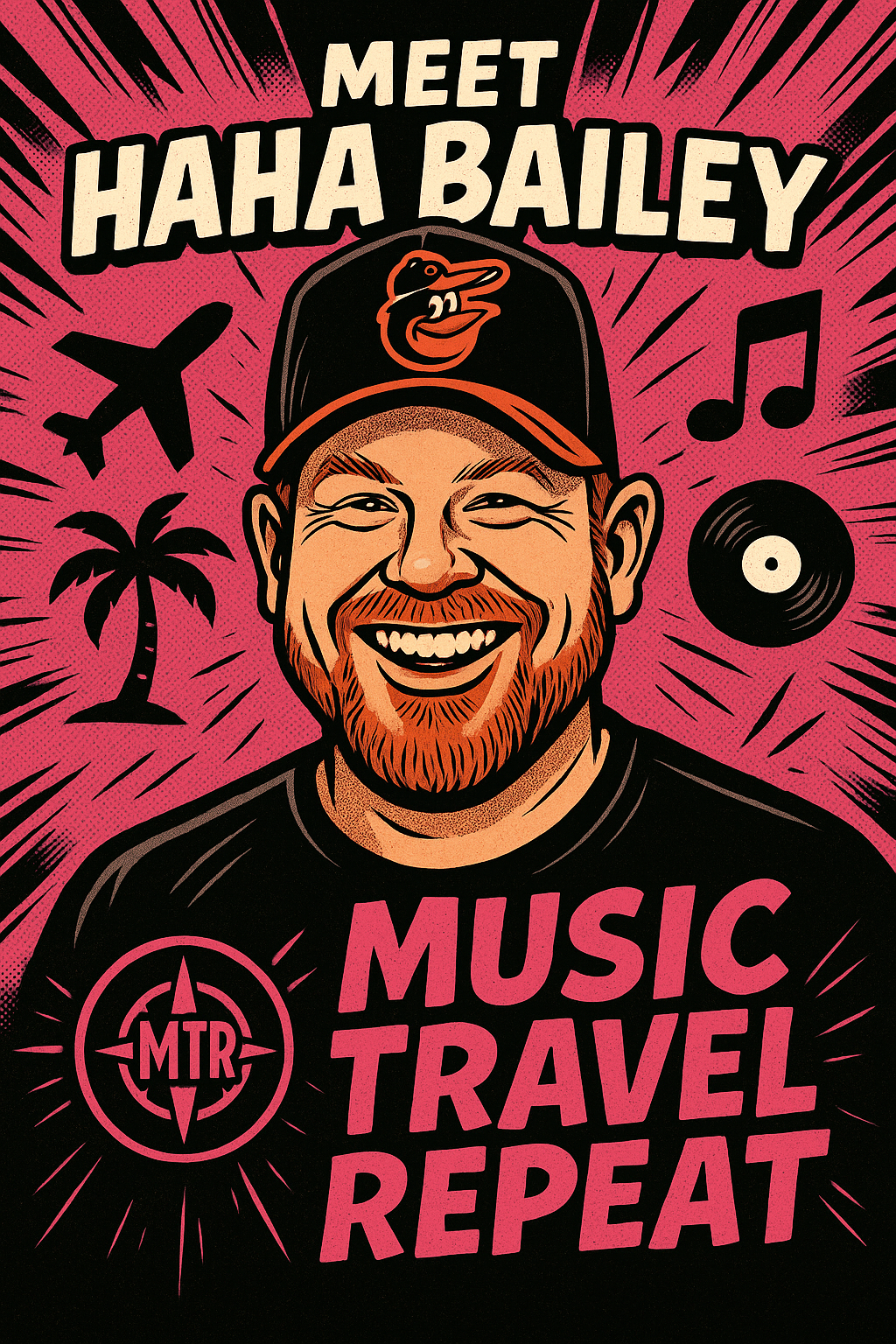
Haha Bailey writes like a man who’s seen too much and still believes in something better. Music Travel Repeat began as a lifeline — a place where heartbreak meets hope, and survival meets song. His essays carry the weight of lived experience and the light of someone who never stopped searching for grace. If you’ve ever been lost, you’ll find pieces of yourself here. Read The Restless, The Hopeful, and The Broken.