Music Travel Repeat → Unofficial Music Artist Biographies → Beartooth
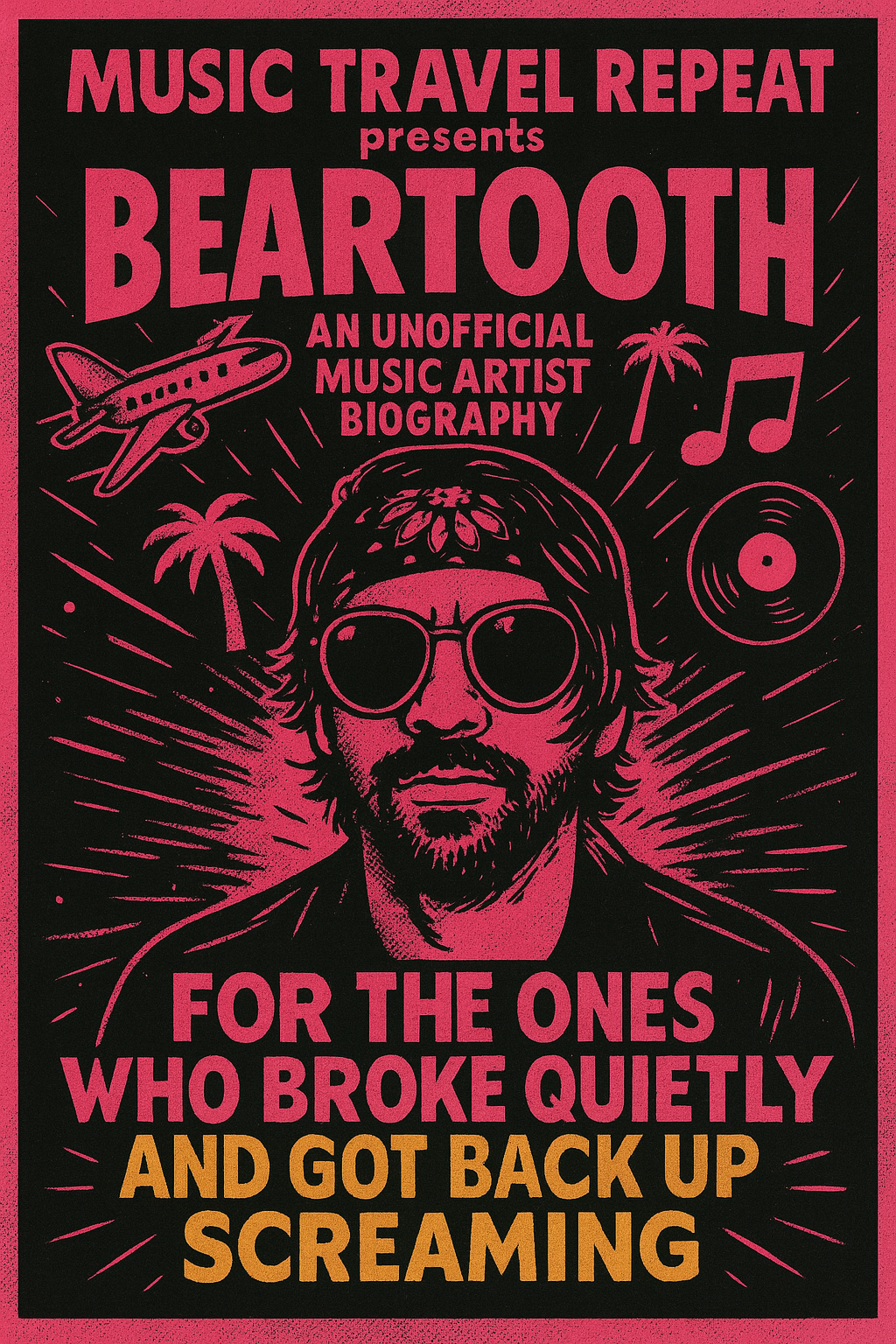
Beartooth: For The Ones Who Broke Quietly And Got Back Up Screaming
The first time I saw Beartooth, they weren’t the headliner—they weren’t even close. They were fourth in a six-act lineup at Rock The Rock Fest 2023 at the Prudential Center in Newark, New Jersey. The night kicked off with
Then came Beartooth—wedged between legends and radio darlings. After them
But from the moment Caleb Shomo stepped up to that mic, the rest of the lineup blurred. It didn’t matter who came before or who would follow. For those few chaotic, soul-shaking minutes, it was just now. And Caleb—screaming, growling, whispering—wasn’t performing. He was unraveling. Like he was spilling secrets not meant for daylight. And somehow, we were lucky enough to hear them.
I was there with GQ, my ride-or-die, my partner in pit etiquette and everything else life throws our way. And whether she realizes it or not, that show stitched itself into the fabric of who I am. Because when you watch someone survive on stage, it makes the fight to survive offstage feel a little more possible. Especially when you’re standing next to someone who makes the chaos feel like home—and looks damn good doing it.
This was also the first and only show that we were not in the pit. For all future shows ,we promised ourselves never to have our asses in seats when the pit is available. Promise kept so far! It just ain't the same dawg.
Fast-forward to Summer of Loud Festival 2025 in San Diego, California. Gallagher Square at Petco Park. Beartooth again—but this time the lineup was even louder. I Prevail, Killswitch Engage, Parkway Drive. The Amity Affliction. Alpha Wolf. The Devil Wears Prada. TX2. And GQ and I weren’t alone this time. Our bestie—The Filipino Bombshell—joined us. And together, we howled into the sun-drenched chaos like we’d found our people again.
That’s the thing about Beartooth. You don’t just listen. You unload.
Beartooth Beginnings: From Breakdown to Breakthrough
To understand Beartooth, you have to start with the man behind the scream. Caleb Shomo didn’t just front the band—he was the band. In the early days, he played every instrument, wrote every lyric, produced every track. Not because he wanted the credit. Because he needed the outlet.
Before Beartooth, there was Attack Attack!—a synth-driven metalcore band with auto-tune and breakdowns and a sound that never quite settled. Caleb was just a teenager when he joined. And like a lot of kids in the spotlight too early, the pressure didn’t turn him into a diamond. It nearly crushed him.
Mental illness. Depression. Self-hatred. All of it boiled under the surface until it exploded into something raw, ugly, and beautiful. That explosion became Beartooth.
Beartooth wasn’t about perfection. It was about pain. Not polished pain. Not poetic pain. Just… pain. Real. Unfiltered. Screamed until your throat bled and whispered until your voice gave out.
Every Beartooth album feels like reading someone’s journal when you’re not supposed to. But instead of feeling like an intruder, you feel invited. Because Caleb doesn’t push you away with his darkness. He pulls you closer.
Sick of Surviving: A Soundtrack for the Broken
Beartooth’s first album, Disgusting (2014), wasn’t just a debut. It was a purge. Cleansing. Tracks like “Beaten In Lips” and “In Between” weren’t radio singles—they were lifelines.
“In Between” especially—God, that one hits. It’s the kind of song you scream along to in the car when you’re not sure if you’re mad at yourself or the world or both. It doesn’t give you answers. It gives you company.
From Disgusting to Aggressive (2016), Disease (2018), Below (2021), and The Surface (2023), the through-line has always been the same: truth, no matter how hard it hurts. And growth, not the kind you can post about, but the kind that leaves stretch marks on your soul.
Each album is a checkpoint in Caleb’s personal war. And we, the listeners, are invited to fight alongside him.

The Anatomy of Beartooth: How Caleb Shomo Turned Pain Into Purpose
It starts quietly.
That’s the first lie we believe—that breakdowns are always loud. That they kick in the door and scream their way into your life. But more often than not, they whisper. They come dressed as apathy. As sleepless nights. As the inability to return a simple text. And Caleb Shomo knew that long before he ever screamed about it.
Long before Beartooth became a name shouted in sold-out arenas, it was just one man in a basement studio, trying to make sense of why he didn’t want to wake up in the morning.
He wasn’t chasing fame. He was chasing relief.
The anatomy of Caleb’s breakdown wasn’t linear. There were no easy diagnoses. It was shame tangled in ambition. Guilt tangled in genius. And a growing awareness that the higher he climbed, the further he fell from himself.
He’s been open about his panic attacks. About not being able to breathe in the middle of soundchecks. About writing entire albums in manic, sleep-deprived sprints because stillness scared him more than exhaustion ever could.
But the most remarkable thing?
He used it.
He carved melody out of his meltdowns. He built choruses out of his collapses. And for every moment where the world told him to mask his mess, he responded by turning the volume up.
You can hear it in “The Lines.” You can feel it in “Clever.” You can see it in the way his eyes scan the crowd mid-song, like he’s looking for someone else who gets it—and he always finds them. Because those people find him first.
That’s what makes Caleb’s breakdowns matter. They’re not cautionary tales. They’re survival manuals.
He doesn’t glorify the pain. He demystifies it. He gives it language. Shape. Rhythm. He gives you a soundtrack to scream into the void when you’re too tired to explain yourself.
More Than a Band: Beartooth Is A Permission Slip to Feel
Beartooth shows aren’t just concerts—they’re emotional triage units. Mosh pits are the pressure valves. Guitar riffs are the gauze. And Caleb’s voice? That’s the suturing needle, closing up wounds that never healed right the first time.
What sets them apart isn’t technical prowess (though they have it) or flawless production (though it’s there). It’s honesty. Brutal, guttural, inconvenient honesty. The kind that makes you flinch and then lean in.
I’ve seen a lot of bands. But few feel like confessions set to distortion the way Beartooth does. They don’t sing at you. They scream with you.
And in a world where so many of us are just trying to make it to tomorrow, that might be the most healing sound of all.
When Silence Feels Like a Threat: The Healing Noise of Beartooth.
Some music fills a room. Beartooth fills the silence you didn’t even realize was haunting you.
It’s not just noise—it’s a roar that somehow knows your name. It doesn’t ask permission. It doesn’t knock politely. It breaks the door down and drags your secrets into the light, only to wrap them in distortion and make them dance.
There’s a moment in every Beartooth song where you stop pretending. Where your shoulders fall, your fists un-clench, and you stop lying to yourself about how “fine” you are. That’s not coincidence. That’s design. Caleb has built a catalog of songs that specialize in truth extraction. You don’t always want to listen—but you always need to.
Maybe it’s because the voice behind the music has been there—on the floor, back against the wall, unsure if getting back up is worth it. And instead of offering empty promises or fake light, he offers something more sacred: understanding.
Beartooth doesn’t rescue you. They recognize you. And sometimes that’s more powerful.
There’s healing in that kind of noise. In the kind of feedback that feels like a hug. In breakdowns that sound like battle cries. In riffs that throb like a pulse you forgot you had.
It’s music for the emotionally concussed. For the quietly unraveling. For the ones who laugh too loudly at parties but cry in parking lots afterward.
Beartooth is the noise you turn to when silence feels like a threat.
And when it hits—when the guitars crunch just right, when the scream tears through the sky like a meteor—you don’t feel alone anymore.
You feel found.
Aggressive Empathy: When Beartooth Screams What You Can’t Say
Beartooth doesn’t tiptoe around your triggers. They stomp through them, unapologetically.
Every track Caleb writes is a line in the sand between repression and release. These songs don’t ask if it’s a good time to fall apart. They just do. Loudly. Viciously. With the kind of rawness that would make most mainstream acts wince.
Take “You Never Know.” It's not a song that’s trying to be subtle. It's a punch to the throat and a hand on your back at the same time. It’s aggressive empathy—shouted, not whispered.
Or “I Was Alive,” which doesn’t pat you on the back for surviving—it demands you remember what it took to get here. Caleb dedicates this song to his Grandfather.
This is music for the nights when journaling won’t cut it. When a quiet cry won’t do the job. When you need the kind of release that slams into your chest and steals your breath for a second—just long enough to remind you you’re still breathing.
There’s a reason these songs feel more like declarations than melodies. Caleb isn’t just singing about pain. He’s declaring war on it. And not the kind of war that ends in victory parades. The kind that ends in ashes—and the quiet decision to rebuild anyway.
These are the songs that don’t apologize for being loud. For being messy. For being human. They don’t beg for understanding—they command it. They take up space and dare you to make room for them in your narrative.
Because not every song is meant to soothe. Some are meant to scream alongside you until your silence finally breaks.
And when it does? You don’t say thank you.
You say: “Play it again.”
Not Just Breakdown Music—It’s Breakthrough Music.
Call it what you want—metalcore, post-hardcore, screamo—but whatever label you slap on Beartooth, know this: it’s not just breakdown music.
It’s the sound of a generation excavating themselves.
Sure, the guitars crunch. The bass drops hit. The drums explode like they’re trying to break out of your chest. But there’s a heartbeat under it all—steady, persistent, human.
Beartooth isn’t just built for the pit. It’s built for your drive home after. For the mirror you stare into when the mask slips. For the empty room where you finally allow yourself to ask, “Am I okay?”
There’s power in the breakdowns, yes. But there’s grace in the space between them. The refrains where the screaming stops just long enough for you to catch your breath—and sometimes, hear your own thoughts for the first time in days.
Songs like “Skin” and “The Past Is Dead” don’t just make you head bang. They make you confront. They tap into that part of your soul you try to keep under lock and key. And then they hand you the key and dare you to open the door.
This is music that lives in the tension. In the both/and. It’s both destruction and rebuilding. Both rage and remorse. Both fists and open palms.
Beartooth may be loud, but they’re not careless. Every lyric has a purpose. Every chord is deliberate. It’s a sonic invitation to be honest with yourself in ways most of us never are.
So no, it’s not just breakdown music.
It’s breakthrough music.
Still Here: For the Ones Who Stayed When It Hurt to Stay.
This one’s for the ones who didn’t leave. For the ones who held on—by a thread, by a prayer, by the skin of their teeth. For the ones who showed up to the show with red eyes and shaking hands but screamed anyway.
Beartooth is for you.
Because staying is the hardest thing. Staying when it would be easier to numb. To disappear. To ghost your own life and pretend it didn’t hurt as much as it does.
But you didn’t.
You stayed. You kept breathing. You kept answering your name even when you didn’t recognize the sound of it anymore.
And Caleb Shomo sees you.
He writes for the moments when survival feels less like triumph and more like punishment. For the late-night drives where you just need to scream something louder than your thoughts. For the mornings when brushing your teeth feels like a miracle.
Beartooth's music is a heartbeat. It’s the inhale you take right before you admit you’re not okay. It’s the sound of someone else doing it first, so you don’t feel alone.
There’s an invisible choir at every Beartooth concert—souls singing not in harmony, but in shared heaviness. Some are healing. Some are barely hanging on. All are honest.
And when the lights go down and the feedback swells and Caleb walks on stage like a man who’s survived fire just to carry yours for a while—you remember.
You’re still here.
And that means something.
It means everything.
You Are Not Alone in the Noise: A Lifeline from One Listener to Another.
Dear You,
This isn’t just another unofficial music artist biography. It’s a thank-you note. A lifeline. A mirror.
Because if you’re reading this, it means you’ve felt it too—that ache that sits under your ribs like a tenant who won’t leave. That desperate hope that somewhere, someone understands what you’re trying so hard not to say.
You found your way to Beartooth for a reason.
Maybe it was a lyric. Maybe it was a scream. Maybe it was the way Caleb’s voice cracked just as yours did. Whatever it was—it reached you. And that matters.
Beartooth is more than a band. It’s a place. A place where your hurt doesn’t make you weak. Where your sadness isn’t something to be fixed, but something to be felt. Where healing isn’t a finish line—it’s a fight song.
You’re allowed to be messy here. You’re allowed to be loud. You’re allowed to not know what you’re doing or why you’re crying in the car again or why some nights feel like sirens and some mornings like static.
You’re not broken.
You’re becoming.
And this music—these songs—they aren’t cures. They’re companions. Soundtracks for sorting through the wreckage, for screaming into your pillow, for choosing to stay one more day.
So from one listener to another:
Thank you for being here.
Thank you for still listening.
You are not alone in the noise.
With everything,
Catch you in the chaos,
Haha Bailey
Explore More Unofficial Music Artist Biographies