Music Travel Repeat → Unofficial Music Artist Biographies → Nonpoint
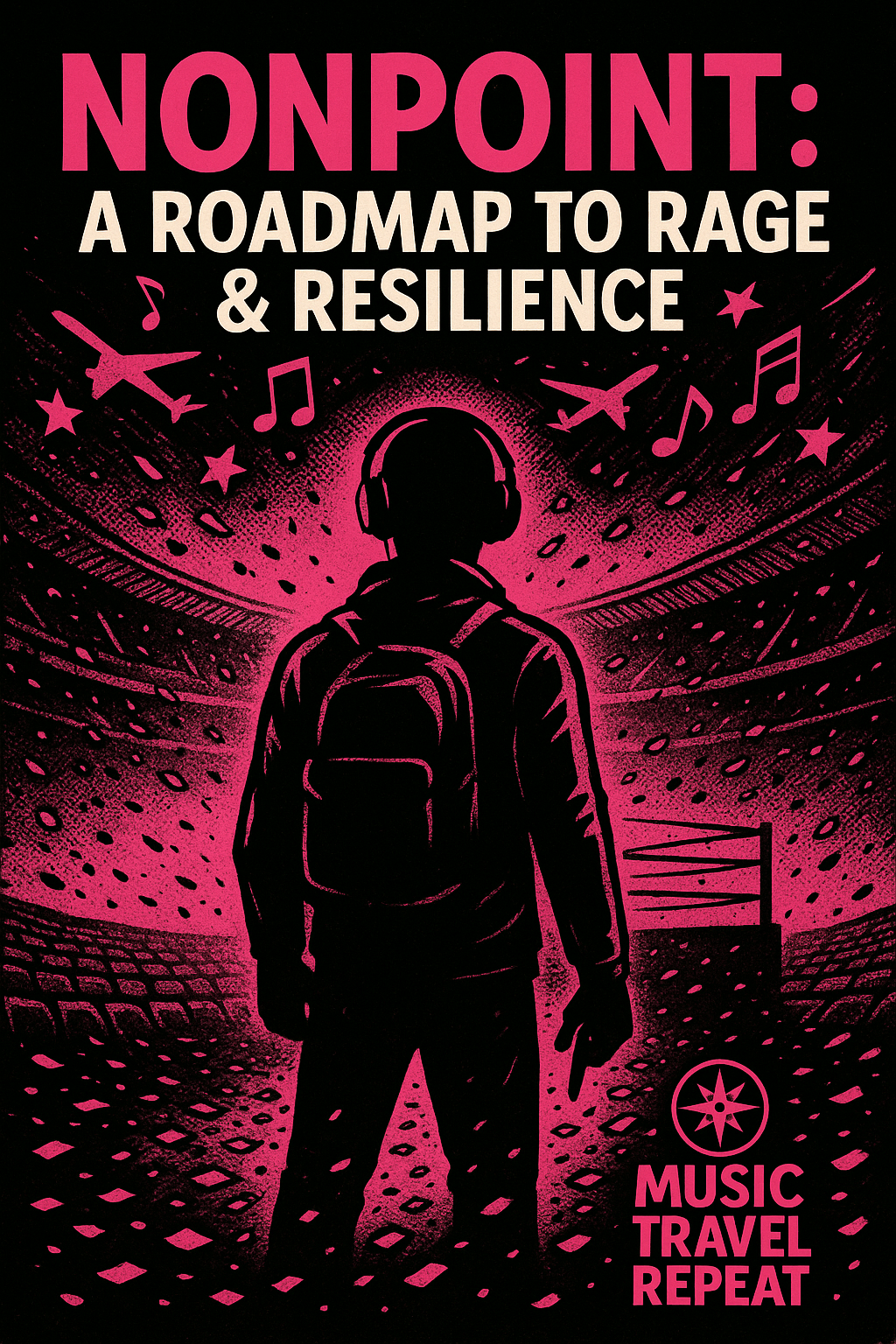
Nonpoint: A Roadmap To Rage & Resilience
You ever have one of those nights where everything’s quiet, but nothing feels calm?
The kind of night where your mind won’t shut off, your chest feels heavier than it should, and the air seems to vibrate with things left unsaid. That’s when music stops being entertainment and starts being survival. That’s when Nonpoint found me.
I wasn’t looking for them. That’s the thing about the bands that save you—they don’t arrive with fanfare. They sneak in through the static. One riff. One scream. One lyric that doesn’t feel like poetry, but prophecy. And suddenly you realize: this noise knows me.
It was somewhere between 2 AM parking lot shifts and long drives to nowhere. I was living in transition—physically, emotionally, spiritually. Nights blurred into mornings. My car smelled like old coffee and worn-out ambition. And the only thing that made the silence bearable was the chaos coming through my speakers.
Nonpoint didn’t just play music. They lit a fuse.
There was something sacred about the anger in those songs. It wasn’t reckless—it was focused. It wasn’t just screaming—it was confession. And it gave me something I didn’t know I was allowed to feel rage without apology. Pain without shame. Hope, but louder than a whisper.
Because that’s what Nonpoint has always done best. They make survival sound like a battle cry.
There’s a ferocity in Elias Soriano’s voice that doesn’t just hit—it hollows. A rawness in Robb Rivera’s drums that feels like a heartbeat you didn’t know was yours. They don’t ask for your attention—they demand it. And somewhere in all that thunder, I started to recognize pieces of myself.
Not the polished parts I tried to show the world. The wreckage. The rust. The soft spots I’d armored over after too many disappointments. Nonpoint didn’t heal me, not exactly—but they gave me permission to feel it all. To be mad. To be broken. To be loud about it.
And the coquí. God, that little frog—half mascot, half mirror.
That symbol on their albums wasn’t just an artistic choice. It was a quiet declaration: small doesn’t mean weak. Overlooked doesn’t mean voiceless. That little frog—native to Puerto Rico, loud beyond its size—felt like me. Felt like anyone who's ever had to scream just to be heard.
I started carrying their songs with me like armor. “Bullet with a Name” when I needed to feel dangerous again. “Alive and Kicking” when I barely was. “Circles” when my whole life felt like déjà vu in a loop. Their music didn’t offer answers—but it stood beside me while I asked the questions.
And in the haze of nights I’d rather forget—bunked in a van, sleeping in club stairwells, counting down to the next shift—I remember blasting “Chaos and Earthquakes” so loud the windows rattled. Not because I wanted to be noticed. But because I didn’t want to disappear.
Nonpoint understood that.
They still do.
So no, this isn’t just another blog post about a metal act from Florida.
This is about what it means to be broken and loud about it. About the power of screaming not because you’re angry, but because you’re still fighting. About the way music sometimes becomes the only map when everything else stops making sense.
This is about the loud hope of Nonpoint.
And how, in the middle of the noise, I found my way back to myself.
Where Is Nonpoint From?
Nonpoint formed in Fort Lauderdale, Florida, during the mid-1990s when the South Florida rock scene was quietly producing some of the heaviest and most emotionally honest bands in the country.
The band began when drummer Robb Rivera started building what would eventually become Nonpoint, originally performing under the name Nonpoint Factor before the group simplified the name and began developing the sound fans know today.
Florida’s underground metal and alternative scenes played a huge role in shaping the band’s early identity. The humid club circuits, DIY shows, and relentless touring culture created the kind of environment where a band either got tougher or disappeared.
Nonpoint chose toughness.
Who Are The Members of Nonpoint?
Over the years Nonpoint has had several lineup changes, but two figures have remained the driving force behind the band.
Elias Soriano — Lead Vocals
Elias is the unmistakable voice of Nonpoint. His ability to move between melody, aggression, and spoken intensity helped define the band’s signature sound.
Robb Rivera — Drums / Founder
Robb Rivera is the rhythmic backbone of Nonpoint and the band’s founding member. His groove-driven drumming style gives Nonpoint its unique balance of heaviness and rhythm.
Throughout their career, the band has also featured several talented guitarists and bassists who helped shape the evolving Nonpoint sound while maintaining its core intensity.
The story doesn’t begin on a massive festival stage or with a million-stream debut. Like most things that end up mattering, it started in the margins—in the humidity of Fort Lauderdale, Florida, sometime in the mid-’90s. Back when the scene was more hopeful than structured. When music was louder than strategy. Before “likes” or metrics, before algorithms, before the noise got diluted.
And that’s where Nonpoint was born.
But before they were a name printed on tour shirts, they were just noise in a room. Just a drummer with a dream and a front man with fire in his throat.
Robb Rivera — The First Pulse
Robb Rivera wasn’t chasing a trend. He wasn’t building a brand. He was surviving—and rhythm was the way he did it. His early band was called Nonpoint Factor, a name that bounced around from show flyers to demo CDs, gaining little steam but a lot of grit. Robb kept that fire going, even as lineups rotated like turnstiles. One by one, players came and went—but Robb stayed behind the kit, relentless, like a heartbeat you couldn’t shut off.
It’s hard to explain to people what it means to drum your way through pain. But Robb didn’t just play his instrument—he bled into it. And when things kept falling apart around him, he doubled down.
What he needed wasn’t just a band. He needed a voice. And that’s where Elias Soriano comes in.
Elias Soriano — A Voice That Broke Through the Static
Most front men try to be loud. Elias didn’t have to try.
He had a kind of voice you don’t forget—gritty but grounded, the sound of someone who’d lived the lyrics long before writing them. R&B smoothness in one breath, a full-on metal growl in the next. He didn’t just front the music—he became it.
And maybe that’s why when Elias joined up with Robb, something clicked that hadn’t before. The chemistry wasn’t manufactured—it was magnetic. Real recognizes real. And in the dive bars and strip mall venues of Florida, that meant something.
Together, they trimmed the fat—cut “Factor” from the name—and Nonpoint was born.
The name itself came from a song by Believer, a progressive metal band, but Elias would later admit it didn’t mean much to them at first. “It has something to do with pollution,” he once said, “but to us, it just sounded cool.” And sometimes that’s enough. Sometimes meaning comes after the naming.
Looking back, it’s kind of poetic. Because that’s what Nonpoint would become to so many people—a name we didn’t fully understand at first, but later couldn’t live without.
What Does The Nonpoint Frog Logo Mean?
Somewhere along the way, Nonpoint adopted the coquí—a tiny, unassuming tree frog native to Puerto Rico—as their visual symbol. It appeared in liner notes, crept onto album covers, and showed up in voice samples tucked inside Development.
Most people probably didn’t get it.
But I did.
The coquí is small. Unremarkable to look at. Easy to overlook. But at night? That frog sings. Louder than it has any right to. It fills entire forests with a voice that shouldn’t be possible. It’s a sound that says, “I may be small, but you will hear me.”
Sound familiar?
That frog became a kind of unofficial spiritual mascot for the band—and for those of us who felt unseen. The weird kids. The overlooked ones. The ones who yelled into the void and hoped someone—anyone—was listening.
The coquí made sense. And it still does.
Separate Yourself and Struggle: The DIY Years
Before their major-label break, Nonpoint did what every real band does first—they went indie. Not because it was trendy, but because it was the only way. No big budgets. No distribution deals. Just sweat, savings, and the unwavering belief that what they were doing mattered.
Their 1997 debut, Separate Yourself, was raw and untamed. It didn’t sound like a band trying to “make it.” It sounded like a band trying to stay alive. The production was rough. The lyrics were jagged. But it moved. And when you’re hurting or hungry or hanging on by a thread, polish isn’t what you’re looking for. You want truth. Even if it cuts.
Then came 1999’s Struggle, released on Jugular Records. The name says it all. The album wasn’t a victory lap—it was a warning shot. A declaration. The beginning of something loud that refused to be ignored.
That’s the thing about albums like that. They don’t go viral. They go underground. Passed from hand to hand. Burned onto mix CDs. Blasted from dorm windows and secondhand car stereos. They become lore before they become legacy.
From Florida Bars to the Billboard Charts
By the time Statement dropped in 2000, the groundwork had already been laid. They’d sharpened their sound. Tightened the screws. And when MCA Records stepped in, Nonpoint didn’t change who they were—they just got louder.
And that’s where most people first heard them. That was the entry point. But for some of us, the true beginning wasn’t a polished record store release.
It was a frog on an album cover. A burned copy of Struggle passed around like a secret handshake. A feeling that this noise—theirs, ours—wasn’t just background sound.
It was the origin of something loud.
Something necessary.
Something that was about to shake the silence.
Statement: When the Fire Got National
You don’t forget your first real taste of national exposure.
For some bands, it’s a moment. A viral song. A TV feature. A co-sign from someone higher up the chain. For Nonpoint, it was a record called Statement—and it lived up to its name.
This wasn’t just an album. It was a warning flare. A battle cry. A musical line in the sand from a group of Florida outsiders who refused to be ignored any longer.
Released on October 10, 2000, via MCA Records, Statement was Nonpoint’s major label debut, but it didn’t sound like a band trying to fit in. It sounded like a band throwing punches.
Every track bled conviction.
Every riff dared you to turn away.
And every lyric from Elias Soriano felt like it had been carved into skin before it made it onto paper.
Hitting the Scene Like a Cannonball
At a time when nu-metal was crowding the airwaves with its angst-laced hooks and baggy-panted fury, Nonpoint showed up with something different. Cleaner. Sharper. More controlled. It wasn’t performative anger. It was personal.
You could hear it in “What a Day,” the lead single that quickly became their calling card. It wasn’t trying to be clever. It was honest frustration. Disillusionment set to groove-heavy distortion. And while others in the scene were layering on gimmicks, Nonpoint just told the truth—with a rhythm section you could feel in your ribcage.
The song peaked at No. 24 on the Billboard Mainstream Rock charts, but its true impact wasn’t in the numbers. It was in the way it stuck. Fans didn’t just like the song—they carried it.
There’s something permanent about tracks that hit at the right time in your life. “What a Day” was the soundtrack for burnout. For the guy mopping floors after midnight. For the kid driving home from school with no answers and too many questions. For anyone who ever screamed into the mirror after swallowing down too much silence.
The Tour That Turned Everything Up
A record can be powerful. But a tour? That’s where the legend gets written.
To promote Statement, Nonpoint didn’t just hit the road—they owned it. They played with Mudvayne, Fuel, Taproot, Drowning Pool, and Hed PE—a roster of misfits, fire-starters, and angst architects. And then came the real prize:
Ozzfest 2001.
That tour wasn’t just a rite of passage—it was a coliseum. And Nonpoint didn’t flinch. They went out on the U.S. leg with the kind of energy most bands save for album finales. They weren’t background noise between bigger names. They were a threat to the hierarchy.
If you’ve ever worked backstage, you know the difference between a band with a fan base and a band that builds one every night. Nonpoint did the latter. You could feel it. Fans who had never heard of them showed up the next night wearing the shirt. Buying the CD. Screaming the lyrics by week three.
This wasn’t luck. This was earned.
Charting on Grit
A year after release, Statement finally entered the Billboard 200, peaking at No. 166—not a number that’ll earn you a Grammy, but a foothold. A declaration that this band had planted something. That this wasn’t going to be a one-album cycle and done. They were in it for the long haul.
And if the album wasn’t universally understood by critics, that was fine. Because fans got it. And that’s who Nonpoint was always playing for. Not reviewers. Not execs. Not playlists or trends.
For the ones carrying too much and looking for a place to scream it out.
Statement in the Music Travel Repeat Universe
Looking back now, Statement doesn’t sound like a debut.
It sounds like a survival guide.
The grooves hit like adrenaline shots. The lyrics read like journal entries. There’s no pretense. No overproduction. Just four guys from Florida kicking the door off its hinges and saying, “We’re here. Try to stop us.”
I still remember the first time I heard “Victim.”
I was in my first year at an alternative high school—the kind of place they send you when you win too many fights in regular ones. I wasn’t starting them. I was finishing them. One punch, clean and fast, and it’d be over. Most times they didn’t even know where to find me afterward because I’d just go back to class like nothing happened.
That day was no different. Another hallway scuffle, another trip to the principal’s office that never happened because I disappeared before anyone could blink. I ended up in the back corner of the library, headphones in, scrolling through burned CDs and secondhand MP3 files on a beat-up iPod.
And then—Statement.
And then—“Victim.”
That opening riff hit like a warning shot.
Not to anyone else… to me.
Suddenly, everything I had been shoving down—rage, pride, exhaustion, that heavy feeling that no one actually saw me unless I was swinging—rose to the surface like a bruise.
Nonpoint didn’t ask me to calm down.
They didn’t tell me to be better.
They gave me permission to be pissed—to have fire in my chest and still feel something real underneath.
That song didn’t just soundtrack a moment.
It named a part of me I didn’t know needed naming.
And from that point on, I wasn’t just surviving school.
I was surviving me.It hit harder.
That’s the thing about real records. They grow with you. And Statement was one of those rare albums that didn’t just survive the scene—it outlived it.
A Statement That Meant More Than the Title
In hindsight, Statement wasn’t flashy. It wasn’t market-perfect. It didn’t dominate charts. But it dug in.
It showed us what Nonpoint really was: a band that didn’t need validation to know they were vital. A band that understood volume is only power when it comes from truth. A band that—long before the algorithms and the image crafting—was brave enough to be themselves.
And that? That still matters.
Because sometimes you don’t need another hit.
You just need someone to tell you it’s okay to be pissed off, tired, alive, and still fighting.
Statement was that voice for me.
It still is.
Development, Recoil, and the Circles We All Run In
Some albums feel like declarations. Others feel like confessions.
And then there are the ones that feel like mirrors—ugly, unflinching, honest.
That’s what Development and Recoil were for me.
Two albums released just years apart, but spiritually tied together by the push-pull tension of a band trying to grow without losing its bite.
Development (2002): When You’re Asked to Soften
If Statement was the spark, Development was the hesitation that followed.
Released in 2002, Nonpoint’s sophomore major-label album arrived at a time when the industry wanted edge—but only if it came in a box. Labels were trying to bottle rebellion, sell angst in digestible doses. And in the middle of that machine, Nonpoint—raw, untamed, unapologetic—was asked to clean it up a little.
And you can hear it.
There’s a melodic thread woven through Development that wasn’t present on Statement. The vocals are smoother. The production’s tighter. The fury still simmers, but it’s measured now, like a boxer fighting with one hand tied behind their back.
It’s not a bad record—not even close. In fact, for many fans, this is where they first fell in love. “Your Signs” and “Circles” became unexpected anthems, charting modestly and landing on gaming soundtracks like NASCAR Thunder 2003 and Hot Wheels AcceleRacers.
But if you listen closely, you can almost hear the tension. The friction between what the band wanted to say and what the industry wanted to sell.
And honestly? That made me love it more.
Because haven’t we all been there?
Trying to show up authentically in a world that keeps asking us to dilute ourselves?
I Remember “Circles” Like a Memory, Not a Song
It was one of those cheap hotel nights.
You know the kind—lights that hum just a little too loud, carpet that smells like broken promises, and a vending machine full of snacks that probably expired sometime during the Bush administration. The first one.
I’d just finished running security for a show in Baltimore, Maryland. Big K.R.I.T with Slim Thug to be exact. I was the last one in the venue, doing what I always do: making sure everything got out cleaner than it came in. As a professional, I never ask for autographs. Never treat artists like they owe me something just because I was backstage.
But that night?
I caved.
I was a fan.
Big K.R.I.T. was just starting to pop, and I was rooting for him. Believed in what he was doing. Thought maybe we came from the same kind of invisible. So when he walked out with his manager, I stepped up and asked—quietly, respectfully—if he’d sign my CD.
He looked me up and down, rolled his eyes, threw his hoodie up, and turned his back like I didn’t exist. Like I wasn't the body in between him & the fans all night. Didn’t say a word.
Three people alone outside a closed venue with no one else in sight.
Five minutes later, I was on I-83, windows down, and that CD flew out of my hand like it had insulted my mother. I never listened to him again.
They say don’t meet your heroes. That night made it true.
So there I was—wet shoes, empty vending machine, pride still sore—alone in my rental, asking myself why I even do this.
And then “Circles” came on.
Out of nowhere.
Buried in an old playlist I hadn’t touched in years.
Those first few notes didn’t just hit—they healed.
In seconds, I was back in the house I grew up in. In my bedroom. Baseball cards sprawled over the floor, the smell of burnt Pop-Tarts and angst hanging thick in the air. I was 17 again, laying on the floor, staring up at the ceiling, wondering if this life would ever feel like mine.
That’s what Development did.
It didn’t shove truth down your throat or demand you feel something big. It just sat next to you. Quiet. Familiar. Honest.
And in that moment—after all the noise, the letdown, the silence—
That song didn’t just save the night.
It reminded me why I still show up.
Because even when the headliners disappoint you,
the right song never will.
Recoil (2004): The Snapback to Self
If Development was the band pulling its punches, then Recoil was them spitting blood and saying, “Try me again.”
Released in 2004 under a new label—Lava Records—Recoil was a return to the fire. You could tell from the first note of “The Truth.” No more smoothing the edges. No more waiting for permission.
This was Nonpoint, unapologetically reactivated.
The grooves were nastier. The riffs were meaner. Elias’s vocals carried a kind of earned exhaustion, like someone who’d tried playing nice and found it didn’t work. “Rabia”—the Spanish-language track on the album—was raw and righteous. A declaration in another tongue, but understood by anyone who’d ever had to shout to be heard.
“Wait” felt like an emotional uppercut. “Done It Anyway” carried that self-awareness you don’t get until you’ve already made the mistake. And through it all, Robb Rivera’s drums hit like thunder on dry ground—sharp, cathartic, loud enough to wake up the parts of you you’d buried.
These Weren’t Just Albums—They Were Stages of Growth
What I love about Development and Recoil is that they exist in conversation with each other.
They’re like the two versions of you that live between compromise and clarity.
The one who tries to fit in—Development.
The one who says screw it and kicks the door back down—Recoil.
Most of us live our lives in that loop. We circle through self-doubt, then break out again. Get wounded. Heal. Soften. Harden. Soften again.
That’s why this era of Nonpoint hit me so hard. It didn’t just sound like life—it followed its rhythm.
The Lyrics That Still Echo
“Why do I try to make it right? When everything I do just seems to fall apart?”
That’s from “The Truth.”
It’s not profound. It’s not poetic in the traditional sense.
But it’s honest. And that’s always been enough for me.
We’ve all been there—trying to fix something with tools we don’t have, trying to love people who don’t know how to be held, trying to be seen in places that were never meant for our kind of light.
The Circles We All Run In
You ever feel like you’ve already lived the same day a thousand times?
Different city. Same bed. Different venue. Same ache.
That’s what this era of Nonpoint understood. They didn’t just name the song “Circles”—they wrote from inside it. Inside the pattern. Inside the repetition. Inside the pain that comes from not being able to break out yet, but refusing to stop trying.
And somewhere in all that—somewhere in the swirl of tours, lost friendships, shifting lineups, and tired motel rooms—Nonpoint gave me something I didn’t expect:
Company.
They didn’t have the answers. They still don’t. But they never claimed to.
What they offered was a seat beside them in the mess. A chorus to shout. A riff to ride. A reminder that maybe we’re not so alone in these circles after all.
To the Pain and the WWE Years: Sound tracking Grit
There’s something almost poetic about a band’s fourth or fifth album. It’s no longer the fever dream of a debut or the experimental stretch of a sophomore. It’s where most artists start to lose the thread—or double down and stitch it deeper.
In 2005, Nonpoint didn’t just double down.
They lit the damn thing on fire.
To the Pain wasn’t just another album—it was a declaration of survival. A clenched fist to the face of everything trying to quiet them down. After label changes and internal battles, the pressure to stay relevant in a shrinking rock landscape was real.
But Nonpoint? They didn’t just stay relevant. They became essential.
A Record That Felt Like a Fight
To the Pain was released on November 8, 2005 through Bieler Bros. Records, the independent label founded by Jason Bieler—someone who had already worked with the band through previous records. The shift away from a major label wasn’t a retreat. It was a calculated rebellion.
And it gave us songs like “Bullet with a Name.”
Let’s talk about that track for a second.
Because for many of us—especially those working backstage, living between tour stops, trying to pay rent with tips and hope—“Bullet with a Name” wasn’t just a song. It was therapy. It was that moment when everything in your life is stacked against you and someone finally says, “I see it. I hear it. I feel it too.”
Elias didn’t just scream those words.
He spit them like gospel.
The groove locked in behind Robb’s relentless drumming. The bass lines hit like body blows. And the guitars? They felt like purpose on fire.
The track hit No. 22 on the Mainstream Rock charts. But again, this wasn’t about numbers. This was about a band reclaiming the power that the industry tried to polish out of them.
Soundtracking Violence, Grit, and Getting Back Up
And maybe it’s no surprise that To the Pain became a soundtrack for blood, sweat, and chaos.
Nonpoint’s music found a home in places that celebrated conflict—not because they were aggressive for the sake of it, but because they understood the fight beneath the surface.
WWE SmackDown vs. Raw 2007 featured “Bullet with a Name” and “Alive and Kicking”
The Condemned (2007) used “Bullet with a Name” to score its violence with emotional weight
Miami Vice borrowed Nonpoint’s cover of “In the Air Tonight” for its 2006 reboot—a haunting, growling rendition of Phil Collins’ classic that turned eerie nostalgia into a slow-building war cry
These placements didn’t just boost exposure—they were cosmic alignments.
Because if you’ve ever been pinned down by life, if you’ve ever fought your way out, if you’ve ever had to wear your pain like armor—then Nonpoint felt like your inner monologue with the volume turned up.
To the Pain, by the Numbers—But Also by the Nerve
The album debuted at No. 147 on the Billboard 200, selling roughly 9,000 copies in its first week.
Those numbers might not shock today’s streaming-obsessed industry, but in 2005—on an indie label, with minimal mainstream press—it was proof that the band’s fan base wasn’t just loyal... it was growing.
“Alive and Kicking” followed as a second single, peaking at No. 25, and for fans still nursing bruises from life’s uppercuts, it felt like a rallying cry.
I used to blast that song during midnight workouts in a warehouse gym on the outskirts of Owings Mills, Maryland.Cold concrete. Flickering lights. That old punching bag in the corner.That chorus?
“You’re never gonna hold me down...”
That wasn’t just defiance.
It was truth I needed to believe.
Beyond the Ropes — The WWE Connection
It’s impossible to talk about this era without acknowledging how pro wrestling and Nonpoint collided in the best way possible.
WWE didn’t just use Nonpoint’s music—they amplified it.
Because in the ring—where pain becomes performance, and grit becomes narrative—Nonpoint fit like a glove.
They didn’t write for winners.
They wrote for the ones who kept getting knocked down... and still showed up.
“Bullet with a Name” became the unofficial anthem for anyone out there fighting battles no one could see.
And as someone who spent his life working behind the curtain, watching the wrestling world from the loading docks and production shadows, I can tell you this:
It didn’t matter if it was the main event or the opening act—when Nonpoint came through the speakers, the whole energy shifted.
It was like a flare to the soul.
This Wasn’t Just a Comeback. It Was a Warning.
To the Pain wasn’t Nonpoint trying to reclaim old ground.
It was them claiming new territory—proving that you didn’t have to play the game to win it.
You just had to be willing to hurt for it.
They toured hard—three months with Sevendust, followed by slots on Disturbed’s Music as a Weapon Tour alongside Flyleaf and Stone Sour. They hit every corner of the country, armed with nothing but adrenaline and intention.
And every night, they turned the stage into a confessional booth on fire.
They weren’t looking for chart positions.
They were looking for souls still clinging to the edge, hoping for one more scream of hope.
Why To the Pain Still Hits Like It’s Brand New
Almost two decades later, I still find myself coming back to this album when life feels overwhelming.
There’s something holy in the way Nonpoint balanced rage with resilience.
They never promised a solution.
What they offered was companionship in the chaos.
I’ve cried to this album.
I’ve healed to it.
I’ve written backstage while it played quietly from my phone, waiting for a main event I wasn’t prepared for.
I’ve driven all night through West Texas with nothing but To the Pain and highway static for company.
And every time I hear that opening riff from “Bullet with a Name,” I remember:
I survived.
So did they.
So will you.
What Does “Bullet With A Name” Mean?
“Bullet With A Name” is one of Nonpoint’s most recognizable songs, and for many fans it represents the emotional center of the band’s message.
The track captures the feeling of carrying anger, pressure, and frustration for years — until it finally has somewhere to go.
Instead of glorifying rage, the song channels it.
It’s about taking everything that life throws at you and refusing to let it define you. The aggression in the music becomes a release rather than destruction, which is why the song continues to resonate with fans nearly two decades after its release.
Live and Kicking + Vengeance: A Band That Refused to Fade
There’s a moment in every band’s career where they either dig in deeper or disappear entirely.
Some bands burn out quietly, their names fading from flyers and festival posters until they’re a footnote in someone else’s story. Others double down, eyes bloodshot and fists still swinging, determined to prove that staying power isn’t about popularity—it’s about purpose.
In the late 2000s, Nonpoint chose the latter.
They didn’t vanish. They didn’t bend.
They turned up the volume.
And for people like me—people who don’t just listen to music but lean on it like scaffolding—those years mattered more than the ones with radio hits.
Live and Kicking — Proof of Life
In a world where anyone can look good in a studio, Live and Kicking was Nonpoint’s way of saying:
“We’re better live. Come find out.”
Released on November 7, 2006, the CD/DVD set was recorded at their April show in Fort Lauderdale—a hometown gig full of sweat, fire, and gratitude.
The band could’ve picked a bigger venue. They could’ve polished the sound to perfection. But instead, they chose real. Raw. Close quarters. Because that’s what Nonpoint has always been—a band that thrives in tight, emotional spaces, where you can see the spit fly and feel the bass in your sternum.
And yeah, it sold just under 3,500 copies that first week, but this wasn’t about sales.
It was about staking their claim in a scene that was shifting away from the kind of honesty they offered.
When other bands were chasing trends, Nonpoint planted a flag in the dirt and said:
“This is who we are. Take it or leave it.”
And we took it.
Some of us needed it.
I watched the DVD backstage in a green room in Baltimore one night, worn down after a double-shift. I didn’t even care about the menu screen—I just pressed play and watched. The camera angles weren’t flashy. The cuts weren’t dramatic. But the energy?
Electric.
I remember seeing the way Elias gripped the mic like it owed him answers.
The way Robb’s hair flew with every cymbal crash.
The way the crowd didn’t just sing along—they screamed like they knew these songs had saved someone.
That wasn’t a performance.
That was testimony.
Vengeance — The Quiet Anger of Refusal
In 2007, Nonpoint dropped Vengeance, their fifth major album. It wasn’t adorned with hype or bloated with industry buzz. There were no magazine covers or label-funded media blitzes.
Just the music.
And the message inside it.
Released through Bieler Bros. Records on November 6, 2007, Vengeance sold around 8,400 copies its first week and peaked at No. 129 on the Billboard 200.
And yet… it hit me harder than most albums that topped the charts that year.
Maybe it was because Vengeance didn’t feel like it was written for critics.
It felt like it was written for fighters.
“March of War” — Not Just a Song, But a Warning
The album’s lead single, “March of War,” wasn’t your typical radio bait.
It didn’t ask for permission.
It announced itself, boot prints first.
Released quietly on their Myspace page—remember those days?—the track landed like a boot to the chest. Not flashy. Not overproduced. Just pure, controlled fury.
And that’s what made it stick.
This wasn’t war as spectacle.
This was war as metaphor.
For identity. For art. For every inch they’d fought to keep.
For every night spent playing a half-full club in some forgotten town where the Wi-Fi didn’t work and the promoter forgot to print the flyers.
This was a song that said:
“We’re still here. You can’t erase us.”
A Band Built for the Underground, Not the Algorithm
The late 2000s weren’t exactly kind to hard rock.
The industry was pivoting. Streaming was beginning to change everything. Labels were tightening belts. Nu-metal was a dirty word in most critical circles. The scene was thinning out, bands vanishing one by one.
But Nonpoint didn’t chase trends.
They toured harder.
They got louder.
They leaned on the fans who’d been there since Separate Yourself and Struggle.
And maybe that’s why Vengeance hit differently for those of us still tuned in.
It wasn’t a crossover attempt.
It was a call to arms for the ones who never fit into any box in the first place.
Not Just a Track list, But a Survival Playlist
Let’s talk about a few more cuts from Vengeance—because this album deserves more flowers than it’s gotten:
“Wake Up World” — A punchy reminder that numbness is the enemy.
“Bring Me Down” — That chorus? Still gets stuck in my teeth like glass.
“Everybody Down” (Remix) — Featured in WWE SmackDown vs. Raw 2008, it brought Nonpoint back into a space they were built for: adrenaline, theatrics, and high-stakes catharsis.
This wasn’t background music.
It was wall music—the kind you lean against when everything else is crumbling.
The Tours That Never Stopped
To support Vengeance, Nonpoint hit the road—again.
The Great American Rampage Tour
What Does Not Kill You Tour with 12 Stones and Anew Revolution
Another round with Mudvayne and In This Moment
These weren’t tours for the faint of heart. These were grind-it-out, city-after-city, shoulder-the-gear-yourself kind of tours. The ones where you don’t get catering, just cold pizza. Where the green room is a mop closet and the stage is half-lit—but the fans? The fans show up anyway.
And Nonpoint never phoned it in.
They played like it was Madison Square Garden, even if it was Madison, Wisconsin.
Why This Era Still Matters
Because they could have quit.
They could have stepped back.
They could’ve said, “We’ve had our moment.”
But instead?
They refused to fade.
In a scene that too often treats its artists like trends, Nonpoint dug in.
Live and Kicking was the evidence.
Vengeance was the aftermath.
These records weren’t made for awards shows.
They were made for the ones still walking through fire, headphones on, fists clenched.
And to this day, when I need to remember who I am—when life starts to blur and burnout feels like gravity—I put on Vengeance and sing my scars out loud.
Vengeance, Miracle, and the Cost of Persistence
Some albums scream.
Some weep.
And then there are the ones that don’t ask for attention. They stand in the doorway, battered and silent, just long enough for you to see they’re still breathing. Still standing. Still here.
That was the emotional weight of Vengeance.
But survival in this industry isn’t just about making noise—it’s about enduring the quiet. The part after the buzz fades. The moment when you realize grit doesn’t guarantee glory.
Nonpoint knew that. And still, they showed up.
Not for a chart position.
Not for applause.
But because this is what they do. This is who they are.
And in 2010, they gave us Miracle—an album that felt less like a comeback and more like a last stand.
The End of Something, and the Start of Something Gritty
In 2009, Nonpoint quietly separated from Bieler Bros. Records. The honeymoon was over. The scene was shifting. The radio wasn’t calling like it used to. Other bands in their lane were breaking up, turning into side projects, or leaning into nostalgia tours.
But Nonpoint?
They doubled down.
They recorded Miracle on their own terms—with a new producer, a new fire, and a title that felt less like marketing and more like a confession.
Because by that point?
Still being here was the miracle.
A Title That Carried Weight
Think about that word for a second: miracle.
It’s not loud.
It’s not angry.
It’s desperate.
It’s sacred.
It’s what you whisper when you’ve got nothing left but hope.
This wasn’t just a record. It was a message from a band who’d been through the wringer—internally, professionally, spiritually—and still had something left to say.
When the album dropped on May 4, 2010, it debuted at No. 59 on the Billboard 200, making it the second-highest debut of the band’s career. That wasn’t just a commercial win. That was a life raft.
For a band that had released acoustic EPs on their own label, streamed Pantera covers on Myspace, and hustled nonstop in an industry that was rapidly shifting beneath their feet—that chart number mattered.
It said: We’re still in the fight.
The Title Track Was a Battle Cry
“Miracle” wasn’t just the name of the album—it was the heartbeat.
A song that throbbed with slow-burning conviction.
Not flashy. Not overly polished.
Just honest.
I first heard it during a 3 a.m. drive through the I-95 corridor between Philadelphia and Baltimore. No streetlights. Just broken white lines and a gas station burrito getting cold in the passenger seat.
When the chorus hit, I didn’t just hear it. I felt it.
That ache in Elias’s voice.
That restraint in Robb’s drums—like holding your breath through a breakdown.
That guitar tone that sounded like it came from a place deeper than distortion.
It didn’t feel like a single.
It felt like a plea.
“Frontlines” and the Real Meaning of Service
The album’s second single, “Frontlines,” wasn’t about empty patriotism or clichés. It was about human cost. A tribute to the military, yes—but also to anyone who wakes up every day and goes to war with the world just to survive.
The song wasn’t just dedicated to soldiers in uniform—it was for the quiet warriors. The ones fighting depression. Addiction. Grief. Exhaustion.
In the pit of that track is a simple truth:
“I will stand my ground until the end.”
That lyric isn’t a metaphor.
It’s a promise.
It reminded me of long shifts at Power Plant Live!, where I was working security. I remember standing in the wings during a summer show—body on autopilot, brain a mess—and hearing that song echo off the walls.
And I just stood there, still as stone, letting the sound stitch me together.
Because when your life feels like a front line?
You don’t need a lullaby. You need a soundtrack.
Soundwave Australia — The First Time Abroad
In 2010, Nonpoint played the Soundwave Festival in Australia—their first time ever performing on that side of the globe. After over a decade of domestic grinding, this was the moment they became global.
And they didn’t show up as rookies.
They showed up as survivors.
I didn’t make it to that tour, but I remember watching a clip of their performance in Brisbane—someone’s shaky camera phone video uploaded at 240p. The sound was terrible. The video grainy.
But the energy?
Unmistakable.
And the crowd?
They knew the words.
Half a world away, and people were still screaming “What a Day” like it had been written just for them.
The Billie Jean Moment: Sincerity Disguised as Sarcasm
During this same season, Nonpoint released a cover of Michael Jackson’s “Billie Jean”—what started as a fun nod became something darker and weirdly beautiful.
They stripped the track of its dance pop vibe and gave it grit.
They slowed it down.
They made it brooding.
Haunted.
Almost like they were asking:
“What happens when icons fall?”
“What happens when legends outlive the love?”
And for a band like Nonpoint—fighting for every bit of space they’d earned—it was fitting.
A tribute.
A challenge.
A reminder that even miracles come with a cost.
Why Miracle Still Hurts (and Heals)
It’s not a perfect album.
There are production choices you might question.
A few moments that feel like they’re reaching for something that doesn’t quite land.
But Miracle was never supposed to be perfect.
It was supposed to be human.
Flawed.
Frayed.
But unbroken.
It was a record that said:
“We’re still here. And if you’re still here too—this one’s for you.”
That message?
Still echoes.
The Cost of Staying
This is the part of the story no one talks about.
The emotional toll of staying in a game that doesn’t love you back the way it used to.
- The label shifts.
- The endless tours.
- The quiet hotel rooms.
- The fans who drift away.
- The songs that get overlooked.
- The friends who quit.
- The gear that breaks.
- The voice that cracks.
- The hope that flickers.
But Nonpoint kept showing up.
And that’s why Miracle matters.
Because it wasn’t about chasing a hit.
It was about showing up anyway.
And sometimes, that’s the real miracle.
X, Chaos, and Independence
There’s something symbolic about the letter X.
It marks a spot.
A chapter.
A crossroads.
An unknown.
A warning.
And for Nonpoint, in 2018, X wasn’t just their tenth album.
It was a declaration.
Not of dominance.
Not of perfection.
But of independence.
By this point in their career, they weren’t chasing accolades. They weren’t trying to fit into someone else’s genre box or live up to nostalgic expectations. They were simply doing what they’d always done:
Surviving.
Only now, they were doing it on their own terms.
The Tension Behind the Title
X was released on August 24, 2018 — twenty-one years after the band’s formation. And that title wasn’t just a Roman numeral. It was a marker.
A reminder:
This isn’t the beginning.
This isn’t the end.
But it is a line in the sand.
Because this was more than an album drop.
This was Nonpoint declaring creative sovereignty.
No major label.
No safety net.
Just their truth, poured into tape.
The world had changed.
So had the band.
But the mission?
Still intact.
“Chaos and Earthquakes” — The Sound of Everything Collapsing
The lead single, “Chaos and Earthquakes,” sounded like it had been recorded in the center of a personal storm.
And honestly?
Maybe it had.
Because that song didn’t just hit — it crashed.
From the opening riff, you could feel the walls close in.
The drums weren’t just beats — they were warning signs.
The vocals weren’t just loud — they were urgent.
And the lyrics?
“You can’t run from chaos and earthquakes.”
They didn’t feel like metaphor.
They felt like memoir.
In a world fraying at the seams, Nonpoint was still speaking to the ones who never stopped feeling everything at once.
I remember playing it on repeat on my drive into Baltimore before working a Billy Currington show. My headphones were garbage. It was muggy as hell outside. But that chorus? It still landed.
Because the chaos wasn’t at my job— it was in me.
And somehow, this band I’d been following for over a decade still knew exactly how to soundtrack my storms.
The DIY Energy of the “Chaos and Earthquakes” Video
The video for the single didn’t have big-budget CGI or cinematic fluff.
It didn’t need it.
The editing was frantic.
The lighting was stark.
The band performed like they were exorcising something.
It felt honest.
Like a band with nothing to prove — and everything still worth saying.
And that’s always been Nonpoint’s power.
They don’t perform for the camera.
They perform for you.
The one still clinging to the edge.
The one watching late at night from a cracked phone screen, wondering if you’re the only one falling apart.
Spoiler:
You’re not.
“Dodge Your Destiny” — The Quiet Rebellion
Released alongside “Chaos,” the track “Dodge Your Destiny” didn’t scream.
It smoldered.
It was darker. More restrained. A slow boil rather than an explosion.
It’s the kind of song that doesn’t hit right away.
You feel it creeping in.
The tension. The fatigue. The clarity that comes from finally realizing:
You can’t outrun what’s meant to break you open.
It’s not a stadium song.
It’s a mirror.
And for me, it showed up during a walk through Baltimore's Inner Harbor after a 12-hour backstage shift. My body ached. My mind was frayed. And as I crossed a rain-slick bridge under busted streetlights, the chorus kicked in like a whisper from the void.
I stopped walking.
Because suddenly I wasn’t alone in my doubt anymore.
Building 361 Degrees — Going Independent, Going All In
In April 2021, Nonpoint took a leap that most bands dream of but few survive:
They announced the creation of their own record label — 361 Degrees Records.
This wasn’t a vanity move.
This was survival turned into sovereignty.
After decades of contract negotiations, creative compromises, and getting told what to cut, tweak, or package differently — they said:
No more.
No more middlemen.
No more gatekeepers.
No more waiting for permission to be who they are.
The name “361 Degrees” itself is clever: a full circle is 360 — this is one degree more.
Because Nonpoint doesn’t just complete the cycle.
They transcend it.
And for the fans?
This wasn’t just cool.
It was proof.
That when you stick to your truth long enough, eventually…
You own the whole damn studio.
Why X Still Feels Like a Middle Finger and a Hug
Most bands get soft by Album Ten.
Nonpoint got clearer.
X doesn’t try to be flashy.
It doesn’t chase chart positions or viral moments.
It’s a record that feels like it was made in a bunker — for the ones who’ve already been through the worst and still wake up swinging.
There’s no desperation in these tracks.
Only conviction.
Every scream is calibrated.
Every lyric is earned.
Every note is played like it might be the last chance to say what needs to be said.
And in a music world increasingly focused on speed, trends, and templates — X was a brick wall of intentionality.
You either get it or you don’t.
Nonpoint doesn’t care.
They’re not here to impress you.
They’re here to remind you you’re not dead yet.
No More Handouts. Just Hands Raised in the Pit.
What Nonpoint did with X wasn’t just impressive.
It was instructional.
For every band wondering if the industry still has space for the old guard…
For every fan questioning whether the artists they grew up with can still go the distance…
For every creative out there afraid to lose the algorithm but desperate to keep their soul…
This album said:
“Yes. You can still do it your way. But it’s going to cost you everything you’re not.”
And if that’s not freedom, I don’t know what is.
Best Known Nonpoint Songs
Over the years, several Nonpoint songs have become staples for fans and live audiences.
Bullet With A Name
Alive and Kicking
What A Day
Circles
Breaking Skin
Frontlines
Rabia
Victim
Each of these tracks reflects a different part of the band’s identity — aggression, reflection, perseverance, and the constant fight to keep moving forward.
Sound: The Controlled Chaos of Nonpoint
Let’s talk about the music.
Nonpoint’s sound has never been easy to categorize — and that’s intentional.
They’ve been labeled nu metal, alternative metal, hard rock, groove metal, even rap metal.
But at the end of the day?
They’re just Nonpoint.
They’re the sound of:
Screaming in your car because you can’t afford therapy.
Staring at the ceiling at 2 am, unable to silence your thoughts.
Getting up again even when you swore last night was the last time.
Elias Soriano’s voice is like a switchblade — sometimes clean, sometimes shredded, always cutting through the noise with precision.
Robb Rivera’s drums?
They don’t just keep time.
They declare it.
And the guitars — whether it’s Andrew Goldman, Jaysin Zeilstra, or BC Kochmit — always bring a tension between the mechanical and the melodic, the technical and the emotional.
This isn’t shredding for applause.
It’s distortion with intention.
Style: A Band That Won’t Sit Still
From Separate Yourself to X, their musical evolution has been steady — not because they were chasing trends, but because they were shedding skins.
Let’s look at the arc:
Early Albums (Separate Yourself, Struggle, Statement) — Aggressive. Unfiltered. Wearing their influences like tattoos.
Development Era — Slightly more melodic, more produced, more introspective. You could feel the label pressure creeping in.
Recoil and To the Pain — A return to heaviness. But this time, measured. Focused.
Vengeance through X — Nonpoint fully stepping into their own groove. Blending rap, scream, melody, groove, and grit in a way that only they can pull off.
At every stage, they could’ve conformed.
They could’ve gone radio rock or leaned full thrash.
But they didn’t.
They carved their own lane — then defended it like a border.
DNA of Influence
If you cut open a Nonpoint record, you’ll find fragments of:
Earth Crisis and Hatebreed in the aggression
Nine Inch Nails and Stevie Ray Vaughan in the guitar textures
R&B and hip hop in the vocal delivery
Alt-rock songwriting sensibilities buried under metal skin
It’s a weird mix.
It’s their mix.
And it works — because it’s true.
Why They Still Hit Harder Than Ever
Nonpoint isn’t just loud — they’re calculated.
Their music is engineered to hit the emotional center, not just the mosh pit.
They know when to slow it down, let the lyrics breathe, make you feel the hurt instead of just hearing it.
They know when to let the groove drive — not just play fast for the sake of playing fast.
And they know that truth always wins out over trend.
You can hear it in tracks like:
“Bullet with a Name” — Rage. Precision. Targeted chaos.
“Breaking Skin” — Vulnerability disguised as violence.
“Frontlines” — Empathy wrapped in distortion.
“What a Day” — Catharsis you can scream.
Every track is a page from the same journal.
Different chapters, same voice.
The Frog as Metaphor
The coquí doesn’t stop singing.
Even in the middle of storms.
Even in the dark.
It sings because that’s what it was born to do.
And so does Nonpoint.
Their use of the frog — whether in artwork, merch, or vocal samples — is more than a cute nod to Puerto Rican roots.
It’s a mission statement.
We are small, but loud.
We are easy to overlook, but impossible to forget.
We are not mainstream — we are necessary.
And no matter what happens…
We keep singing.
In a world full of noise, Nonpoint created something more powerful:
Resonance.
They don’t just crank amps.
They crack chests open.
They aren’t the band you play at parties.
They’re the one you reach for at 3 a.m. when your world is falling apart.
And that’s why they endure.
Not because they’ve changed with the times.
But because they’ve outlasted them.
Why Nonpoint Still Matters in the Music Travel Repeat Universe
There are some bands that mark a moment in your life.
And then there are bands that become a part of your DNA.
For me, Nonpoint is both.
They weren’t just the soundtrack to my youth, or a flash of adrenaline at a live show I caught in passing. They were the oxygen I breathed when everything else felt suffocating. They were the gut-punch and the hand on the shoulder all in one.
And even now, after decades of records, reshuffles, radio silence, and returns—they still matter. Maybe more than ever.
The Travel
Let me start here, because travel is in my blood—and in every pixel of Music Travel Repeat.
I’ve wandered through forgotten venues in Amarillo, Texas.
Sat in near-empty airport terminals at 3 a.m. with nothing but a backpack and a broken heart.
I’ve slept in rental cars outside of concert halls I couldn’t afford to stay near.
And I’ve chased music like it was a north star made of distortion and neon signs.
Nonpoint?
They were there for all of it.
Their music played in every city where I didn’t know anyone.
In every bar bathroom where I had to splash cold water on my face and remind myself I belonged.
In every run-down motel with questionable locks and the hum of some regional rock station bleeding through the wall.
When you travel often enough—especially alone—you need anchors.
And Nonpoint became one of mine.
The Music
I’ve written about Seether.
I’ve written about shows that cracked me open and bands that helped stitch me back together.
But Nonpoint is different.
Because their music doesn’t beg you to feel—it dares you to.
It throws a punch and says,
“What are you still holding in?”
And when you answer—when you let go—the songs don’t flinch.
They hold space.
They get it.
They know what it’s like to scream your truths into a room that doesn’t want to hear them.
To feel like you’re on your last thread—and somehow, that’s when the melody finally hits.
From “Circles” to “Chaos and Earthquakes,” from “Miracle” to “Breaking Skin,” their catalog is a survival manual.
Not one with answers—just one that reminds you:
“You're not the only one who feels like this. Keep going.”
The Lyrics That Stayed
You know the ones.
The lines that feel like they were written for your exact moment—even though the writer has never met you.
For me, it’s:
“I never cared about the game, I just want to be myself.”
“I will stand my ground until the end.”
“I don’t care what you think. You don’t matter to me.”
Those weren’t lyrics.
Those were lifelines.
When I didn’t have the words for what I was going through—
Nonpoint already did.
The Fire That Still Burns
You want to know why Nonpoint still matters to Music Travel Repeat?
Because they’re living proof that loud doesn’t mean lost.
That anger can be sacred.
That consistency isn’t boring—it’s brave.
In a world where even music has started to feel like background noise, they still show up with intention.
They don’t chase algorithms.
They don’t pivot for profit.
They speak truth.
They bring fire.
They stay real—even when it hurts.
And in this community, where we write from airplane seats and mosh pits, where we chase healing in hotels and holler our pain into microphones—we need that fire.
We deserve that fire.
What They Mean Now
Nonpoint isn't nostalgia for me.
They aren’t the past.
They’re now.
They’re the band I return to after another loss.
The playlist I lean on when another plan falls apart.
The voice I blast in the car when I’m not sure if I’m making anything matter.
They’re what staying power looks like in real time.
They’re the loud echo in the quiet spaces of my life.
And that means more than chart placements.
More than critics.
More than the “metal vs. nu-metal” debate.
In the Music Travel Repeat universe, they are a North Star for the wanderers.
The ones who don’t just listen to music, but live inside it.
So Here’s to Them
To Elias, Robb, and every member who ever strapped on a guitar, grabbed a mic, or loaded gear into a van that smelled like stale pizza and ambition:
Thank you.
For not quitting.
For not compromising.
For writing the songs that held me together in places I didn’t know how to name.
For showing up night after night, even when the audience was smaller than expected and the world had moved on.
You still matter.
Your songs still save.
And here, in this corner of the internet, under neon skies and distortion-drenched dreams—
You are immortal.
Before you close this tab, before the playlist kicks in and your wheels hit the highway—or maybe just the hallway between who you used to be and who you’re trying to become—I want to say this:
Thank you.
For being here.
For still believing that music can mean something.
Because in a world where everything is curated, clipped, and disposable…
You chose to spend time with a band that doesn’t chase fame.
You chose to sit in the depth of it all.
You chose Nonpoint.
And in doing that, you chose yourself.
The Road Ahead Is Yours
I don’t know where you’re headed next—
Maybe a last-minute trip to see a bucket list band in a dusty bar.
Maybe just to the grocery store, headphones in, trying to outrun a thought that won’t stop echoing.
Wherever you're going, take this with you:
You’re not weak for still being angry.
You’re not broken for needing music to cope.
You’re not alone.
You’re wired for feeling.
And bands like Nonpoint?
They’re not here to fix that.
They’re here to amplify it—until the truth rings louder than the lie.
If This Spoke to You…
If this story—the grit, the grief, the refusal to fade—if it met you where you are, there’s another piece I need you to read:
That post lives in the same part of the soul.
It’s for the wanderers. The feelers. The ones who’ve stood in the back of the venue with tears in their eyes because someone on stage finally said the thing they couldn’t.
It’s about finding connection in distortion.
About flying thousands of miles just to hear one song.
About what happens when the music doesn’t just move you—it finds you.
So if Nonpoint cracked something open…
Seether might help you make sense of the pieces.
Until Next Time
Keep traveling.
Keep feeling.
Keep pressing play on the songs that know your name—even when the rest of the world forgets how to pronounce it.
I’ll be out there, too.
In the pit. On the plane. Dropping bills at the merch table.
Writing it all down.
Trying to make sense of the noise we call life.
And if you see a little frog stamped on the back of someone’s hoodie?
Nod.
You’ve found your people.
Catch You In The Chaos,
Haha Bailey
Explore More Unofficial Music Artist Biographies