Music Travel Repeat! › The Restless, The Hopeful, and The Broken ›
Mr. Misunderstood: The Art Of Not Fitting In
I’ve never fit in.
Not in school. Not in church. Not at most jobs. Not even at some family dinners, if I’m being honest. And for a long time, I thought that meant something was wrong with me.
But the older I get, the more I realize—maybe not fitting in isn’t the flaw. Maybe it’s the feature.
You’d be surprised how many people don’t know what to do with someone like me. I’m a walking contradiction. A man trained to keep people safe for a living—watchful, quiet, serious. But I’m also the same guy who flies across the country just to stand in a crowd of strangers and scream the lyrics to a song that saved my life at 17. I can recite security protocol in my sleep, and I’ve also cried in the front row of a punk show with a stranger’s sweat on my shoulder.
Tell me where that’s supposed to fit.
The Chaos and The Calm
And here’s something I don’t talk about much—some days, the chaos feels safer than the calm.
See, when you grow up in a house where the quiet could turn cruel at any moment, you start to associate stillness with danger. Silence becomes the drum roll before the door slams. The calm becomes the warning. So you learn to stay in motion. You learn to read the room like it’s a security detail. You stay ahead of it. You scan for exits. You never let your guard down all the way, not even when the world tells you it's okay.
But music changed that for me.
It gave me a different kind of chaos—one that didn’t demand fear. One that welcomed me, even when I didn’t know how to receive it. A breakdown in a metal song felt more like home than my childhood living room. That’s the part that messes with you—the noise became my comfort, not the enemy.
And still, somewhere along the way, I had to learn how to rest.
Not just sit still. I mean really rest. Rest my shoulders. Rest my spirit. Rest the version of myself that always has to be in charge, always has to anticipate the next fire. That’s harder than any pit I’ve thrown myself into.
But I’m learning.
I’m learning that calm isn’t the absence of noise—it’s the presence of trust. And that kind of trust? It’s slow. It’s built. It’s earned in the quiet, brick by brick, day by day. It’s a long exhale that says, You’re safe here. You can let go.
I’ve found that kind of calm in the most unexpected places—a long hug at baggage claim. The sound of GQ humming in the kitchen. The in-between hours of a red-eye flight when the cabin lights are low and the world feels too sleepy to hurt you. That kind of peace? That’s holy ground.
But it took a long time to recognize it.
And I still crave the chaos sometimes, if I’m honest. Not because I’m addicted to the noise, but because it reminds me I’m alive. The crowd. The scream. The sweat. The ache in your legs after standing all night for a band you’d bleed for. It’s not just about the volume—it’s about being part of something bigger than yourself, even for one song.
But I’ve learned that if I don’t balance it out, I burn out.
So I build spaces for stillness now. I light candles in hotel rooms like it’s a chapel. I talk to God on balconies. I write letters to people who will never read them. I take deep breaths, long showers, and sometimes I cry for no reason other than the fact that my heart still works. That’s the calm. And it’s just as sacred as the chaos.
Maybe that’s the lesson the road keeps trying to teach me: real life isn’t about picking one or the other.
It’s about learning how to dance between the fire and the stillness.
And somehow, calling both of them home.
And even now, after all this time, there are days I still flinch at peace.
It’s strange to admit, but sometimes the absence of noise feels more like a warning than a gift. Like something’s about to go wrong. Like the world is holding its breath before it breaks again. And I don’t say that for dramatic effect—I say that because when your nervous system gets wired in trauma, stillness doesn’t feel safe. It feels suspicious.
That’s why I used to chase the kind of chaos that looked like control. Packed calendars. Overcommitment. Airports every week. Tasks I didn’t need to say yes to but did anyway—because the moment I stopped moving, I’d have to feel everything I worked so hard to outrun.
But the music taught me there’s a different kind of chaos. One that doesn’t take—it gives. Not the chaos that burns your life down, but the kind that sets your spirit on fire in the best way. The kind that lives in drum fills and guitar solos and the sweaty magic of a pit where no one knows your name, but everyone knows your pain.
And when the lights go down after a show like that—when you’re breathless and aching and your shirt’s sticking to your back and your heart feels just a little more healed than it did before—that’s when you realize: maybe the chaos never had to be the enemy.
It could be the communion.
But even communion needs contrast.
And that’s where the calm comes in.
It didn’t arrive all at once. It tiptoed in, disguised as small, quiet moments. The first time I let someone else drive. The night I sat on a motel bed and didn’t check my phone or plan the next move. The morning I let the sun hit my face before I hit the ground running.
Calm, I’ve learned, is cumulative. It’s not a switch. It’s a whisper. It builds slowly, like trust does. It doesn't demand you change overnight—it just asks that you stop pretending you’re not tired.
So now, when I find myself in a new city, I take the long way to the venue. I let myself get a little lost. I look up instead of down. I listen more than I speak. I find local coffee shops that play records and candlelit bars that don’t care how I’m dressed. And in those pockets of quiet—where no one needs me to perform, protect, or pretend—I start to feel something I once feared I’d never find:
A gentleness with myself.
And I’ll be honest with you—it’s terrifying.
Because once you taste calm, the false comfort of constant movement doesn’t hit the same. Once you’ve stood still long enough to hear your own heartbeat, you realize how loud you were living just to drown it out.
So now I’m trying something different.
I’m learning to let the calm speak. To let it undo me, in all the ways chaos never could.
To let it be enough.
Even if it still scares me sometimes.
Especially then.
The Fear of Fitting In
There’s a certain ache that comes from standing in a room full of people and still feeling like you’re on the outside of the glass.
It’s not loud. It’s not sharp. It’s more like a slow, dull throb—the kind you learn to live with. You watch everyone else laugh at the same jokes, nod at the same opinions, dress in a way that says “I belong here.” And you? You’re still wondering if your presence makes the air feel different.
For a long time, I took that as evidence that something was wrong with me. That I needed to change. That if I just said the right thing, or kept my mouth shut, or learned how to nod more convincingly when I disagreed, maybe I’d be accepted. Maybe they’d see me. Maybe I’d stop feeling so damn invisible.
But you can only hold your breath for so long before your lungs start begging for air.
What I’ve come to understand is that the fear of not fitting in doesn’t mean you’re broken—it means you’re awake. It means your soul hasn’t gone quiet. It means you’re still paying attention to the parts of yourself that the world keeps asking you to mute.
Because the truth is, most people don’t want you to be real. They want you to be digestible. Predictable. They want you to say the right things in the right tone and never make them uncomfortable.
But I was never built for shallow waters.
I was made for depth. For mess. For meaning.
And once you realize that, the fear doesn’t disappear—but it stops running the show. You stop bending yourself just to fit into spaces that were never meant for you in the first place. You stop apologizing for your volume, your silence, your questions, your dreams, your history.
You start showing up whole.
That doesn’t mean it gets easier. It doesn’t mean there aren’t still moments where I question myself—at family gatherings, in green rooms, even backstage with the people I’m paid to protect. I still catch myself thinking, “Maybe I should say less. Maybe I should just blend.”
But then I remember the cost of fitting in: your soul.
You trade your truth for belonging, but it’s the kind of belonging that evaporates the moment you speak honestly. That’s not connection. That’s conditional tolerance. And I’m done making myself small just to be tolerated.
What I want—what I’m fighting for—is something deeper. Real connection. The kind that doesn’t flinch when you’re messy. The kind that stays when you’re complicated. The kind that looks at your scars and doesn’t blink.
And to find that, you’ve got to stop performing.
You’ve got to stand in the discomfort of being misunderstood and let it teach you how to love yourself out loud.
Because the fear of not fitting in? That’s just the echo of a world that hasn’t learned how to hold someone like you yet.
But don’t worry.
You’ll find your people.
You’ll recognize them when you speak your truth and they don’t run.
And when you do?
You’ll wonder why you ever wanted to blend in at all.
I used to think the goal was to be liked.
That if I could just read the room well enough—say the clever thing, smile at the right time, nod along even when something scraped against my spirit—I’d finally feel what everyone else seemed to carry so effortlessly: ease. Belonging. Some kind of invisible membership card that got them into the secret club of people who fit.
But there’s a loneliness that creeps in when you edit yourself too much. At first, it feels like strategy. Survival. You shave off your edges and think you’re making yourself more palatable. But over time, you start to forget which parts were you and which parts were the costume. You become so fluent in fitting in that you lose your native tongue—the one your soul used to speak.
That kind of fitting in? It doesn’t fill you. It hollows you out.
I remember one night, years ago, at a family function. Everyone was laughing at a joke that didn’t sit right with me. I smiled anyway. Pretended it didn’t matter. But later, driving home alone, I felt this ache in my chest—not from the joke itself, but from the silence I gave it. From the way I abandoned myself in a moment when I needed to stand taller.
That was the night I started to understand the cost.
Because here’s the hard truth: when you try to belong everywhere, you end up belonging nowhere.
Especially not to yourself.
The world will hand you masks at every turn. Some of them even come with applause. But every time you wear one, you drift further from your own face. And one day, you wake up and realize the mirror doesn’t look familiar anymore. You’ve become a curated version of a person you never meant to be.
And for what?
So people who never really saw you could like a version of you that never really existed?
I’ve been there. I’ve lived that version of myself. And I survived it. But I don’t want to just survive anymore.
I want to live wide open. Even if it means I confuse people. Even if I get labeled “too intense,” “too emotional,” “too much.” Because the right people? They won’t flinch. They won’t ask you to tone it down or tuck it in. They’ll love you in stereo, not silence.
And that love—that true, steady, soul-safe kind of love—only finds you when you stop shrinking and start showing up.
So now, when I walk into a room and feel that familiar flutter of “you don’t belong here,” I try to breathe into it. I remind myself that I don’t have to belong everywhere to belong somewhere. That sometimes, standing on the outside of something false is the most honest place to be.
I’d rather be misunderstood for who I am than celebrated for who I’m not.
Because at the end of the day, real belonging doesn’t ask you to trade your fire for approval.
It just asks you to keep it lit.
Living in Tijuana: The Discomfort That Feels Like Home
Most people move to feel more comfortable. I moved to feel less.
Tijuana isn’t easy. And I didn’t come here looking for easy. I came here looking for true. For raw. For something that didn’t come wrapped in plastic or shrink-wrapped with convenience. Something I couldn’t control, predict, or outsmart. And I found it here—in the chipped sidewalks, in the neighborhoods that come alive after dark, in the smell of grilled meat wafting down uneven alleys, and in the conversations I can only halfway understand.
I walk into stores and smile like a child. Not because I’m simple. But because I’m lost in the language, and that smile is the only full sentence I know how to offer.
And it’s humbling. Every single day.
There are no shortcuts when you don’t know the words. You can’t charm your way through a culture that doesn’t bend just because you’re American. Tijuana doesn’t coddle. It doesn’t hand you comfort. It hands you a mirror and says, “Learn.” And if you’re willing—you do.
I’ve learned to slow down. To listen. To pay attention to context, tone, eyes. I’ve learned that connection doesn’t always come through grammar. Sometimes it comes through shared silence. Through laughter when I mess up. Through a neighbor handing me a beer I didn’t ask for, not because we speak the same language, but because we share the same sky.
I didn’t grow up in a place that felt like home. That wasn't my parents fault. I was different. Hardheaded. Lord knows I didn't make it easy. I've always been running. I didn’t have roots that made sense. But somehow, here—in this city that never invited me in and still lets me stay—I’ve started to feel grounded in a way I never have before.
Because discomfort doesn’t just stretch you.
It saves you. It strips away the noise of who you thought you had to be. It demands you show up with empty hands and a willing heart. And when you do, when you stop performing and just exist—you start to belong. Not in the way that makes headlines. But in the way that lets your shoulders drop.
That’s what Tijuana gave me. Not perfection. Not ease.
But belonging that was earned.
There’s a certain honesty in discomfort you just can’t fake.
You learn quickly in a place like this—Tijuana doesn’t care who you were somewhere else. It doesn’t hand you gold stars for your résumé or care how many stamps are in your passport. It looks you in the eye and says, “Are you here now?” And if you are, it asks you to mean it.
There are no performance reviews here, no customer surveys to validate your goodness. Just the kind of daily interactions that strip you of pretense. You either show up real or you don’t show up at all.
And maybe that’s exactly why I stay.
Because there’s a kind of grounding that happens when no one knows your name but they still wave when you pass. When the lady at the corner taco stand remembers how you like your order—not because you speak the language well, but because you’ve been kind, consistent, human. There’s something holy about being recognized for presence instead of performance.
I used to think safety came from control—knowing the route, having the language, having the answers. But here? Safety comes from surrender. From letting go of the illusion that I can predict or polish or perfect anything. It comes from laughing at myself when I butcher the word for pineapple and getting corrected by a 6-year-old with salsa on her cheeks.
That kind of humility—it rewires you. It breaks you down, but it doesn’t break you apart. It breaks you open.
And once you’re cracked open, the real learning begins.
I’ve learned more about connection from hand gestures, eyebrows, and shared street food than I ever did in classrooms or conferences. I’ve learned that sometimes the most sacred thing you can say is nothing at all—just a look that says, “Gracias. Lo siento. Estoy aquí.” Thank you. I’m sorry. I’m here.
And in those moments, I start to feel something that’s hard to describe. Not comfort, exactly. But a strange, earned kind of peace. Like my soul isn’t sitting in a hotel lobby anymore, waiting for the next flight out. It’s unpacked. Settled in. Lit a candle. Made a home.
Not a perfect one. But a real one.
There are still days I feel like a ghost walking through someone else’s life. Days I miss the ease of familiarity. Days I want to scream because the internet’s out and I can’t explain myself clearly enough to fix it. But those are the days I grow the most. The days I remember why I came in the first place—to stop chasing comfort and start chasing truth.
And if truth is what I’m after, then this city—with all its grit and color and contradictions—is the most honest thing I’ve ever known.
Tijuana doesn’t pretend to be easy.
But it’s teaching me that belonging isn’t about being understood perfectly.
It’s about being welcomed anyway.
Embracing the Contradiction
There was a time when I thought being whole meant being consistent. That to be real, you had to be one thing—strong or soft, serious or silly, protector or feeler. Like the world only made room for one version of you at a time.
But life keeps proving me wrong in the most beautiful ways.
Because here’s the truth: I’m still learning how to hold both.
In person I'm dry and sarcastic.
At my job I'm serious and silent.
When I'm with GQ I'm never serious.
When I write, I'm thoughtful and emotional.
I can be the guy who keeps people safe and still need someone to hold space for me when I fall apart. I can memorize a threat matrix and still get wrecked by the second verse of a sad song I’ve heard a hundred times. I can stand six feet tall and still feel like a little boy most days, aching for a kind word I didn’t get when I needed it most.
And none of that cancels the other out.
For so long, I felt like I had to pick. That I had to hide the mess so I could keep the job, wear the suit, stay composed. But something changed when I stopped trying to be clean and just started trying to be true.
That’s when the contradictions stopped being shameful.
And started feeling holy.
Because maybe we were never meant to make sense on paper. Maybe we were built for nuance. For both/and, not either/or. Maybe the contradiction isn’t the problem—it’s the proof that you’re still growing.
Some days, I’m the guy who doesn’t talk much. I listen more than I speak, and I stand in the back of the room like I’ve been hired to watch the exits—because half the time, I have. I carry myself like a man with a job to do, shoulders square, eyes scanning, always two steps ahead of the worst-case scenario.
But then there are other days—like in the car with GQ, windows down, playlist up, me singing way off-key to some 2000s emo track that most people would have deleted from their iPods a decade ago. And I’m laughing. Genuinely laughing. Not the kind I give to clients to make them feel safe, but the kind that spills out of you before you can stop it. The kind that reminds you that you’re still alive beneath the armor.
And the strangest part?
Both versions of me are true.
That’s the contradiction I used to be ashamed of. Like I had to pick one lane and stay in it. Like I couldn’t be a protector and a poet. Like I couldn’t be a bodyguard in a bulletproof vest on Thursday and still cry during a wedding scene in a romantic comedy on Friday.
But if life has taught me anything, it’s this: wholeness isn’t about being consistent.
It’s about being honest.
Because truth doesn’t always wear the same face. Sometimes it shows up as strength. Sometimes it shows up as softness. And the miracle is that it can live in the same person, in the same body, in the same day—and not cancel itself out.
There’s a quiet kind of freedom that comes from owning your contradictions. The freedom to walk into a room and not shrink just because someone can’t categorize you. The freedom to say, “Yes, I’m tender and tough. I’ll hold your story with reverence, and if need be, I’ll take a hit for you too.”
I used to think people wanted clarity. Simplicity. But what I’ve found is that the people who are worth holding onto—they want truth. And truth is rarely tidy. It’s messy and jagged and sometimes it smells like sweat and sage and last night’s tears. But it’s real. And real is what lasts.
So I’ve stopped trying to sand down my edges.
I’ve stopped apologizing for being a little too much of this and not enough of that. I’ve stopped trying to translate my soul into someone else’s dialect just so they feel more comfortable around me.
And in that letting go, I’ve found something sacred.
A life that actually feels like mine.
Because maybe that’s what embracing the contradiction really is: it’s not about figuring yourself out and locking it in. It’s about giving yourself permission to change, and grow, and surprise yourself sometimes. To wear black and love pink. To carry a gun and cry during church hymns. To be both the storm and the shelter.
To be, fully, unbelievably, you.
Own Your Space
You don’t have to shrink to be worthy.
That’s the line I keep coming back to. Over and over again, like a favorite lyric that catches in my throat when I least expect it.
Because for most of my life, I believed the opposite.
I thought worthiness had to be earned—through obedience, silence, usefulness. I thought you had to fit into someone else's blueprint just to be loved.
But the longer I’ve lived, the more I realize: the spaces we belong in are the ones where we’re allowed to show up without editing ourselves.
So here’s your permission slip, in case you’ve been waiting for one:
You don’t need to fit in.
You just need to be you.
And that? That’s more than enough.
It took me a long time to understand that shrinking doesn’t keep the peace—it just postpones the pain.
I used to walk into rooms and immediately scan for how much of myself was allowed. Like I was some emotional DJ, turning the volume of my personality up or down depending on the crowd. I’d laugh a little softer. Speak a little less. Nod when I disagreed, just to keep the temperature comfortable for everyone else. Because somewhere along the way, I learned that my full presence could be… inconvenient.
But here’s what I know now: any space that asks you to dim your light so others don’t squint was never meant to be your home.
I’ve learned to stop apologizing for taking up space. And not just physical space, but emotional space. The kind of space that says, “This is who I am. I’m not yelling, I’m not demanding—I’m just not hiding anymore.”
And let me be real with you—it’s terrifying.
Not at first, but later. After the moment passes. When you’re lying in bed at 2 a.m. replaying every sentence, wondering if you were “too much,” if you should’ve edited that story, if the room got a little quieter after you spoke. And still—still—I choose to keep showing up.
Because I’ve lived on the sidelines of my own life. I’ve smiled politely while parts of me withered. And I don’t want to do that anymore. I want to walk into the room—heart-first, chin up—and know that if I’m too much for the wrong crowd, that’s not a reason to shrink. It’s a reason to find the right one.
I want to belong where I don’t have to bargain with my identity.
Where I don’t have to break myself into bite-sized pieces just to be digestible.
Where I’m not loved for what I hide, but for what I reveal.
And maybe you’ve felt it too—that ache of invisibility. That sense that your thoughts are too layered, your emotions too complex, your dreams too loud. And maybe you’ve wondered, like I have, if life would be easier if you just… toned it all down.
But easy isn’t the goal.
Alive is.
And feeling alive means taking up space. It means sitting in your truth even when your hands shake. It means not rushing to fill the silence just because someone else is uncomfortable with your depth. It means knowing that your presence—your full, messy, honest presence—is not a disruption.
It’s a gift.
So if no one’s ever told you this, let me say it now:
You are not too much.
You are not too late.
You are not a problem to solve or a riddle to decode.
You’re a living, breathing song still being written—and you deserve to be played at full volume.
So stand tall. Speak clearly. Feel deeply. And when the world tries to make you smaller?
Take a deep breath…
…and own your space anyway.
Catch you in the chaos,
Haha
Next Post: I Don't Know If I'm Tired Or Just Lonely
Previous Post: Why I Don't Take Pictures with the Wrestlers
Written By Haha Bailey
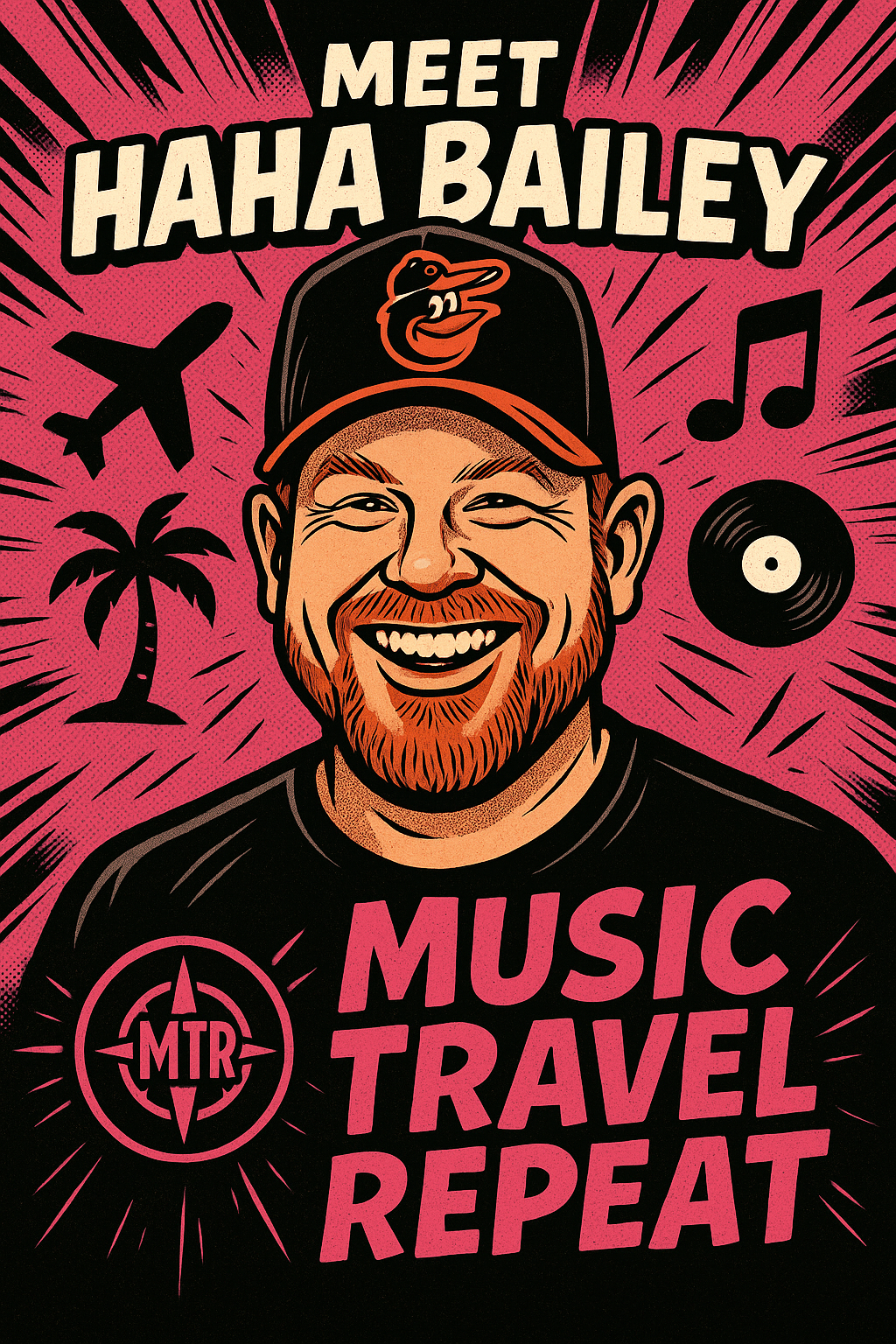
Haha Bailey knows that sometimes the road teaches what the therapist can’t. His playlists on Music Travel Repeat blend healing with horsepower, mixing pain and poetry beneath open skies. Listen to The Backseat Benedictions: Music For A Road Trip.
The Restless, The Hopeful, and The Broken
- Cardboard Cowboys & Life Bans From Walmart
- Seether In Seattle: A Musical Homecoming For The Restless Heart
- The Immortality Equation: Concerts + Connection = A Life Well-Lived (Now With Bonus Emotional Growth @ 30,000 Feet)
- Brian Wilson, 1942–2025: A Tribute from Music Travel Repeat
- Executive Protection: The Invisible Job Reality
- Letters To My Younger Self: What I Wish I Knew Before Hitting The Road
- The Loudest Silence : Sons, Fathers And The Stages That Never Clapped
- The Song That Undid Me
- Between Matches & Melodies: Make Little Moments
- Summer Of Loud 2025 & The Ego At The Gate: What Petco Park's Door Guy Got Dead Wrong
- Another Year Older: Notes From the Messy Middle
- Why I Don't Take Pictures with the Wrestlers
- Mr. Misunderstood: The Art Of Not Fitting In
- I Don't Know If I'm Tired Or Just Lonely
- Why I Still Cry on Airplanes (And Why That’s Okay)
- A Ska Revival with Less Than Jake, The Suicide Machines, Fishbone & Catbite in Phoenix, Arizona!
- The Desert Road to Redemption
- Chevelle in Pittsburgh — Loud Medicine for a Restless Week
- James Taylor’s Wolf Trap Concert and the Father-Son Lessons I Didn’t Expect
- GQ: The Heartbeat Behind The Chaos
- Why I Finally Asked For A Divorce
- Atreyu at The Nile: Blood, Banter, and the Beauty of Not Being on Duty
- Thanksgiving 2025