Music Travel Repeat! › The Restless, The Hopeful, and The Broken
Between Matches & Melodies: Make Little Moments
The funny thing about life is that the “big moments” — the ones we
- plan for
- save for
- dress for
- ache for
— rarely end up being the moments that actually define us.
We spend months preparing for weddings, rehearsing for championship fights, setting countdowns on our phones for concerts circled on the calendar. We convince ourselves that these are the chapters our story will hinge on, that if we can just make it to that night, everything else will make sense.
But then the wedding passes in a blur of toasts and snapshots you don’t even remember posing for.
The championship fight is over in twenty minutes, and suddenly the gloves are off and you’re just another tired body trying to catch your breath.
The concert ends with two encores, house lights coming on too soon, and you’re left blinking under fluorescent bulbs, ears still ringing but the magic dissolving like smoke.
And then… silence.
That’s when you realize: life isn’t built in the headline moments. It’s held together by the little ones.
I’ve spent years living in two worlds obsessed with spectacle — professional wrestling and live music. Both are industries that thrive on big lights, big sound, big emotion. Both promise people a chance to escape their lives for a couple hours, to feel something larger than themselves.
But here’s the truth I’ve learned standing in the wings, just outside the spotlight: the real moments — the ones that stay with you long after the pyrotechnics fade — aren’t the main events. They’re the pauses.
- The nod of gratitude you catch in the hallway from an athlete who doesn’t have the words.
- The laugh that erupts backstage when someone tells a joke to break the tension before a big match.
- The way strangers sing softly while waiting for the encore, voices cracking but hearts wide open.
We call them “in-betweens.” I call them survival.
Because if you only live for the main event, you’ll spend most of your life waiting. And life is too fragile, too unpredictable, to waste on waiting.
I’ve come to believe this: the middle matters more than the mountaintop. Between matches and melodies is where we’re reminded that we’re alive — and that we’re not alone.
Between Matches
I’ve stood in more hallways than I can count. Cement floors under my boots, fluorescent lights buzzing overhead, the smell of sweat and adrenaline hanging in the air.
The world knows professional wrestling as a spectacle: the fireworks, the ring entrances, the story lines that play out like soap operas written in bruises. But my view has always been different. My job isn’t to perform. My job is to protect. To make sure the chaos stays inside the ring and doesn’t spill out where it can’t be controlled.
And in that role, I’ve learned something most fans will never know: the match itself is only part of the story. The rest — the real story — happens in between.
There’s something sacred about the walk from the locker room to the ring. Fans see the grand entrances — pyro exploding, music blasting, cameras flashing. But five seconds before that? It’s just a person in spandex and boots, standing in a hallway with their chest heaving, waiting for the cue.
- I’ve seen the toughest wrestlers — men and women with bodies carved from discipline and pain — close their eyes and whisper a prayer before stepping into the light
- I’ve seen them bounce on their heels, trying to shake off the nerves
- I’ve seen the moment of doubt flicker across their faces right before they plaster on the persona the world came to see.
And I’ve been there, just off to the side, keeping watch. Noticing the humanity that never makes it on camera.
One time, a wrestler I’d been assigned to protect — a guy known for his arrogance and brutal style — leaned against the wall, took one last deep breath, and looked at me. “Do you think they’ll care if I lose tonight?” he asked.
The question stunned me. Not because of what he asked, but because of who asked it. This was a man the crowd loved to hate, someone who built his career on dominance and swagger. But in that moment, stripped of lights and noise, he was just a man wondering if he mattered.
I didn’t give him a motivational speech. I just nodded and said, “They came for you. Win or lose, they’ll remember you.”
He smiled, almost sheepishly, then walked out to the roar. That night, I realized something: even giants need reassurance. And sometimes the little moment — a quiet word in a hallway — means more than the main event.
The match ends. The crowd cheers, boos, or sits in stunned silence. The cameras cut. The commentators sign off. And then the wrestlers limp back down the same hallway they came in through, adrenaline starting to crash.
Here’s the thing nobody talks about: victory and defeat feel eerily similar when the noise dies.
I once watched a wrestler who had just won the biggest match of his career — a title belt strapped around his waist, his name echoing through the arena — sit down on a plastic chair backstage and bury his head in his hands. He wasn’t crying from joy. He wasn’t celebrating. He was just… empty.
A few feet away, the man he defeated was slumped against the wall, ice pressed to his shoulder, ribs bruised and swelling. Nobody was chanting his name anymore. The cameras had already moved on. But I could see it in his eyes — he wasn’t broken by the loss. He was broken by the loneliness that followed it.
And here’s the part that gets me: for a brief moment, they locked eyes across the room. No words. No handshakes. Just two warriors who had shared the most intense fifteen minutes of their lives.
That silence spoke louder than any victory speech ever could.
Because respect doesn’t always need to be shouted. Sometimes it’s just held in the quiet.
If you’ve never been on the road after a wrestling event, you might not know the strange mix of exhaustion and stillness that settles in. The adrenaline’s gone. The noise is gone. You’re just a body in a car, headlights cutting through the dark.
I’ve driven countless miles down empty highways after nights like that. The wrestlers I guarded would sometimes fall asleep in the backseat, still half in costume, while I replayed the night in my head. Not the big moves, not the finish — but the small things. The nod in the hallway. The whispered prayer. The silence backstage.
It’s in those drives that I realized something vital: the “between” is what makes the “during” possible. Without those small moments of humanity, the big moments would crush us.
And maybe that’s true outside the ring, too. Maybe the fights of everyday life — the bills, the heartbreaks, the endless responsibilities — aren’t defined by the big events, but by the small mercies we give and receive along the way.
When people ask me what it’s like working backstage in professional wrestling, I never talk first about the matches. I talk about the humanity.
- The veteran who tapes up a rookie’s wrists because the kid’s hands are shaking too much
- The trainer who sneaks a joke to make someone laugh right before they go out
- The moment when the arena is empty and the janitor is sweeping the floor, but one wrestler stays behind just to sit in the silence, soaking it all in.
These are the little moments that never make TV. But they’re the ones that keep the whole thing alive.
Because at the end of the day, the fight ends. The noise fades. The cameras cut. And what you’re left with are the small, fleeting, fragile things that happen in between.
And maybe — just maybe — that’s where the real story is.
Between Melodies
Music has always been my other arena.
If wrestling is where I learned about resilience, then concerts are where I learned about release. Both demand presence, both burn bright, and both fade fast. But music carries a different kind of weight. Wrestling tells a story written in bruises. Music tells a story written in hearts.
And just like the matches, the magic of music often hides in the in-between.
The Pause Before the First Note
There’s a moment at every show — right after the house lights dim but before the band strikes the first chord — when the whole room feels like it’s holding its breath.
You can feel it in your chest. The hush that sweeps across a crowd of thousands. The way strangers shift closer together, instinctively sensing they’re about to share something they’ll never forget.
It’s fragile, that silence. You don’t even realize how holy it is until you’ve been to enough shows to understand: this is the heartbeat before the music. The collective prayer.
I think of a night in Seattle when Seether took the stage. The crowd had been buzzing, restless, beers sloshing in plastic cups. But the second the lights went black, it was like someone pressed pause on the world. And in that pause, I remember hearing one voice — just one — whisper, “Here we go.”
Related Content: Seether In Seattle: A Musical Homecoming For The Restless Heart
Four words. Barely audible. But it carried the weight of every heart in that room.
Moments later, the first note ripped through the speakers, and the world came unglued. But what I still remember is the in-between — the silence before the storm.
The world celebrates the chorus. The anthems. The singalongs that shake the rafters. But the moments that stick with me are the imperfections. The cracks. The times the music breaks open and becomes more than sound.
- I’ve seen singers choke up in the middle of a verse, unable to finish because the lyrics cut too close that night
- I’ve seen guitar strings snap mid-song, forcing the band to laugh it off and improvise
- I’ve seen whole crowds keep singing when the microphone cut out, carrying the song with nothing but human voices.
Those moments weren’t on the set list. They weren’t rehearsed. But they were real.
I remember watching Ayron Jones play in a club so small the stage was barely a foot high. His guitar strap broke halfway through a solo. For a split second, you could see frustration flash across his face. But then he just dropped to his knees, cradled the guitar like it was an old friend, and kept playing. The room went wild — not because it was perfect, but because it wasn’t.
Related Content: Ayron Jones: The Sound of Survival
That night taught me something: the cracks don’t ruin the moment. They make the moment. They remind us that music, like life, isn’t meant to be flawless. It’s meant to be felt.
There’s something beautiful about the banter that happens between songs.
- A front man cracking a joke
- A drummer tossing a water bottle into the crowd
- A bassist tuning strings while someone in the pit yells a request.
Sometimes it’s silly. Sometimes it’s profound. But it’s almost always the part you don’t expect to remember — until years later, when it drifts back into your memory like a ghost.
I’ll never forget the night Nonpoint stopped mid-set because a fight broke out in the crowd. The band’s energy was high, the pit was swirling, and then Elias Soriano put his hand up and said, “We don’t do that here. We’re family. Pick him up.”
The crowd froze. And then, like a switch, dozens of hands reached down to pull the fallen kid back up. Within seconds, he was on his feet, smiling through a busted lip, throwing his arms around the same people who’d knocked him down.
Related Content: Nonpoint: A Roadmap To Rage & Resilience
That wasn’t on the set list. But it was the most important part of the night.
Because sometimes the real concert happens between the songs.
The concert ends. The encore fades. The lights come up.
And then comes one of my favorite little moments: the walk back to the car.
It doesn’t matter if it’s through downtown streets, a grassy field, or a cracked stadium parking lot — there’s always a quiet magic in that shuffle back to reality. Your ears are still ringing. Your voice is hoarse from singing. The world feels both heavier and lighter at the same time.
I remember leaving a Parkway Drive show in San Diego. The night had been pure chaos — walls of death, circle pits, Winston McCall screaming like a man possessed. But the memory that stayed with me wasn’t inside the venue. It was outside, walking under the city lights with GQ & her best friend, all of us too wired to sleep but too tired to talk. We just kept laughing, for no reason, replaying moments only we would carry.
Related Content: Summer of Loud & The Ego At The Gate: What Petco Park's Door Guy Got Dead Wrong
Related Content : Parkway Drive: Outrunning The Breakdown
That’s the thing about concerts: the music stops, but the moment lingers. And sometimes the best part isn’t what happens on stage — it’s what happens in the echo after.
Here’s what I believe: concerts aren’t just about music. They’re about communion.
Not in the religious sense, though it feels just as sacred. But in the sense that for a couple hours, strangers become family. Divides dissolve. Pain loosens its grip. And everyone in the room agrees — without words — that life is hard, but it’s worth singing through.
- I’ve seen it in a mother holding her daughter close during a ballad, both of them crying quietly in the dark
- I’ve seen it in a group of drunk friends locking arms and belting out lyrics they half-remember.
- I’ve seen it in the way the crowd always — always — makes room when someone falls in the pit.
Those aren’t little things. They’re everything.
Because at the end of the night, nobody remembers how clean the guitar solo was.
- They remember how they felt
- They remember who they stood beside
- They remember the little moments that made the noise worth it
The Thread That Holds It Together
At first glance, wrestling matches and rock shows don’t have much in common. One is built on story lines and steel chairs, the other on melodies and amplifiers. One trades in violence, the other in harmony.
But the longer I’ve lived in both worlds, the more I realize they’re not opposites. They’re cousins.
- Both are chaos contained
- Both are places where you enter one way and leave changed
- Both are temporary sanctuaries where pain gets dressed up in spectacle and released under bright lights.
And both live or die on the little moments in between.
If you’ve ever been backstage before a fight, you know the silence can be louder than the crowd. The same is true at a concert right before the first note. In both arenas, there’s a fragile thread that ties everyone together — a collective breath before the noise.
That thread is presence.
The fighter stepping into the ring isn’t thinking about tomorrow’s grocery list. The singer stepping to the microphone isn’t worried about next week’s bills. In that moment, the only thing that exists is this.
- This crowd
- This night
- This song
- This fight.
It’s a lesson I’ve carried into my own life. Too often, I’ve been guilty of living ahead of myself — racing toward some future moment, convinced that’s when life will really start. But wrestling and music keep reminding me: the thread worth holding onto is the one that ties you to now.
Because if you’re not present, you miss it. And you don’t get it back.
On the road, life blurs together. Cities start to look the same. Hotels, airports, arenas, venues — rinse, repeat. After a while, you don’t measure your days by calendars. You measure them by road maps and set lists.
And yet, in the middle of that blur, the smallest things become anchors.
- Like the diner off I-95 where a waitress in her sixties called every wrestler “baby” while pouring burnt coffee, treating them not like performers but like sons
- Like the gas station outside Albuquerque where I bought a CD from a local kid who swore his band would make it one day — and 9 months later, I saw them open for one of my favorite acts
- Like the bus ride where half the band was asleep, and the other half was singing quietly to the radio, voices scratchy but harmonizing anyway.
None of those made the highlight reel. None of them were “main events.” But they’re the memories I carry. Because those are the threads that keep the blur from swallowing you whole.
There’s a rhythm to both matches and melodies that feels strangely familiar.
In wrestling, there’s the slow build — the lock-ups, the grapples — before the momentum shifts and the crowd surges. In music, there’s the verse building to the chorus, the bridge that bends before it breaks.
And then comes the eruption: the slam, the solo, the chorus, the pin fall.
Both are controlled chaos. Both pull something primal out of us. And both remind us that life itself follows the same pattern: build, break, release, repeat or music, travel, repeat.
But what holds it together isn’t the big moments. It’s the quiet beats in between. The deep breath between verses. The silence between rounds. The thread of anticipation that keeps everyone on edge, waiting, alive.
Without those pauses, the noise would lose its meaning.
I’ve always believed the walk back to the car is as important as the main event.
After a wrestling match, you see
- fans reenacting moves in the parking lots
- kids with replica belts slung over their shoulders
- parents carrying tired children asleep against their chests
After a concert, you hear
- voices singing scraps of the last chorus
- laughter echoing under the night sky
- strangers swapping stories while weaving through traffic cones.
Both spaces — the post-show parking lots — are liminal zones. They’re thresholds between chaos and normalcy, where the high begins to fade but hasn’t completely left you yet.
And if you pay attention, you’ll notice something: people linger. They don’t want to go home right away. They stall by their cars, talk longer than necessary, replay their favorite moments with wide eyes.
Why? Because we all know instinctively that the thread is delicate. Once you drive away, once the lights of the venue disappear in your rear view mirror, the spell breaks. So we cling. We hold onto the little moments in the parking lot because they’re the stitches that bind the memory to our souls.
Travel itself is just another match, another melody. It’s a rhythm of departures and arrivals, of beginnings and endings. But what I’ve learned from years of airports and highways is that the magic almost never happens where you think it will.
The highlight isn’t always the city skyline. Sometimes it’s the stranger you meet in the boarding line who tells you their whole life story before you even take off.
It isn’t always the headliner. Sometimes it’s the opener who plays like their life depends on it.
It isn’t always the main stage. Sometimes it’s the busker on the corner who makes you stop and cry without warning.
Travel humbles you into noticing the in-between. It forces you to see that life isn’t just about destinations. It’s about the threads you gather along the way — the little moments that keep you tethered when everything else feels like motion.
- Wrestlers survive because of the people who tape their wrists and crack jokes in the locker room
- Musicians survive because of the fans who sing when their voices give out
- Travelers survive because of the strangers who offer directions when you’re lost.
We survive — all of us — because of the threads.
Threads are fragile. They’re easy to miss, easy to dismiss. But woven together, they become something strong enough to carry us through the chaos.
And maybe that’s the point. Maybe life was never meant to be lived as one long string of main events. Maybe it was always meant to be a tapestry of little moments, held together by threads we barely notice at the time.
The matches, the melodies, the miles — they all fade. But the thread remains.
Making Little Moments
The biggest secret I’ve learned — and I’ll admit I’m still learning it every single day — is this:
Little moments don’t just happen. You have to make them.
Life will hand you chaos by the armful.
- Bills
- Broken hearts
- Missed flights
- Matches that don’t go your way
- Concerts that sell out before you can grab a ticket
- Disappointments that feel heavier than any stage light or steel chair ever could.
If you wait for life to slow down, you’ll wait forever. The only way to survive — the only way to live a life worth remembering — is to choose to carve out little moments right in the middle of the noise.
When I was younger, I thought slowing down was for the weak. I thought if I wasn’t grinding, pushing, hustling, I was wasting my time. Every moment had to “count,” but by “count” I meant “move me closer to the big thing.”
But somewhere between airports and arenas, I realized something: the pause button isn’t weakness. It’s survival.
You know the sound that happens when a crowd finally quiets, when the band is tuning their guitars, when the wrestler is crouched in the corner catching their breath? That hush? That’s not wasted time. That’s the marrow of the moment.
Now, I try to carry that into everyday life.
- Pausing mid-conversation to really look at the person across from me.
- Pausing in the middle of a long drive just to pull over and watch the sunset instead of racing to the destination.
- Pausing at the airport to strike up a conversation with the janitor mopping the floor, because their story might be the real headline of the day.
The pause button doesn’t steal time. It gives it back.
Making little moments is often about rebellion — not the kind with fists and fire, but the quiet kind. The rebellion against rushing. Against numbness. Against living like the only things that matter are the big ones.
I think of a wrestler I once worked with who, no matter how late it was, always stayed an extra fifteen minutes after the crowd cleared just to sign autographs for kids waiting by the barricade. His body was bruised, his flight was early, his schedule was brutal — but he made a choice. He made that little moment matter for those kids, knowing they’d never forget it.
I think of a show in Chicago where the band stopped mid-set, cut the lights, and asked everyone to put their phones away for just one song. “We want you to feel this with your eyes, not your screens,” the singer said. The result? One of the most powerful silences I’ve ever experienced, broken only by a thousand voices singing in the dark.
And I think of my own life — moments where I chose to linger instead of leaving.
- A late-night diner conversation with my best friend when I should’ve been asleep
- A phone call to my mom on a random Tuesday
- A slow dance in the kitchen with someone I love, no music playing except the hum of the refrigerator.
Little rebellions, all of them. And yet they’re the things I’ll carry long after the main events blur.
Another way to make little moments? Gratitude.
Not the Instagram kind, where you post a list of blessings with a latte in the background. I mean the raw kind — the kind you feel in your bones when you realize how easily it could all be gone.
- I’ve been in locker rooms after injuries that could’ve ended careers
- I’ve been in concert crowds where storms rolled in and lightning threatened to cancel everything
- I’ve been on highways where a few feet in the wrong direction could’ve meant I never came home.
Those moments rewire you. They teach you not to take anything for granted.
Now, I try to practice gratitude in the smallest places.
- Thanking the flight attendant by name
- Telling a sound guy after a show that his work mattered
- Hugging longer than the schedule allows
- Writing down one thing each night that I don’t want to forget.
Gratitude turns the ordinary into the sacred. It makes little moments glow.
Some of the best little moments don’t even belong to you — they’re the ones you help make for someone else.
I’ve seen this in protection work more times than I can count. The athlete is exhausted, the musician is drained, but a fan comes up with trembling hands and a Sharpie. It’s easy to brush past. Easy to say, “Not tonight.”
But I’ve also seen what happens when they stop, even for thirty seconds. That fan walks away with a story they’ll tell for the rest of their life. And all it cost was a moment of presence.
That’s what I want to live like: a maker of moments for others. Someone who chooses to pause, to see, to acknowledge. Because those little offerings — a smile, a word, a handshake, a song sung louder because you know someone needs to hear it — they multiply.
And in the end, that’s the real legacy. Not the main events, but the little moments of kindness scattered in between.
The older I get, the more I believe holiness isn’t just in churches, rings, or stages. It’s in the ordinary.
- It’s in the way GQ laughs when she’s trying to hide her smile
- It’s in the sight of a kid on their dad’s shoulders at a concert, wide-eyed at the lights
- It’s in the sound of strangers singing together off-key but on-heart
- It’s in the silence of a hotel room at 3 a.m., when you realize you’re still here, still alive, still trying.
If I could offer one piece of advice — to myself as much as to anyone else — it’s this: don’t wait for the big things to feel holy. Look for it in the cracks. In the between.
Because that’s where life is really happening.
Don’t Miss The Messy Middle
When I look back over my life, I realize the big moments don’t carry me the way I thought they would.
- The weddings
- The championships
- The concerts with the fireworks and the confetti cannons
They sparkle, sure. They glow for a night. But then they fade into photographs and dates on a calendar.
What carries me — what holds me together on the quiet nights, when the world feels heavier than I can bear — are the little moments.
- The nod in the hallway from a wrestler too exhausted to say “thank you” but meaning it with his eyes
- The crack in a singer’s voice when the lyrics got too close and they couldn’t hide anymore
- The laughter of my friends spilling out of a rental car in a city we barely knew, headlights guiding us nowhere in particular.
Those are the things that stay.
I used to think survival meant pushing through, gritting my teeth, waiting for the next main event. But survival — real survival — has always been about the middle.
- The pause before the match
- The silence before the song
- The walk back to the car.
Those in-between spaces are where healing sneaks in. Where gratitude grows roots. Where connection takes shape.
Looking back, I realize some of the most important moments of my life didn’t announce themselves. They slipped in quietly, tucked between chaos and calm. And if I hadn’t slowed down, I might have missed them.
Maybe that’s what I want to leave you with: don’t miss the middle.
Here’s the thing about little moments: they don’t seem like much when they happen. A laugh. A look. A quiet drive. But when you string them together over years, they become a tapestry stronger than any single headline.
When I think of my late nights on the road, I don’t remember every town or every arena.
- I remember the diner waitress calling us “baby.”
- I remember the wrestler whispering a prayer
- I remember strangers singing into the night.
Those threads — fragile, fleeting, ordinary — are what hold the whole story together.
And I think that’s what we’re all weaving, whether we know it or not. A tapestry of little moments. Some bright, some dark, but all essential.
I’d be lying if I said I haven’t missed some. I’ve been
- too busy
- too distracted
- too proud
to notice when life was offering me something small but sacred.
I regret
- the hugs I cut short
- the calls I didn’t return
- the nights I scrolled instead of listening
- the people I brushed past because I was chasing something “bigger.”
But maybe regret has its own gift.
- It sharpens your vision
- It makes you hungry not to miss the next one
- It teaches you to pay attention
— because the middle matters more than you realized.
So here’s my invitation, to you and to myself:
Make little moments.
- Pause when the world tells you to rush
- Laugh when life tries to be too serious
- Say “thank you” when no one expects it
- Hug longer than the schedule allows
- Sing even if you’re off-key
Notice the threads. Collect them. Cherish them.
Because one day, when the main events blur and the big moments fade, those little stitches of memory will be what keeps your story from unraveling.
If you remember anything, let it be this:
Don’t just live for the main event. Don’t just wait for the big song.
Meet life in the middle.
- Between matches and melodies
- Between chaos and calm
- Between who you were and who you’re still becoming.
And when you find yourself standing in the quiet between the noise — when the lights have dimmed and the crowd has gone home — make it sacred.
Because those little moments?
They’re the only ones that last.
Catch You In The Chaos,
Haha Bailey
Next Post: Summer of Loud & The Ego at the Gate: What Petco Park's Door Guy Got Dead Wrong
Previous Post: The Song That Undid Me
Meet Haha Bailey
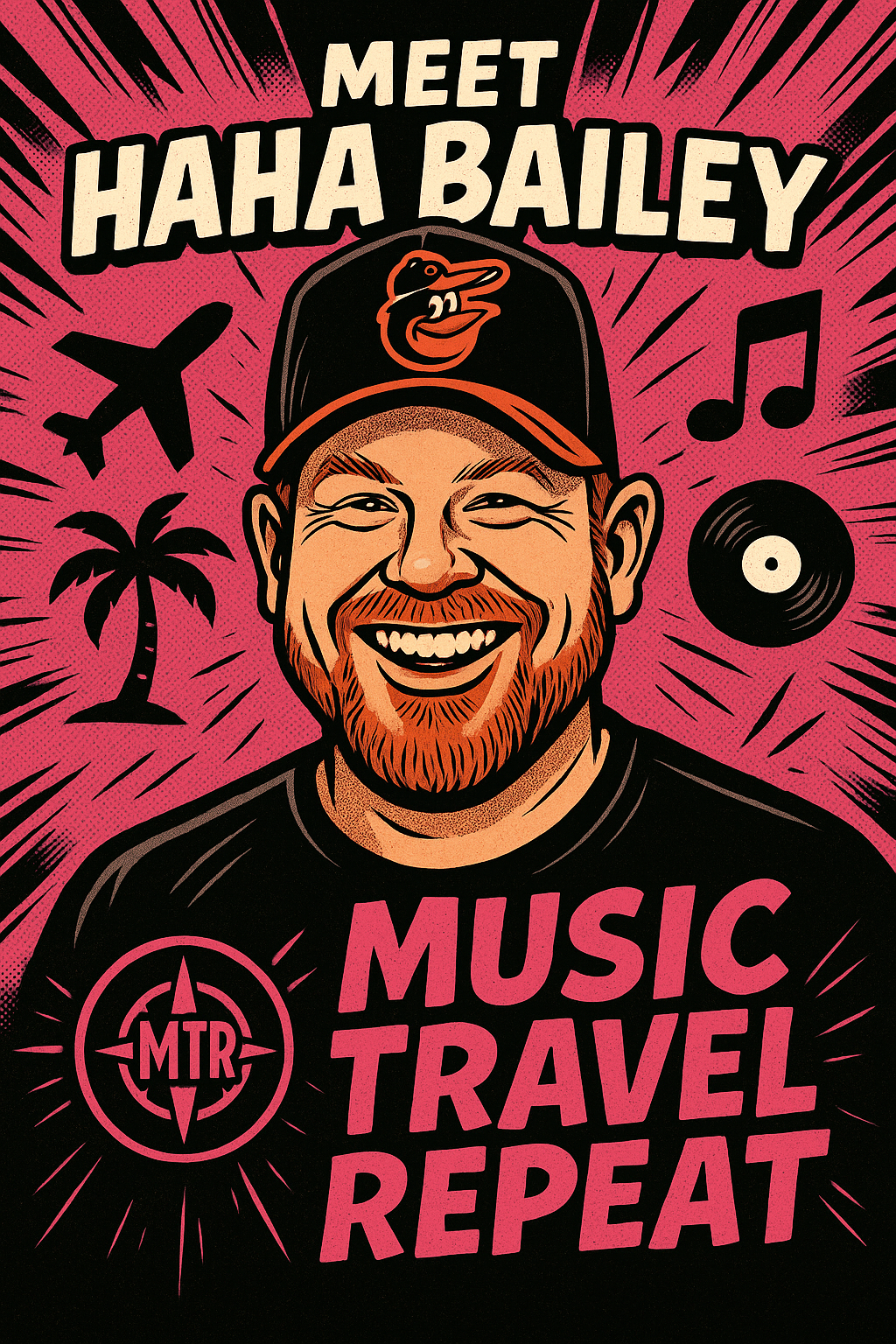
Haha Bailey writes like a friend who doesn’t flinch at your truth. Read more of his essays on The Restless, The Hopeful, and The Broken — where music, travel, and redemption meet on the same road.
- Cardboard Cowboys & Life Bans From Walmart
- Seether In Seattle: A Musical Homecoming For The Restless Heart
- The Immortality Equation: Concerts + Connection = A Life Well-Lived (Now With Bonus Emotional Growth @ 30,000 Feet)
- Brian Wilson, 1942–2025: A Tribute from Music Travel Repeat
- Executive Protection: The Invisible Job Reality
- Letters To My Younger Self: What I Wish I Knew Before Hitting The Road
- The Loudest Silence : Sons, Fathers And The Stages That Never Clapped
- The Song That Undid Me
- Between Matches & Melodies: Make Little Moments
- Summer Of Loud 2025 & The Ego At The Gate: What Petco Park's Door Guy Got Dead Wrong
- Another Year Older: Notes From the Messy Middle
- Why I Don't Take Pictures with the Wrestlers
- Mr. Misunderstood: The Art Of Not Fitting In
- I Don't Know If I'm Tired Or Just Lonely
- Why I Still Cry on Airplanes (And Why That’s Okay)
- A Ska Revival with Less Than Jake, The Suicide Machines, Fishbone & Catbite in Phoenix, Arizona!
- The Desert Road to Redemption
- Chevelle in Pittsburgh — Loud Medicine for a Restless Week
- James Taylor’s Wolf Trap Concert and the Father-Son Lessons I Didn’t Expect
- GQ: The Heartbeat Behind The Chaos
- Why I Finally Asked For A Divorce
- Atreyu at The Nile: Blood, Banter, and the Beauty of Not Being on Duty
- Thanksgiving 2025