Music Travel Repeat! › The Restless, The Hopeful, and The Broken
The Song That Undid Me
When a Lyric Breaks You Open
It’s funny how you can hear thousands of songs in your lifetime, memorize every note, sing every chorus, and still—one night, one line, one syllable—undoes you.
That night wasn’t the first time I had heard that lyric. I’d spun that record before. I’d hummed it on long drives, maybe even skipped past it when my mood didn’t match its weight. But standing there, in the blur of stage lights and strangers, it landed differently. Almost violently. As if the words had been waiting for me. Patient, merciless, deliberate.
I realized something in that moment: we don’t always choose when a song breaks us. Sometimes it chooses us.
And God, it chose me.
One of the strangest things about live music is the way it can shrink or expand the room around you. That night, it shrank. Thousands of people, all shoulder to shoulder, all moving as one—and suddenly, I
- couldn’t hear them
- couldn’t see them
- couldn’t feel the bass in my chest the same way.
It was like I was inside a bubble where only that lyric existed.
"I didn’t know what I needed until I left it all behind."
The words didn’t just echo through the speakers. They echoed through me. They rattled against the decisions I’d made, the love I’d lost, the house I’d left, the silence I carried.
And for the first time in years, I didn’t fight it.
Tears don’t always come like the movies. No dramatic sobbing. No gasps for air. Mine came like a leak in a dam. Slow. Relentless. Stubborn. I blinked, wiped my face quickly, looked down at my shoes like maybe no one would notice.
But inside, something had cracked wide open.
- It wasn’t just sadness
- It wasn’t just regret
- It was recognition
The singer didn’t know my story, but in that line, they told it back to me.
- Every failed attempt at being “fine”
- Every room I’d walked into with a smile that didn’t match my insides
- Every conversation where I said “I’m good” when I wasn’t
The lyric didn’t heal me. It named me.
I grew up in churches that preached about confession and forgiveness, about kneeling at altars and unburdening yourself. Maybe that works for some. But me? I never really felt lighter after spilling my soul in a pew.
Music, though—that was my confessional. That night, it was like the singer reached across the stage, handed me the microphone, and said, “Go ahead. Admit it.”
And I did, without ever opening my mouth.
- I admitted I wasn’t okay
- I admitted I’d been running
- I admitted I’d been holding my breath for years, waiting for someone to give me permission to exhale.
And when the tears came, they felt less like weakness and more like a baptism.
As the song carried on, my body betrayed me.
- My hands trembled
- My chest ached
- My knees felt weak like I might buckle
It was as if my muscles remembered every mile of carrying grief I refused to set down.
That’s what no one tells you about heartbreak—it doesn’t live only in the mind.
- it nests in the body
- in the tension of your shoulders
- in the knot at the base of your spine
- in the headaches you blame on bad sleep
That lyric shook something loose. And all of a sudden, I wasn’t just listening to music. I was releasing years of unspoken things I didn’t even know I was storing.
What surprised me most wasn’t the pain. I’d known pain before. I’d carried it, dressed it up, hidden it well. What surprised me was the relief.
There’s a strange freedom in breaking open, in admitting that the armor you’ve been wearing isn’t working anymore. It’s terrifying, yes—but it’s also liberating. That night, under the stage lights, I gave myself permission to not have it together.
And instead of shame, I felt human.
I’ve heard people talk about chasing songs—digging through playlists, searching for that one verse that fits like a key in a lock. But sometimes, it doesn’t work like that. Sometimes the song finds you first.
That night, I wasn’t searching. I wasn’t even expecting to feel much at all. I’d shown up because I love live music, because being in a crowd sometimes feels safer than being alone.
But the song didn’t care about my plans. It came barreling through anyway. It knocked down the doors I’d built to keep myself safe. And as much as it hurt, I’m grateful it did.
That lyric was a mirror. One I had avoided for years. One I didn’t want to stand in front of. But standing there, undone, I couldn’t look away.
And maybe that’s what music really is at its best
- not entertainment
- not distraction,
- not even comfort
But a mirror. One that reflects back who we are, who we were, and who we might become.
I walked into that venue thinking I was just a fan. I walked out knowing I’d been confronted.
Eventually, the spell broke. The crowd came back into focus. I heard the voices singing around me, felt the push and pull of bodies swaying in rhythm. For a moment, I even joined them—sang the words through a cracked voice, wiped my face again, smiled when a stranger bumped shoulders with me.
But I wasn’t the same as when I walked in.
That’s the paradox of a night like that. Everyone in the room hears the same lyric. Everyone sings the same melody. But somehow, each of us walks away carrying a different story.
Mine just happened to be heavier than most.
The truth is, nothing “fixed” that night. I didn’t walk out magically healed, or free from regret, or sure about my future. But I walked out with a seed planted.
Because once a lyric names you, you can’t go back to pretending you don’t recognize yourself.
And maybe that’s the start of healing: not the absence of pain, but the presence of honesty.
That’s what that lyric gave me. Honesty.
And for a man who had spent years playing strong, silent, and unshaken—that was enough to undo me.
Standing in the Crowd, Not on Duty
There’s a different kind of weight you carry when you’re on the job. When I’m working,
- every concert is a chessboard
- every face is a potential move
- every sound in the distance
- every sudden shift in the crowd
- every hand that lingers too long near the barricade
my body catalogues it all. My head never stops moving, never stops counting exits, never stops preparing for the “what if” that I hope never comes.
But that night? That night
- I wasn’t the guy in black standing against the wall with my arms folded
- I wasn’t the ghost blending into the background, scanning the room like a hawk
- I wasn’t the quiet protector who disappears when the lights go up and the noise comes down.
I was just a man. A ticket holder. Another body pressed into the crowd, waiting for the music.
It felt strange, almost uncomfortable at first. Like walking without a coat after wearing armor for so long. I kept looking around, out of habit, tracking exits, watching faces. Old instincts die hard.
But slowly, the relief set in.
- no one expected anything of me
- no one looked my way for reassurance
- no one even noticed I was there
I wasn’t responsible for anyone’s safety but my own.
For someone like me—someone who has lived in the shadows of stages, who has been the quiet wall behind larger-than-life figures—that anonymity felt like a gift.
And yet, it also left me exposed. Without a role to play, without a uniform or a purpose, I had to face myself.
That’s the trouble with always being on duty: you can start to confuse the role with the person. People see the protector, the planner, the one who doesn’t flinch. And after a while, you start to believe that’s all you are.
But standing in that crowd, stripped of the badge of responsibility, I felt naked. For once, I couldn’t hide behind the job. I couldn’t distract myself by scanning for threats or rehearsing responses.
I had to sit in my own skin. And if I’m honest, I didn’t always like who I found there.
It wasn’t the crowd pressing into me that made it hard to breathe. It was the weight in my chest. The accumulation of months—years—of silence and self-denial.
I had built my life around being needed. Around being useful. Around being the one who keeps chaos at bay for everyone else. But when the role fell away, I was left with a question I didn’t know how to answer: Who am I when I’m not holding someone else together?
The truth I had been avoiding was this: without the distraction of duty, I was broken. And music wasn’t about to let me forget it.
The thing about standing in a crowd as a civilian is that you see things differently.
- You catch the joy on people’s faces, the way they clutch each other when their favorite song starts
- You notice the tears, the raised hands, the heads tilted back as if they’re praying.
I used to notice those things for tactical reasons—reading body language, scanning for signs of trouble. But that night, those details weren’t warnings. They were mirrors.
I realized I wasn’t the only one carrying weight into that room. Every person there had dragged something behind them—grief, regret, hope, longing. The music wasn’t just for me. It was for all of us.
And for once, I let myself belong to the “us.”
When you’re used to being the strong one, surrender feels like danger. But that night, in that crowd, I learned surrender can also feel like safety.
No one was asking me to hold it together. No one was watching to see if I would break. I could let go, and the music would carry me. The crowd would swallow me whole, and instead of being lost, I’d be found.
But here’s the hard truth: even when you’re “off duty,” your ghosts still show up. The music pulled them out of me like moths to a flame.
For once, I didn’t need to be the wall. I could just be the man leaning against it.
- I saw the boxes stacked in the hallway the night I left my marriage
- I saw the kitchen table where two plates sat but only one got touched
- I saw the empty side of the bed that mocked me with its silence.
Those memories walked into that venue with me, uninvited. And when the lyric broke me open, they spilled into the open.
I had nowhere to run, no job to bury myself in, no headset buzzing in my ear to drown it out. Just the ghosts, the music, and me.
And yet—that was the very thing that saved me. Because when you spend years hiding behind a role, behind a uniform, behind a wall of “I’m fine,” you forget what it means to be human.
That night, the music reminded me. Humanity isn’t about control.
- it isn’t about always being prepared
- it isn’t about strength without weakness.
It’s about standing in the middle of a crowd, undone by a song, and realizing you’re still alive enough to feel.
There’s a strange alchemy in live music: the way strangers hold each other without even knowing it. The sway of bodies, the shared breath, the unspoken agreement that we’re in this moment together.
I let that crowd hold me that night. I let myself disappear into the noise, into the lights, into the lyric that cracked me open.
And in doing so, I found something I hadn’t felt in years: belonging.
By the time the song ended, I wasn’t “healed.” I wasn’t “fixed.” But I was different.
- I had stopped fighting the silence inside me
- I had stopped pretending I was immune to the very thing that makes us human: heartbreak, grief, longing.
For once, I wasn’t on duty. I wasn’t guarding anyone. I wasn’t guarding myself.
And in that surrender, I realized something simple and profound: sometimes the bravest thing you can do is stand in a crowd, let the music break you, and not fight your way back to composure.
Because maybe composure isn’t what saves us. Maybe honesty does.
Carrying Guilt and Silence After Divorce
Divorce isn’t a clean break. People talk about it like it’s a single event
- papers signed
- rings slipped off
- a door closing
But the truth is, it unravels you in layers. It doesn’t end when the ink dries. It lingers. It clings to your clothes, your skin, your mornings.
I thought leaving would bring clarity. I thought it would quiet the storm. Instead, it left me standing in the wreckage with more questions than answers.
Who was I without her?
Who was I without us?
Who was I without the story I had built my whole life around?
I carried guilt the way some men carry weights at the gym—every day, strapped across my shoulders, never setting it down. Only difference was, no one could see mine.
To the world, I looked like a man moving on.
- I showed up to work
- I cracked jokes when I needed to
- I smiled at the right times
But inside, I was suffocating.
It’s easy to talk about betrayal, about anger, about screaming matches and slammed doors. What’s harder to talk about is the guilt that comes when you walk away quietly. When you leave not because of a blow-up, but because of a slow death.
There was no final fight. No broken plates. Just silence. And silence is a harder thing to forgive yourself for.
If guilt was my weight, shame was my uniform. I wore it everywhere. To the grocery store. To the gym. To the airport. It followed me like a shadow.
Shame whispered in my ear when I lay down at night: You failed.
It shouted at me when I passed happy couples on the street: You’re the one who gave up.
It lingered in every phone call with family, every hesitant question from friends: Why didn’t you try harder?
The truth? I had tried. For ten years, I had tried. But when you realize you’ve been holding something together by sheer force of will—and that the other person doesn’t want to hold it with you—that realization guts you.
Still, shame doesn’t care about truth. Shame only knows how to stick.
The house we lived in looked perfect from the outside. Fresh paint, trimmed yard, neighbors who waved when you drove by. But inside, it was hollow.
I remember the night I packed the last box. I walked through each room like a ghost, my footsteps echoing off walls that once held laughter. The kitchen smelled like lemon cleaner, but no meals would ever simmer on that stove again.
Her eyes didn’t meet mine as I carried the final load. That silence cut deeper than any argument ever could. It said everything we had been too afraid to admit: we were done.
I drove away with the windows down, not because I wanted fresh air, but because I needed proof that I was still breathing.
People assume the worst part of divorce is the loss. But for me, it was the silence that followed.
At first, I thought I craved it. After years of tension, years of walking on eggshells, I told myself silence would be peace. But silence doesn’t always mean peace. Sometimes it means absence.
The first meal I ate alone was a sandwich I barely tasted. The first night in my new place
- I sat on the floor with nothing but a mattress and a stack of records
- I put on a record just to fill the space, but when the needle hit the groove, I realized the silence inside me was louder than anything on the speakers
Freedom wasn’t loud. It was quiet. And it was terrifying.
There’s a second wave of grief no one prepares you for. It doesn’t hit when you sign the papers. It doesn’t even hit the night you leave.
It comes later.
- when the mundane creeps in
- when you forget to buy milk because there’s no one to remind you
- when you roll over in bed and realize you’re the only one there
- when you cook too much pasta and have to throw half of it away.
It’s grief not for the person, but for the rhythm you built together. Even if that rhythm was broken, it was familiar. And losing familiarity feels like losing part of yourself.
So I ran. Not literally at first, but emotionally. I filled my days with work, my nights with noise, my weekends with movement. I convinced myself that if I stayed busy enough, I could outrun the silence.
I took every job that kept me on the road. I said yes to projects that meant
- airports
- hotels
- rental cars
- early mornings
- late nights
Momentum became my medication.
And from the outside, it looked like resilience. Look at him, still moving, still grinding, still showing up. But the truth was, momentum wasn’t healing. It was hiding.
There are conversations you have in your head that never make it into the world. Conversations
- with the person you left
- with the family who never understood
- with the version of yourself who thought forever meant forever.
Mine usually happened late at night, when I was too tired to fight them off. I’d replay moments, rewrite them, imagine what I could’ve said differently.
But here’s the thing:
- you can’t edit a life like you edit a story
- you can’t cut out the parts you don’t like
- you can’t rewrite the ending just because you hate the way it landed.
And so those conversations became ghosts too—haunting, unspoken, unfinished.
It took me a long time to learn how to sit with the silence instead of fearing it. Music helped. Not always in the way people expect—sometimes it hurt more than it healed. But even the hurt was a reminder that I was
- still alive
- still capable of feeling
- still more than the shell I was afraid I had become
I began to realize that silence wasn’t always absence. Sometimes it was space.
- space to rebuild
- space to breathe
- space to discover who I was without the marriage, without the weight, without the shame.
It didn’t happen overnight. Healing never does. But slowly, painfully, I learned that silence could also be a beginning.
Looking back, I see that guilt and shame weren’t just weights—they were teachers. They forced me to face myself without the safety net of a role, a partner, or a distraction.
I wasn’t proud of everything I saw. But I was honest. And maybe that’s where becoming begins—not in perfection, not in victory, but in honesty.
I’m still becoming. Still learning how to live with the choices I made, still learning how to forgive myself for not being who I thought I’d be. But carrying guilt taught me something I might not have learned otherwise: that even broken men can build again.
The Illusion of Healing Through Motion
I used to think movement was the same thing as progress. If I kept my feet on the gas, if I stayed one flight, one hotel, one security detail ahead of the ache, then maybe I’d trick myself into believing I was healing.
So I ran.
Not the kind of running that earns medals or endorphins.
- mine was the kind of running you can’t measure on a treadmill
- mine looked like packed bags, back-to-back itineraries, inboxes full of contracts
I said yes to everything, convinced that if I filled enough hours, I could outrun the emptiness that followed me home.
The hustle was convincing. On paper, I looked unstoppable. I was the guy flying across time zones, working stadiums one night and arenas the next. Always in motion. Always “doing well.”
People around me bought the story. Man, you’re killing it.
Love seeing you out there.
Always grinding, huh?
I’d nod, smile, deflect. Because the truth is, busyness is one of the easiest masks to wear. No one questions a man who looks productive.
But when the music stopped, when the crowd went home and I was back in some faceless hotel room with a mini fridge humming in the corner, the silence was still waiting.
Airports became the strangest kind of mirror. You’d think all that chaos
- boarding calls
- kids crying
- overhead announcements
would drown things out. But in the middle of a layover, when you’re sitting at a gate staring at a blinking departure board, there’s nowhere to hide from yourself.
I’d scroll my phone, pretend to be busy, but my brain wandered. I thought
- about the life I’d left behind
- about the woman whose name still lingered like smoke in my chest, about the version of me that thought marriage was forever.
And every time I tried to bury those thoughts under another itinerary, they found their way back, stronger than before.
Work is a wall we build high enough to convince ourselves we’re safe. But walls don’t heal. They just block the view.
- every new job
- every twelve-hour day
- every weekend spent traveling instead of resting
was another brick in my wall. It looked impressive. It looked solid. But behind it, I was still crumbling.
I told myself I was strong because I never stopped moving. But the truth? Strength isn’t in avoiding stillness. Strength is sitting down in it. And I hadn’t learned that yet.
There’s a peculiar kind of loneliness that follows you when you live out of a backpack. You’re always surrounded by people
- passengers on planes
- coworkers backstage
- strangers in lobbies
but none of them really know you.
I’d swap pleasantries, laugh at the right jokes, play my part. But deep down, I was just a ghost passing through. A man too scared to sit still long enough to hear his own heart beating.
Because stillness meant honesty. And honesty meant admitting how broken I was.
The strange thing about running is that your body eventually calls you out. I started noticing it on the road
- headaches that never quite went away
- shoulders were so tense they ached when I laid down at night,
- a hollow fatigue that sleep couldn’t cure
- the eventual stroke
Related: Another Year Older: Notes From the Messy Middle
It wasn’t just physical exhaustion. It was the wear and tear of pretending. My body was telling the truth I refused to admit: this wasn’t healing. It was hiding.
I once sat on a plane, halfway across the country, and realized I had no memory of the last week.
- not the shows
- not the faces
- not the cities
Just a blur. That’s when it hit me: I wasn’t living. I was numbing.
“Keeping busy” is one of the most socially acceptable lies we tell. People hear it and nod approvingly. They don’t realize it can be another form of self-destruction.
For me, keeping busy was a shield. If I stacked enough noise, I wouldn’t have to hear the silence inside me. If I packed enough schedules, I wouldn’t have to feel the ache.
But you can only trick yourself for so long. Eventually, the soul catches up.
Every high-energy night was followed by the same crash. The hotel key card beeped, the door swung open, and I’d collapse on a bed that wasn’t mine, staring at ceilings that all looked the same.
- that’s where the questions came
- that’s where the guilt settled in
- that’s where the weight pressed hardest.
Because when the world thinks you’re “living the dream,” but you can’t even look in the mirror without wincing, that’s not healing. That’s hiding in plain sight.
What terrified me wasn’t the work. It wasn’t the grind. It wasn’t even the exhaustion.
It was the thought of stopping.
Because if I stopped, I’d have to face the things I’d buried
- the nights of loneliness
- the marriage I couldn’t save
- the man in the mirror I barely recognized.
So I kept running. Kept hustling. Kept convincing myself that speed was salvation.
But deep down, I knew. Healing doesn’t live in motion. Healing waits in the stillness I kept avoiding.
That’s why that concert broke me. Because I wasn’t ready. I wasn’t standing still. I wasn’t reflecting. I was running full tilt, hiding behind momentum, pretending I was fine.
And then the lyric stopped me. Mid-run. Mid-denial. Mid-escape.
It was like the music planted a foot in my chest and said, Enough. Sit down. Feel this.
And for the first time in a long time, I did.
Looking back now, I see the illusion clearly. I see
- how I dressed up my avoidance and called it resilience
- how I wore exhaustion like a badge of honor
- how I let “busy” masquerade as “healing.”
But I also see the grace in that illusion. Because sometimes, motion is the only thing that gets us through the early days. Sometimes, staying busy is the closest thing to survival we can manage.
The key is not mistaking it for healing forever.
The hard truth is this:
- you can’t outrun grief
- you can’t outwork shame
- you can’t out-schedule heartbreak.
You can numb it for a while. Distract yourself. Even fool the people around you. But sooner or later, it will find you—in the silence of a hotel room, in the blur of an airport terminal, in the middle of a concert when a lyric cuts through your defenses like glass.
And when it does, you realize that motion never meant progress. It just meant delay.=
That night in the crowd, the illusion finally cracked. And when it did, I wasn’t left with a schedule or a job or a distraction. I was left with myself.
And as terrifying as that was, it was also the beginning.
The Sunrise After the Storm
The storm didn’t end all at once. It never does. Movies like to tie things up with dramatic moments
- lightning
- thunder
- a sudden break in the clouds
But storms of the heart? They drag on. They circle back. They wear you down until you forget what it feels like to stand in the dry.
Mine lasted years.
I thought I’d gotten used to the weather.
- the constant ache
- the second-guessing
- the waves of guilt and shame.
I built my life around surviving storms. Always bracing. Always prepared for the next strike.
So when she appeared, it didn’t feel like lightning. It felt like sunrise.
She didn’t show up in a way that demanded attention. There was no dramatic entrance, no sweeping gesture. Just quiet presence.
Like the first rays of light sneaking through the blinds after a long night. You don’t notice it at first. You just realize the darkness isn’t so heavy anymore.
That’s how she arrived.
- not to rescue me
- not to fix me
- not to replace what was lost
Just to remind me what warmth felt like.
She wasn’t new in the strictest sense. A blast from the past, really. Someone whose orbit had crossed mine before, but always on the periphery. Back then, I was married. She was a friend to both of us. She encouraged me to fight for what I had, to give more, to hold on.
And I did. For years, I did.
But marriage collapsed anyway. And when the dust settled, when the house was no longer mine and the silence threatened to consume me, her presence returned.
This time, not as someone on the sidelines of my life, but as someone willing to sit in the middle of it.
Related: GQ: The Heartbeat Behind The Chaos
Our first real conversation wasn’t about music.
- it wasn’t about travel
- it wasn’t about work or the chaos of our separate lives
- it was about regret.
She asked me, “What would you do differently?”
I expected judgment. A sermon. A list of ways I had failed.
Instead, I heard sincerity. Curiosity. A willingness to hold space without filling it with noise.
And without thinking, I said, “I’d stop pretending I was okay.”
She didn’t flinch. Didn’t rush in to console or correct me. She just nodded, her eyes steady, and whispered, “Same.”
That’s when I knew she wasn’t here to play savior. She was here to walk alongside.
It’s hard to explain what it feels like to be truly seen after years of hiding. I had spent so much time wearing masks—protector, worker, husband, survivor—that I forgot what my own face looked like.
But she saw me. Not the version I tried to project. Not the fragments I thought were worth sharing. All of me—the jagged edges, the doubts, the weary faith.
And she didn’t run.
There’s a sacredness in being seen without being fixed. It says: you don’t have to perform here. You don’t have to explain yourself here. You can simply exist.
And for the first time in years, I exhaled without guilt.
We didn’t rush. There was no grand confession, no whirlwind romance. It was slower than that. Quieter. Like two planets cautiously circling each other, testing gravity, making sure we wouldn’t collide.
Brick by brick, we built something steady. No rush. No pressure. Just presence.
She asked questions that didn’t have easy answers. And more importantly, she listened to the silences between them. That’s where I realized she wasn’t trying to fill my void. She was making space for me to fill it myself.
That kind of patience is rare. And it’s holy.
Strangely enough, regret became our bond. Not the kind that festers, but the kind that humbles.
We both knew what it was
- to get it wrong
- to misplace trust
- to stumble in love and faith
And instead of using regret as a weapon, we used it as common ground.
We compared scars—not to outdo each other, but to acknowledge survival. And in doing so, we realized we weren’t defined by the mistakes we made. We were defined by the resilience to learn from them.
The more time we spent together, the more I noticed small shifts in myself.
Laughter came easier. Silence didn’t feel so threatening. Even music, which had once only been a mirror of my pain, started sounding different. It became possibility again.
She didn’t erase the storm. But she reminded me that storms don’t last forever.
And when I looked at her, I realized I was no longer waiting for lightning. I was learning to appreciate sunrise.
It’s tempting to romanticize this as rescue. To say she saved me. But that wouldn’t be fair—to her or to me.
- She didn’t fix me
- She didn’t carry my weight
- She didn’t heal wounds that weren’t hers to heal.
What she did was more powerful: she stood beside me while I faced myself. She gave me room to stumble, to confess, to rebuild at my own pace.
That’s not rescue. That’s love.
Trust after heartbreak is slow work. It doesn’t come with fireworks. It comes with small, steady choices:
- answering honestly when she asks how you’re doing
- letting her see the mess instead of only the polished parts
- believing her when she says she’s not going anywhere
Every time she showed up, every time she stayed, another brick of that wall I’d built came down. And though the work was slow, the sunlight creeping in felt worth every tear, every tremor, every ounce of fear.
Sunrises don’t demand. They don’t force. They arrive quietly, steadily, faithfully—whether you notice them or not.
That’s what she was. A sunrise in human form.
And slowly, my storm began to break.
Looking back now, I realize she taught me something I didn’t even know I needed: that healing doesn’t always look like grand gestures. Sometimes it looks like someone sitting with you in the dark until you’re ready to notice the light.
She didn’t replace my losses. She didn’t erase my grief. But she helped me remember that grief isn’t the whole story.
There’s more. There’s always more.
And so, after years of storms, I found myself standing in the warmth of a sunrise I didn’t see coming.
Not because I chased it. Not because I earned it. But because sometimes, even after everything falls apart, life still offers you a second dawn.
Music as Prayer, Music as Mirror
I’ve never been good at traditional prayer. Not the kind where you fold your hands neatly, bow your head, and find words that sound holy. Whenever I tried, the words felt like stones in my mouth
- heavy
- awkward
- mismatched
to what I was actually feeling. I envied people who could speak fluently in the language of faith, who could cry out to God with confidence.
Me? My prayers always came out sideways. They spilled out in playlists, in lyrics scribbled in notebooks, in the quiet hum of a melody when I couldn’t sleep.
Music has always been my mirror. And for me, that’s enough.
I’ve built playlists like some people build journals. Each song a page. Each lyric a confession I couldn’t bring myself to say out loud.
Related: The Backseat Benedictions: Music For A Road Trip
Late nights on airplanes, I’d scroll through hundreds of tracks, searching for the ones that felt like they knew me better than I knew myself. I’d land on something raw—maybe a lyric about leaving, about longing, about failing—and I’d hit repeat. Over and over until the truth in it became less terrifying.
It wasn’t about the production, the instruments, or the voice. It was about recognition. Music said the things I was too scared to name.
Every playlist I made wasn’t just a soundtrack. It was a prayer in disguise: Here I am. Here’s where I’m hurting. Please, don’t let me stay stuck here forever.
Some people have pews. Some people have altars. Mine has always been a pair of headphones.
I could be surrounded by chaos
- airports buzzing
- security radios crackling
- hotel hallways echoing with slammed doors
and the second I pressed play, the world receded. The music built a sanctuary where honesty was allowed.
- I didn’t have to be the protector there
- I didn’t have to be the strong one
- I didn’t even have to keep it together
All I had to do was listen.
And in that listening, I often heard myself.
I remember one night in a Nashville hotel room more vividly than most. I was supposed to be resting for an early call time, but instead, I sat on the edge of the bed with a song on loop. Eight times in a row. Same track. Same lyric.
The words weren’t polished or profound. They weren’t written to impress. They were just honest. The singer admitted
- their flaws
- their failures
- their inability to get it right
And for some reason, that felt holy to me.
Because isn’t that what prayer really is? Not pretending you’ve got it together. Not dressing your words up for approval. Just admitting: I’m broken. I’m tired. I need help I don’t know how to ask for.
That night, the song prayed for me when I couldn’t.
Over time, I began to notice that certain lyrics stayed with me like liturgy. They repeated themselves in my head at odd times
- standing in line at TSA
- driving down an empty highway at 2 a.m
- sitting at the back of a venue waiting for a show to start.
Those words became anchors. They reminded me of things I’d forgotten
- that leaving didn’t mean failure
- that grief wasn’t the end
- that broken men still had songs worth singing.
It struck me
- how much music resembled faith
- how a three-minute song could carry me further than a sermon ever had
- how a melody could hold space for doubt and hope in the same breath.
For me, the chorus was communion. The verse was confession. The bridge was redemption.
There’s something about a melody that disarms you. Words alone can feel like accusations. But set them to music, and suddenly you’re not defensive anymore. You’re open. Vulnerable.
That’s why I trusted music more than I trusted myself. Music didn’t lie to me. It didn’t tell me to get over it. It didn’t shame me for being stuck. It simply held up a mirror and said: This is where you are. And that’s okay.
Sometimes the mirror showed me wounds I didn’t want to see. Other times, it reflected strength I’d forgotten I had. Either way, it told the truth.
I’ve lost count of how many times I’ve hit repeat on a song until I wore it out. Some people would call that obsessive. For me, it was survival.
When a lyric landed right, when it articulated something lodged deep in me, I wasn’t ready to let it go after three minutes. I needed it to sink in. To seep into the cracks. To stitch something together inside me that I didn’t know how to fix on my own.
The repeat button became a ritual. Each play through a whispered prayer: One more time. Remind me again. Don’t let me forget this truth when the silence comes back.
Music as Prayer for the Ones Who Can’t Pray
What I’ve come to believe is this: music is prayer
- for the ones who can’t find words
- for the ones who left churches bruised
- for the ones who bowed their heads but felt nothing
- for the ones who wanted to believe but didn’t know how.
If prayer is simply honesty directed toward something bigger than us, then music counts. And I’ve prayed more in concerts than I ever have in sanctuaries.
- the pit has been my chapel
- the encore, my benediction
- the lyric that undid me—that was my altar call.
Music as a mirror shows you who you are. Music as a prayer shows you who you might become.
Together, they form a map. A way forward when everything else feels like fog.
That’s why I keep listening the way some people keep kneeling.
- why I keep making backseat benedictions like scripture
- why I still believe that songs can resurrect what grief tried to bury.
Because every time I put on my headphones, I’m not just killing time. I’m seeking. Hoping. Praying.
And more often than not, the answer comes in the form of a lyric that feels like it was written just for me.
The night that lyric shattered me wasn’t just about being broken open. It was about realizing that healing had already begun—quietly, stubbornly, through every song I’d ever clung to.
Healing doesn’t always announce itself with trumpets. Sometimes it hums low in the background, like a bass line you don’t notice until it’s gone.
That’s the benediction of music. It blesses us quietly, faithfully, insistently, until one day we realize we’ve been carried all along.
So yes, music is my mirror. Music is my prayer. And if I’m honest, I trust it more than I trust my own voice.
Because it doesn’t just name what’s broken. It promises that broken things can still sing.
Healing Doesn’t Announce Itself
If you’re waiting for healing to show up like fireworks, you’ll miss it. I used to think it would be loud, obvious, undeniable—like a doctor bursting through the door with test results in hand saying, You’re cured.
But healing doesn’t work that way.
- it doesn’t make speeches
- it doesn’t knock politely before entering
- it sneaks in through the cracks
in ways you don’t even notice until you look back and realize you’re not carrying what you once were.
That night at the concert, when the lyric broke me open, I wanted the music to fix me all at once. I wanted to walk out of that venue new, lighter, whole. Instead, what I got was something quieter: the reminder that healing had already begun.
Healing is more like a sunrise than a lightning strike. You don’t sit there and watch the sky go from black to gold in a single instant. It happens gradually—one shade softening into another, until you realize you can see the world more clearly than you did a moment ago.
The trouble is, when you’re in the thick of grief, you don’t notice the colors changing. You only notice the dark. You assume the night will last forever. But healing is already moving, already working, even while you’re too tired to track it.
It took me years to understand that.
The first signs of healing didn’t come in big, cinematic ways. They came in small, forgettable ones.
- like the morning I laughed at a dumb joke on a podcast and realized I hadn’t laughed—really laughed—in months
- like the afternoon I walked through a grocery store and didn’t feel the sharp ache of loneliness in every aisle
- like the night I fell asleep without needing music to fill the silence.
None of those moments felt monumental. If you’d asked me then, I probably would’ve shrugged them off. But looking back now, I see them as evidence. Healing was quietly stitching me back together while I wasn’t paying attention.
People love to chart recovery like a graph—always up and to the right, no dips, no regressions. But real healing doesn’t follow straight lines. It circles back. It stumbles. It feels like progress one day and collapse the next.
I had nights where I thought I’d finally turned a corner, only to wake up the next morning suffocated by grief again. I had weeks where I felt steady, only to be undone by one unexpected song on shuffle.
At first, I thought those setbacks meant I wasn’t healing. But slowly, I learned they were part of it. The backward steps were just as important as the forward ones, because they taught me grace. They reminded me I was still human.
What I’ve come to believe is this: healing doesn’t need grand entrances. It doesn’t need stage lights or applause. It needs repetition. Consistency. Like a favorite song that gets better the more you listen, even if the lyrics don’t change.
That’s how healing works—through the ordinary rhythms of life.
- through making your bed even when you don’t feel like it
- through showing up for a job, even if you’re still carrying grief in your chest
- through letting yourself feel the ache without rushing to cover it up.
Day after day, moment after moment, healing weaves itself into the soundtrack of becoming.
One of the hardest truths I had to face is that healing doesn’t come with a finish line. There’s no ribbon stretched across the road, no medal around your neck when you’re “done.”
I kept waiting for that arrival. I thought one day I’d wake up and be
- free of guilt
- free of regret
- free of loneliness
But that day never came—and eventually, I realized it wasn’t supposed to.
Healing isn’t about reaching a destination
- it’s about learning how to live while carrying what you’ve lost
- it’s about finding light in the middle of shadows, not erasing the shadows altogether.
I used to think healing could only happen in quiet, controlled environments
- a therapist’s office
- a church pew
- a journal page
But some of the deepest healing I’ve known has happened in unexpected places.
- in the middle of a pit, shoulder to shoulder with strangers who didn’t know my name but somehow knew my pain
- in a roadside diner at 2 a.m., when the waitress poured me another coffee and asked how far I was driving.
- on an airplane, listening to a lyric I’d heard a thousand times, suddenly realizing it meant something new.
Healing hides in plain sight. It doesn’t care about timing. It just needs you to be paying enough attention to notice it when it shows up.
Sometimes healing arrives in the form of kindness you didn’t ask for.
- the text from a friend checking in “just because.”
- the stranger who holds the door a little longer than they needed to
- the person who listens without trying to fix, who just nods and says, “Yeah, that’s heavy.”
Those moments don’t heal everything, but they remind you that you’re not carrying the weight alone. And sometimes that reminder is enough to keep going.
For me, healing wasn’t just about letting go of the past. It was about giving myself permission to live again.
- permission to laugh without feeling guilty
- permission to love without fearing comparison
- permission to rest without proving my worth
- permission to admit I was still broken, even as I was rebuilding
- permission to over use bullet points on The Restless, The Hopeful , and The Broken
That permission didn’t arrive in a single moment. It arrived slowly, like sunrise—one ray of light at a time.
That concert, that lyric that cracked me open—it wasn’t the end of something. It was the beginning.
- the beginning of admitting I was wounded
- the beginning of realizing healing had already been moving through me, whether I acknowledged it or not
- the beginning of letting go of the illusion that one big moment could fix everything.
Healing doesn’t announce itself. It doesn’t blow trumpets. It whispers. It nudges. It sneaks in quietly until you realize you’re not the same as you were yesterday.
And maybe that’s enough.
Music as Resurrection
I think about that show often. Not just the lyric that undid me, but
- the way the crowd seemed to breathe in unison
- the way the lights carved halos over strangers’ heads
- the way I felt my body remember things my brain had been trying so hard to bury.
That’s what music does—it resurrects. Not always in ways that feel comfortable, and not always in ways you’d ask for. Sometimes resurrection is the ache of an old wound tearing open again. Other times it’s the joy of realizing you can still feel something, even after years of going numb. Either way, it breathes life into places you thought were gone forever.
There are parts of me I thought were dead.
- the part that believed in trust
- the part that dared to imagine a future not weighed down by regret
- the part that thought love was still possible
But then a song would hit at the right angle—unexpected, uninvited—and suddenly those dead places would twitch. Move. Sing again.
It’s unsettling when that happens. You want to protect yourself. You want to argue back, No, I buried that part of me for a reason. But music doesn’t negotiate. It revives what it wants to revive. And once it does, you’re left with a choice: ignore it, or let it change you.
Some people kneel at altars built of stone. Mine have always been built of amplifiers and sweat-soaked stages.
The pit is where I’ve felt the most alive and the most undone. It’s where resurrection takes place, even if it doesn’t look holy to anyone else. To me, there’s nothing more sacred than thousands of voices screaming the same lyric at once. That unity, that abandon—it pulls you out of the grave of your own isolation.
I’ve stood in pits where strangers wrapped their arms around me like family, and I’ve walked away different. Resurrected. Not because life magically fixed itself, but because I remembered I wasn’t carrying it alone.
Resurrection doesn’t have to be dramatic. Sometimes it’s just the first breath you take after you thought you’d drowned.
I’ve had nights where the silence of my apartment felt suffocating, where loneliness pressed so hard on my chest I swore I couldn’t inhale. But then I’d put on a record, and the first chord would crack the pressure enough for me to breathe again.
I had the same feeling when I bought my new house in Tijuana.
Related: I Don't Know If I'm Tired Or Just Lonely
That’s resurrection too. Not flashy. Not loud. Just the quiet miracle of breath returning.
There are songs I avoid because they know too much. They hold truths I’m not ready to face. But the thing about resurrection is that it doesn’t wait for permission.
I’ll be walking through an airport or sitting in a coffee shop when one of those songs sneaks through the speakers, and suddenly I’m undone. Tears in public. A lump in my throat I can’t swallow. A wave of memory dragging me under.
And as much as I hate those moments, I’ve learned to see them for what they are:
- proof that I’m still alive enough to feel
- proof that the parts of me I thought were dead are still capable of resurrection
We want resurrection to be tidy. A clear before-and-after story. But it’s not.
When music resurrects something in you, it often drags dirt up with it—regret, grief, questions you thought were settled. It doesn’t return things neatly folded and pressed. It hands them back to you wrinkled, messy, sometimes even bloody.
But messy resurrection is still resurrection. Dead things coming back to life rarely look polished. They look raw. Awkward. Uncomfortable. And that’s okay.
One of the most powerful kinds of resurrection I’ve known is collective. When an artist cuts the mic and lets the crowd carry the chorus, and you realize you’re surrounded by thousands of people who are all rising with you.
It’s not just singing. It’s communion. A shared resurrection
- each voice lifting the others
- each heart beating in time
- each lyric stitching something back together
I’ve walked into concerts feeling hollow and walked out with a fullness I can’t explain. That’s music doing what only it can do—breathing life into what I thought was gone.
Resurrection also comes in the form of memory. A song you haven’t heard in years suddenly plays, and it resurrects a version of you that you thought was lost.
Sometimes that version is painful
- the kid who believed in forever
- the husband who thought he could save a marriage by sheer will
Sometimes that version is beautiful
- the dreamer who believed music could change the world
- the boy who danced in his car with the windows down.
Either way, the song brings them back. Reminds you that those versions of you aren’t gone. They’re still here, woven into your becoming.
At its core, resurrection isn’t just about bringing the dead back. It’s about reminding you that life is still possible.
That’s what music does for me.
- it doesn’t just mirror where I’ve been
- it whispers that there’s more ahead
- it gives me permission to hope again, even when I’m terrified
Every time a lyric pulls me out of myself, every time a melody cracks something open, I feel the faint hum of hope return. Not loudly. Not perfectly. But enough. Enough to keep going. Enough to believe tomorrow might hold something better.
I think of resurrection now as a quiet hallelujah. Not shouted from pulpits or blasted through speakers, but whispered in the spaces we almost gave up.
- the hallelujah of a man who thought he was done crying but finds tears healing him anyway
- the hallelujah of strangers swaying together in the dark, bound by nothing but sound
- the hallelujah of a lyric that names the wound and offers the faintest hint of balm
That’s music’s gift. Not fixing, not erasing, but reviving.
Years later, I listen differently. Not just for confession, not just for grief. I listen for resurrection. For the moments where a song takes me by the hand and says, Get up. You’re not finished yet.
Sometimes it comes as a whisper. Other times, as a scream. But either way, I let it in. Because I’ve learned to trust that resurrection often looks like the simple act of still being here
- still listening
- still hoping
- still rising
To The Ones Still Healing
This part is for you.
- for the ones who walked away from something you thought would last forever
- for the ones who stand in the wreckage of what once felt sacred, clutching questions no one warned you would come
- for the ones who carry guilt heavier than any suitcase, shame that clings like a second skin, silence that feels louder than thunder.
I see you.
I honor you.
And I want you to know: you’re not walking this road alone.
Leaving doesn’t always look like strength. Sometimes it looks like shaking hands on a doorknob, tears you try to swallow, a drive you can barely see through because the windshield wipers can’t keep up with what’s falling inside you.
People will have opinions.
- they’ll say you should’ve stayed
- they’ll wonder why you didn’t fight harder
- they’ll offer advice they’ve never had to live.
But only you know what it cost to leave. Only you know the weight of staying in a place where your soul was withering.
So to the ones who left: don’t let anyone shame you for choosing honesty over illusion. Walking away doesn’t mean you failed. Sometimes it means you finally told the truth.
And to the ones who didn’t choose—whose lives unraveled without warning, whose homes became hollow because someone else walked out—I see you too.
- you didn’t ask for this
- you didn’t plan for the silence
- you didn’t map out a life where someone else’s decision would crack you in half
You may feel discarded. Replaceable. Forgotten. But let me say this: you are not disposable. Your worth isn’t diminished because someone else couldn’t hold it.
Healing for you may feel like clawing back breath one gasp at a time. That’s okay. Keep breathing.
To my ex wife - I forgive you.
There’s a particular cruelty in guilt. It disguises itself as responsibility, whispering, If only you’d done this differently, everything would still be whole.
- maybe you replay arguments in your head
- maybe you rewrite endings that will never exist
- maybe you torture yourself with “what ifs"
Listen to me: you can learn from the past without chaining yourself to it. Guilt might be a visitor, but it doesn’t get to be your landlord.
Set the table for grace instead. Let grace eat first.
Shame is different. Shame doesn’t just critique your actions; it tries to poison your identity. It tells you that you’re not just someone who messed up—you are the mess itself.
But shame is a liar.
- you are not the sum of your scars
- you are not the echo of your worst day
- you are not unworthy of love simply because something ended.
You’re human. And humans break. But humans also mend.
Starting over is terrifying. I won’t pretend it isn’t. The boxes, the new address, the first meal eaten alone, the nights where you wonder if you’ll ever feel at home again.
But starting over is also holy. It’s a chance to build differently this time. To be honest sooner. To carry less pretense and more presence.
You don’t need a ten-year plan. You don’t need it all figured out. You just need the courage to take the next small step. And then another. And then another.
If you’ve ever stood in a crowd and been leveled by a lyric you didn’t see coming—welcome to the club. You’re not weak for crying in public. You’re not dramatic for letting music undo you.
That moment is
- proof you’re still alive
- proof your heart, even battered, still beats
- proof your soul still knows how to respond to beauty.
Don’t be ashamed of the tears. They’re just truth finding its way out of you.
Some of you are still waiting.
- waiting for the grief to lift
- waiting for the silence to soften
- waiting for the day when you don’t wake up feeling like a stranger in your own skin
I wish I could tell you when it will come. I can’t. Healing doesn’t operate on our calendars.
But here’s what I can tell you: you’re closer than you think. Every laugh that sneaks past your lips, every small decision to keep going, every lyric that comforts you—those are steps. Invisible maybe, but real.
One day, you’ll look back and realize you’ve been healing all along.
I know that fear. I’ve sat with it. The thought that maybe I used up all my chances, that maybe love was something reserved for other people now.
But love has a way of surprising us. It rarely arrives when we’re ready. It doesn’t knock on the front door—it slips in through a side window, unannounced, steady, patient.
Don’t close yourself off. Don’t let fear build a cage around your heart. Even broken hearts can hold love again. Sometimes especially broken hearts.
- You don’t have to say you’re okay if you’re not
- You don’t have to smile on command
- You don’t have to perform strength just because the world expects it.
Honesty is braver than pretending. Saying, I’m not fine right now, is its own kind of healing.
So to the ones exhausted by pretending: let the mask drop. Breathe. You’re allowed to be human here.
To the ones still healing, let this be your benediction:
- may you find music that mirrors your soul and prayers that don’t need words
- may you feel the quiet sunrise after the storm and trust it’s meant for you.
- may you laugh again—loud, messy, real—and not apologize for it
- may you discover that healing doesn’t mean forgetting, but learning to carry your story differently
- may you know that you are not alone, not unworthy, not finished.
You are still becoming.
And becoming is holy work.
The Road Still Calls
There’s a reason I keep coming back to the road. Not just because of the music, though that’s part of it. Not just because of the places, the cities that blur into each other, the airports that all smell the same. The real reason is simpler, maybe even softer: the road still calls, and I’m still answering.
Music and travel are how I’ve learned to live again. They’re how I’ve learned to forgive myself, how I’ve learned to hold grief without letting it bury me. Every ticket stub tucked in my bag, every playlist spun at 30,000 feet, every stranger who became a friend in a pit—that’s resurrection at work. That’s healing with sneakers on.
So when I say, Pack your bags, grab your ticket, let’s go, it’s not just about concerts. It’s not just about trips. It’s about reminding myself—and you—that we’re not done yet.
The road has taught me things I couldn’t learn anywhere else.
- it taught me patience when flights were delayed and I had nothing but silence and bad coffee to keep me company
- it taught me resilience when luggage was lost and all I had was the clothes on my back
- it taught me presence when I realized the best parts of life weren’t always on the stage but in the conversations between songs, in the moments no one was recording
The road has been my classroom, my confessional, my proving ground. And every mile I’ve driven, every sky I’ve flown through, every venue I’ve stood inside has shaped me into someone I wouldn’t have become otherwise
We don’t hit the road because it’s easy. We hit it because it reminds us we’re alive.
- because the pit feels like church
- because lyrics can undo you in ways nothing else can
- because there’s something about a stranger’s voice harmonizing with yours that feels like family, even if you never learn their name
We go because staying still hurts more than moving. Because sometimes you need the blur of headlights, the hum of tires on asphalt, the soft weight of a ticket in your pocket to remind you there’s more to life than what you left behind.
Every song is an invitation. To remember. To feel. To become.
And every time I accept that invitation, I pack a little less shame and a little more grace. I carry fewer excuses and more truth. I bring with me not just my own story, but the stories of everyone I’ve stood beside in a crowd, undone by the same lyric.
That’s the beauty of Music Travel Repeat. It’s not just my story. It’s ours. The restless, the hopeful, the broken, all walking this road together.
There’s a strange kind of benediction in movement.
- each city you pass through blesses you in its own way
- each venue leaves a mark
- each song becomes another verse in a prayer you didn’t know you were praying.
And so I keep moving. Not to escape anymore, but to honor the life I’ve been given. To honor the pain that shaped me and the healing that continues to surprise me. To honor the people I’ve met along the way—the ones who hugged me mid-song, the ones who told me their stories after a show, the ones who reminded me that we’re all just trying to survive with a little music and a little love.
If you’re reading this, then you’re part of the road too.
- maybe you’ve stood in the same pit
- maybe you’ve cried on the same flight
- maybe you’ve walked away from something you thought would last forever, and now you’re carrying your own silence, your own second skin of shame.
Wherever you are, whatever you’re holding: you belong here.
Not because you’re fixed. Not because you’re finished. But because you’re still becoming. And becoming is enough
So, pack your bags. grab your ticket. let’s go!
- not because travel solves everything, but because movement reminds us we’re still alive
- not because music erases pain, but because it gives it a name and then sings us into hope
- not because leaving is always the answer, but because sometimes stepping into a crowd is the only way to remember you’re not alone.
The road still calls. And if you listen closely, I bet you can hear it too.
Here's my backseat benediction for you
- may the road rise to meet you in your restlessness
- may the songs you hear remind you of your own strength
- may the silence soften instead of suffocate
- may you find yourself again and again in the lyrics that break you open
- may you always have the courage to answer when the road calls
Pack your bags, Grab your ticket, let's go!
Catch you in the chaos,
Haha
Next Post: Between Matches & Melodies: Make Little Moments
Previous Post: The Loudest Silence: Sons, Fathers, and the Stages That Never Clapped
Meet Haha Bailey
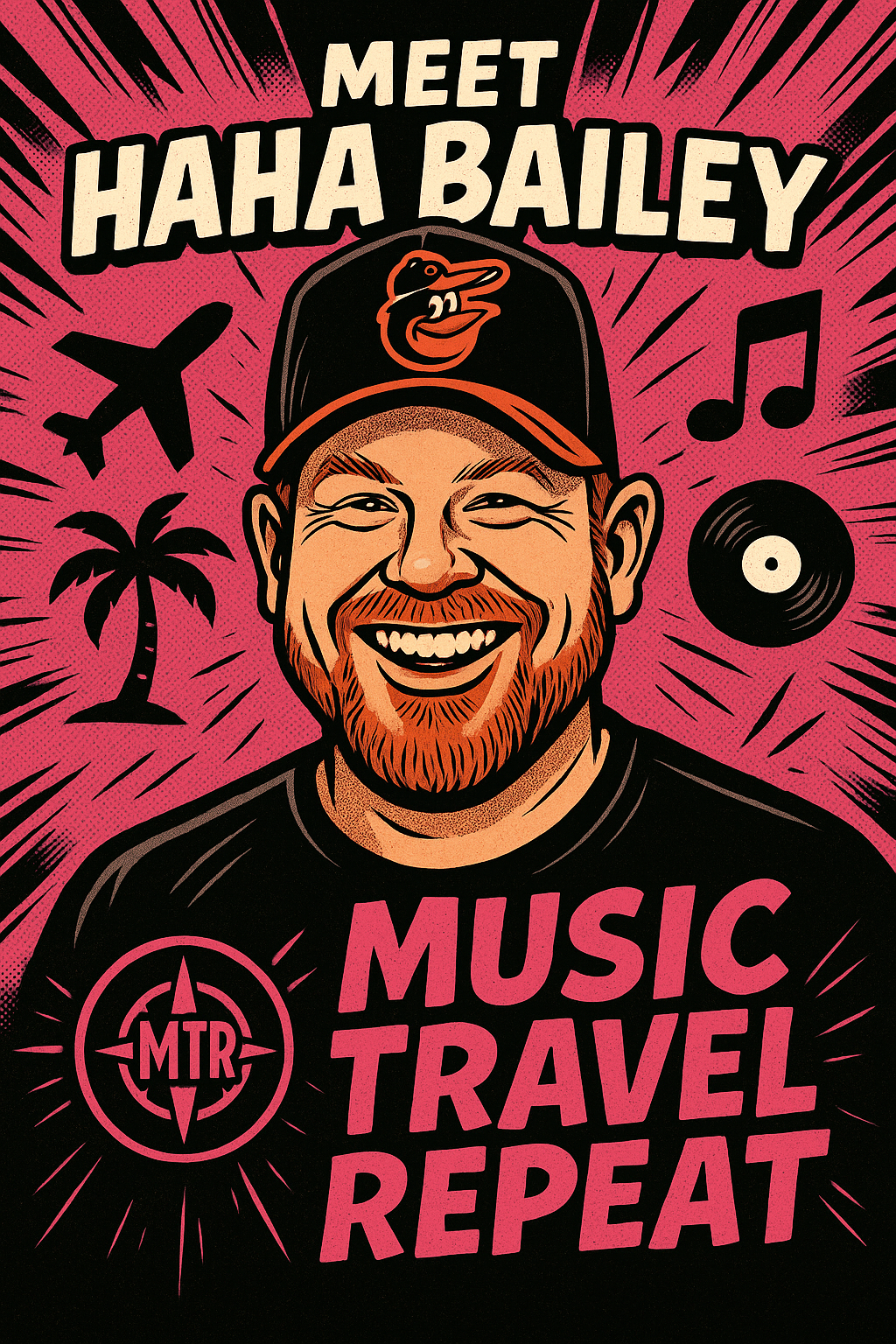
Behind the badge, behind the blog, Haha Bailey is just a man trying to make sense of it all. Read more of his work on The Restless, The Hopeful, and The Broken and let his stories keep you company for a while.
- Cardboard Cowboys & Life Bans From Walmart
- Seether In Seattle: A Musical Homecoming For The Restless Heart
- The Immortality Equation: Concerts + Connection = A Life Well-Lived (Now With Bonus Emotional Growth @ 30,000 Feet)
- Brian Wilson, 1942–2025: A Tribute from Music Travel Repeat
- Executive Protection: The Invisible Job Reality
- Letters To My Younger Self: What I Wish I Knew Before Hitting The Road
- The Loudest Silence : Sons, Fathers And The Stages That Never Clapped
- The Song That Undid Me
- Between Matches & Melodies: Make Little Moments
- Summer Of Loud 2025 & The Ego At The Gate: What Petco Park's Door Guy Got Dead Wrong
- Another Year Older: Notes From the Messy Middle
- Why I Don't Take Pictures with the Wrestlers
- Mr. Misunderstood: The Art Of Not Fitting In
- I Don't Know If I'm Tired Or Just Lonely
- Why I Still Cry on Airplanes (And Why That’s Okay)
- A Ska Revival with Less Than Jake, The Suicide Machines, Fishbone & Catbite in Phoenix, Arizona!
- The Desert Road to Redemption
- Chevelle in Pittsburgh — Loud Medicine for a Restless Week
- James Taylor’s Wolf Trap Concert and the Father-Son Lessons I Didn’t Expect
- GQ: The Heartbeat Behind The Chaos
- Why I Finally Asked For A Divorce
- Atreyu at The Nile: Blood, Banter, and the Beauty of Not Being on Duty
- Thanksgiving 2025