Music Travel Repeat! › The Restless, The Hopeful, and The Broken ›
Why I Finally Asked For A Divorce ( Three Years Ago)
Dear MC,
You always said I loved fixing things.
- Broken locks.
- Broken hearts.
- Broken homes.
You weren’t wrong. But I’ve learned that sometimes the worst thing a man can do is keep trying to fix what’s determined to stay broken.
When I met you, I was twenty-two and still soft around the edges — a teacher who thought compassion could cure anything. You were my boss back then, twice my age and already deep into a marriage you said was built on cruelty. You told me stories of survival, painted your husband as a monster, and yourself as someone who’d endured far too long. You didn’t just want love — you wanted rescue. And I showed up wearing a cape I never should’ve put on.
What started as empathy turned into an obligation. What looked like love was really a lifeline I mistook for purpose. I thought I could protect you from the storm. I didn’t realize you were the storm.
I should’ve known it on our wedding day.
There was one guest — the one we both agreed shouldn’t come. Your son.
He was barely a year or two younger than me, but somehow he held the kind of power over you that logic couldn’t touch. You told me stories about him too
- how cruel he could be
- how manipulative
- how you were trying to set boundaries this time.
I believed you. I trusted you. I thought we were choosing peace.
But then, on the morning of our wedding, he showed up.
You looked me in the eyes and said, “I invited him.”
You didn’t ask. You didn’t warn me. You just decided.
He got drunk before dinner was even served. Loud, disrespectful, entitled. The same pattern I’d seen a dozen times before. And when it finally crossed the line, two of my own security guys — men who’d worked for me, who respected me — had to escort your son out of our wedding.
I still remember the look in their eyes: pity.
Not for him — for me.
That was the day I realized love wasn’t supposed to humiliate you. It wasn’t supposed to make you feel like the bad guy for enforcing the bare minimum of peace. You said he was your son, your blood, your responsibility. And I understood that. But what I didn’t understand was why that always meant I had to bleed for it
After the wedding came the slow erosion — the quiet, daily decay that doesn’t announce itself until one morning you wake up and realize you’ve been dying in increments.
Your son lived with us for a while. Chaos in human form. He brought tension into every room he entered, disrespect dripping from every word. I’d call out his behavior — the lying, the laziness, the manipulation — and somehow I became the villain. You’d defend him, twist it, cry, and say, “You don’t understand, he’s had a hard life.”
So had I.
But I wasn’t threatening anyone’s life.
The night he told me he wanted to kill me, I remember how still everything became afterward. No yelling. No chaos. Just this eerie quiet where I realized I was alone — not because you weren’t there, but because you’d already chosen sides.
That’s what abuse does, doesn’t it? It flips the narrative. It paints the person demanding accountability as the problem. And you let it happen, again and again, until I started believing maybe I was the problem.
But deep down, I knew better. I just didn’t have the strength to walk away yet.
You loved to tell people I was the strong one, the protector.
But I was tired of protecting someone who kept handing my peace over to the people who destroyed hers.
- Every argument became a courtroom, and I was always the defendant.
- Every apology I gave felt like an admission of guilt I didn’t owe.
- Every attempt at peace felt like begging for permission to breathe.
And somehow, even after your son was gone — after you told him to leave, after I tried to rebuild the quiet — you still found new ways to question me.
GQ, for instance.
- You swore I was having an affair with her.
- You turned friendship into accusation, loyalty into leverage.
- You said things like, “She wants you. I can tell.”
But what you didn’t realize is that GQ was one of the few people still fighting for our marriage when I had already lost faith in it.
She defended you when I couldn’t.
She told me to stay when every bone in my body wanted to run.
And still, you made her the villain because that’s what control does — it isolates, confuses, and consumes until there’s nothing left to save.
When I finally asked for the divorce, I didn’t yell.
I didn’t beg.
I didn’t cry.
I just said, “I can’t do this anymore.”
You didn’t even pause. You picked up the phone and called my parents.
Told them I was having a mental breakdown. Said I wasn’t well.
You spun a story about me that made you the hero again — the poor wife standing by her unhinged husband.
But for the first time in my life, I didn’t chase the narrative.
I didn’t try to prove you wrong.
I didn’t try to explain.
Because I finally understood something: You can’t reason with someone who needs to be right more than they need to be loved.
That night, I packed a bag — not out of rage, but out of mercy for myself.
Just enough clothes for a week. Some cash. My headphones. My peace.
I sat in Green Mile 2 outside the house that never felt like a home, and I played “Between a Rock and a Hard Place” by Bailey Zimmerman on repeat. Over and over. The lyrics felt like confession. Like closure.
And when I finally pulled away, I didn’t look back.
I wasn’t running from you anymore.
I was returning to myself.
You once said I had a “savior complex.”
Maybe you were right.
But what you never understood was that I didn’t want to save you anymore — I just wanted to stop drowning beside you.
After I left that night, the silence in Green Mile 2 felt holy.
I remember gripping the steering wheel, knuckles white, while Bailey Zimmerman’s “Between a Rock and a Hard Place” poured through the speakers.
I must’ve replayed it a hundred times between Baltimore and York in the months that followed.
That song wasn’t a breakup anthem — it was an obituary.
For the version of me that kept apologizing for wanting peace.
When I walked away, I left everything behind
- the house
- the furniture
- the money I’d poured into fixing a future that never existed.
I signed the quitclaim deed and handed you a hundred thousand dollars in equity because I didn’t want one more tie between us.
I thought of it as payment — not for what I owed, but for what I survived.
People called me crazy.
My friends, my lawyers, even my own reflection in the bathroom mirror some mornings.
They couldn’t understand why a man would give up that much for nothing.
But it wasn’t nothing.
It was peace.
And peace doesn’t come cheap.
In the weeks after, I learned what alone really feels like.
Not the romanticized kind that Instagram calls “healing.”
- The real kind — the kind where you eat standing up in your kitchen because sitting down feels too final.
- The kind where your phone doesn’t buzz for days and when it finally does, your first instinct is to flinch.
- The kind where every quiet room sounds like accusation.
You told everyone I was having a mental breakdown, and I guess, in a way, I was.
But it wasn’t the kind you feared — it was the kind you cause when you stretch someone so thin they finally snap into clarity.
My mind wasn’t breaking. It was rearranging itself around the truth.
For months, I kept replaying moments — like a detective at a crime scene trying to make sense of the evidence.
- Your son’s threats.
- Your lies to my parents.
- Your constant need to be the victim in every story.
I’d sit there some nights and whisper to myself, “You weren’t crazy. You were just controlled.”
Over and over, until the words started to sound like prayer.
That’s when the fog began to lift.
You made sure to poison the well with everyone who mattered.
Old friends stopped calling.
Family treaded lightly around your name.
It’s hard to defend yourself from a narrative you didn’t write — especially when the other author cries on cue.
So, I stopped defending myself.
I stopped performing explanations for people who’d already chosen which version of me to believe.
Instead, I started rebuilding quietly.
- One gym session at a time.
- One playlist at a time.
- One long highway drive with nothing but music and open sky reminding me that I was still here.
GQ was there through most of it.
She never said, “I told you so.” She just showed up — with coffee, with playlists, with reminders that not every woman needed to be rescued to love you back.
She saw me when I couldn’t even look at myself.
And for a while, that was enough.
You used to accuse me of wanting her.
The truth is, I didn’t.
Not then.
What I wanted was what she represented — truth without manipulation, friendship without fear, honesty without collateral damage.
She didn’t need saving.
She just needed me to be okay.
It’s strange, isn’t it?
How the things that used to define you start to lose their gravity once you leave the orbit of chaos.
I used to think closure meant an apology.
Now I know closure is a choice.
It’s the decision to stop chasing the version of the story where you finally understand why they hurt you.
Sometimes you don’t get that version.
Sometimes you just get freedom.
Years later, when I moved to Tijuana, I remember standing in an empty house — five bedrooms, one heart learning to beat again — and realizing that solitude doesn’t have to mean sorrow.
It can mean starting over without witnesses.
It can mean peace that hums instead of shouts.
I started writing again — not about you, but about everything that came after.
The concerts, the airports, the people who heal me in small ways every day.
Music Travel Repeat was born out of that silence — a way to turn pain into purpose, heartbreak into harmony.
Because sometimes the only way to make sense of the wreckage is to make something beautiful out of it.
If you ever read this — and maybe you will — I hope you understand that I don’t hate you.
I don’t even resent you anymore.
You taught me what boundaries are worth, what freedom costs, and how silence can be sacred.
You made it harder than it had to be, but in doing so, you made me stronger than I ever thought I could be.
And maybe that’s the kind of love story we were meant to have — not one that lasts, but one that teaches.
I’ll close this letter with something I once heard at a show — a singer whispering into the mic between songs:
“Sometimes love isn’t supposed to last forever.
Sometimes it’s just supposed to show you what forever shouldn’t feel like.”
That line stuck with me.
Because for the first time, I understood that walking away doesn’t mean failure.
It means you finally stopped mistaking chaos for care.
It’s been years now.
And I still catch myself thinking about how silence used to scare me.
When we were together, silence meant danger — a storm brewing, a fight waiting to start. I’d fill every quiet moment with noise: a song, a chore, a sentence I didn’t mean to say. Anything to keep from hearing the truth humming underneath it all.
Now, silence means something else entirely.
- It means peace.
- It means home.
- It means I can finally breathe without waiting for the next explosion.
Sometimes I sit in my new truck that never carried me away from you and listen to “Between a Rock and a Hard Place.” The song doesn’t hurt anymore. It just… reminds me.
That song used to be the soundtrack of escape.
Now it’s the sound of understanding.
Because I can finally admit something I couldn’t back then
- I wasn’t perfect either.
- I stayed too long.
- I tried to fix too much.
- I confused endurance for love and guilt for loyalty.
- I carried both like trophies and wondered why my back hurt all the time.
Leaving you didn’t make me a hero.
It just made me human again.
After the divorce, I started traveling more — not to run away, but to find the parts of myself that got buried under all those years of chaos.
Every flight felt like another step away from who I was.
Every concert felt like another reminder that I could still feel something other than fear.
In some city, I can’t even remember which one anymore, I stood in the middle of a crowd singing louder than they could hear themselves. Everyone’s voices blended into one.
And for the first time in a decade, I felt small in a way that didn’t hurt.
Music does that — it takes the noise inside you and turns it into something communal, something survivable.
That’s what Music Travel Repeat became for me.
A home for people who survived their own version of “almost love.”
A place where the restless, the hopeful, and the broken could all find a rhythm to walk out of the wreckage to.
You’d probably roll your eyes if you knew that the woman you once accused me of loving is now part of my life.
GQ never demanded to be my salvation.
She just handed me peace and said, “You can set it down now.”
We still fight sometimes — real, human fights — but they end with laughter instead of collateral damage.
She knows the worst parts of me and doesn’t weaponize them.
That’s new. That’s everything.
And maybe that’s the lesson you and I were meant to give each other — not through staying, but through leaving.
Some people come into your life to teach you how to hold on.
Others come to teach you how to let go.
You were the latter.
I think about your son sometimes — the one who wanted to destroy what little peace we had left. I wonder if he ever found his own version of redemption, or if he’s still chasing chaos because it’s the only language he speaks.
I don’t hate him either.
Because to hate him would mean carrying a part of you I’ve already set down.
Forgiveness isn’t about saying, “It’s okay.”
It’s about saying, “It happened, and it doesn’t own me anymore.”
It’s a quiet, private surrender — not to the past, but to peace.
There’s a line I wrote in my journal not long after I left you.
It still feels true today:
“You can’t love someone into being healed.
You can only love yourself enough to stop bleeding for them.”
I used to think that sounded cold.
Now I know it’s mercy.
- Mercy for you.
- Mercy for me.
- Mercy for all the versions of us who stayed too long in rooms that kept getting smaller.
Sometimes, when I travel for work — standing backstage at a wrestling event or a concert, watching thousands of strangers scream lyrics that mean something different to each of them — I catch myself thinking about you. Not with bitterness. Just curiosity.
I wonder if you ever found peace.
If the chaos finally got quiet.
If you ever tell the story differently now — maybe with less venom, maybe with a little more truth.
And if you ever do think of me, I hope you remember this:
I didn’t leave because I stopped loving you.
I left because I finally started loving me.
- The house
- the accusations
- the lies
they all feel distant now, like a movie I once saw but can’t quite recall the ending of.
What remains are the lessons.
- That peace is louder than passion.
- That silence can be safer than attention.
- That forgiveness is the final act of freedom.
If someone out there is reading this, standing on the edge of their own breaking point — if they’re replaying every “maybe it’ll get better” and every “it’s not that bad” — I hope they hear this part clearly:
You don’t owe anyone your destruction.
- Not your spouse.
- Not your parents.
- Not the story you built to make sense of your suffering.
You can leave and still be kind.
You can walk away and still love them.
You can start over and still believe in good people.
Because survival doesn’t make you hard — it makes you holy.
I forgave you a long time ago, MC.
Not because you asked.
Because I didn’t want to keep carrying the weight of being right.
Sometimes the only closure you’ll ever get is peace that no one else witnesses.
And that’s enough.
So wherever you are — I hope you’ve stopped defending your pain long enough to start healing from it.
I hope the house is quiet now.
I hope you’ve learned what I did:
that love without respect is just endurance in disguise.
And I hope you know that when I finally asked for a divorce, it wasn’t an ending.
It was the first honest beginning of my life.
Catch you in the chaos,
Haha
Next Post: Atreyu at The Nile: Blood, Banter, and the Beauty of Not Being on Duty
Previous Post: GQ - The Heartbeat Behind The Chaos
Written By Haha Bailey
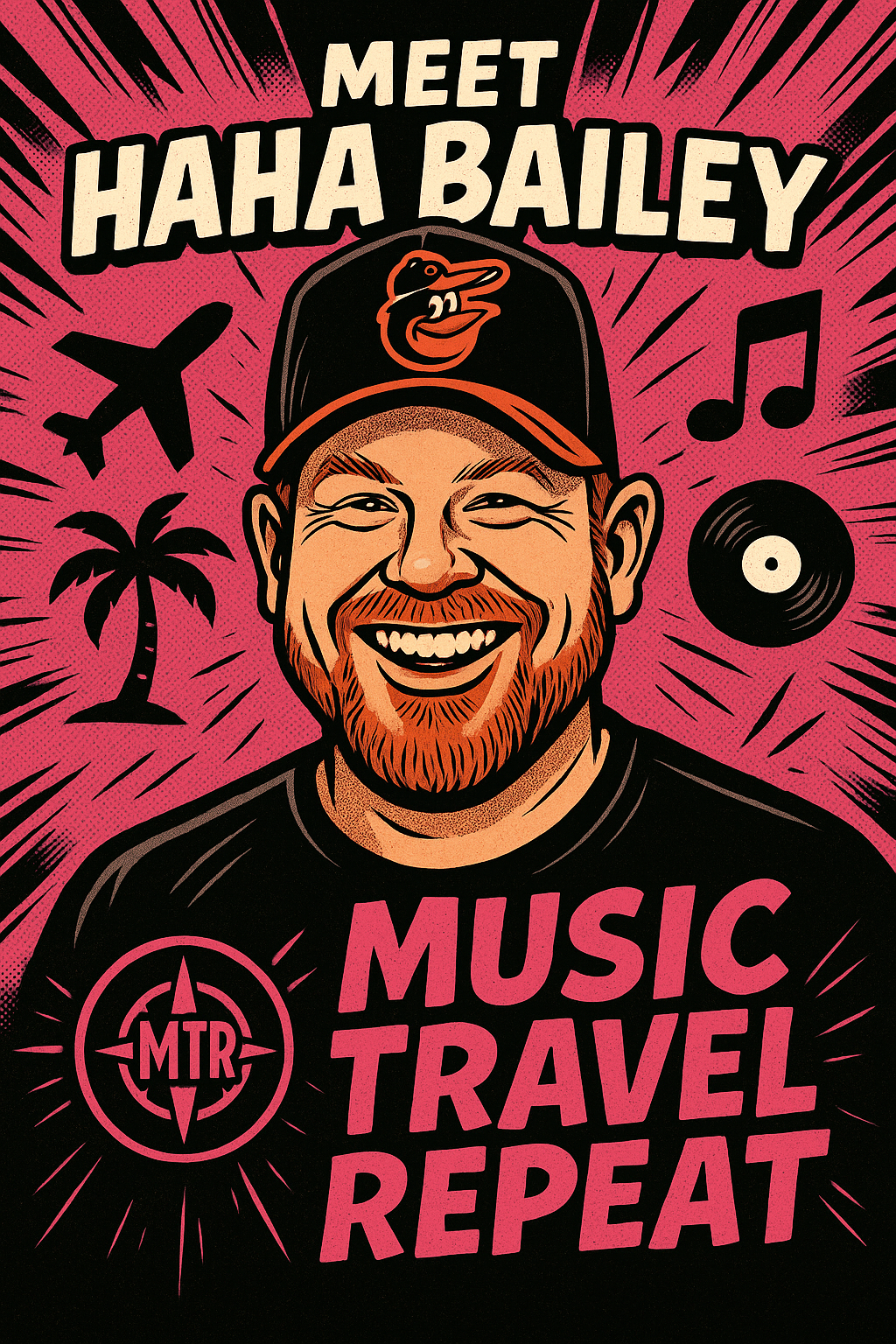
Haha Bailey writes from the spaces most people skip — airport gates, venue corners, and the quiet hours between survival and self-discovery. His stories at Music Travel Repeat are soaked in empathy and road dust. They remind readers that even after loss, love has a way of showing up again. It just takes time and an open heart. Read The Restless, The Hopeful, and The Broken.
The Restless, The Hopeful, and The Broken
- Cardboard Cowboys & Life Bans From Walmart
- Seether In Seattle: A Musical Homecoming For The Restless Heart
- The Immortality Equation: Concerts + Connection = A Life Well-Lived (Now With Bonus Emotional Growth @ 30,000 Feet)
- Brian Wilson, 1942–2025: A Tribute from Music Travel Repeat
- Executive Protection: The Invisible Job Reality
- Letters To My Younger Self: What I Wish I Knew Before Hitting The Road
- The Loudest Silence : Sons, Fathers And The Stages That Never Clapped
- The Song That Undid Me
- Between Matches & Melodies: Make Little Moments
- Summer Of Loud 2025 & The Ego At The Gate: What Petco Park's Door Guy Got Dead Wrong
- Another Year Older: Notes From the Messy Middle
- Why I Don't Take Pictures with the Wrestlers
- Mr. Misunderstood: The Art Of Not Fitting In
- I Don't Know If I'm Tired Or Just Lonely
- Why I Still Cry on Airplanes (And Why That’s Okay)
- A Ska Revival with Less Than Jake, The Suicide Machines, Fishbone & Catbite in Phoenix, Arizona!
- The Desert Road to Redemption
- Chevelle in Pittsburgh — Loud Medicine for a Restless Week
- James Taylor’s Wolf Trap Concert and the Father-Son Lessons I Didn’t Expect
- GQ: The Heartbeat Behind The Chaos
- Why I Finally Asked For A Divorce
- Atreyu at The Nile: Blood, Banter, and the Beauty of Not Being on Duty
- Thanksgiving 2025