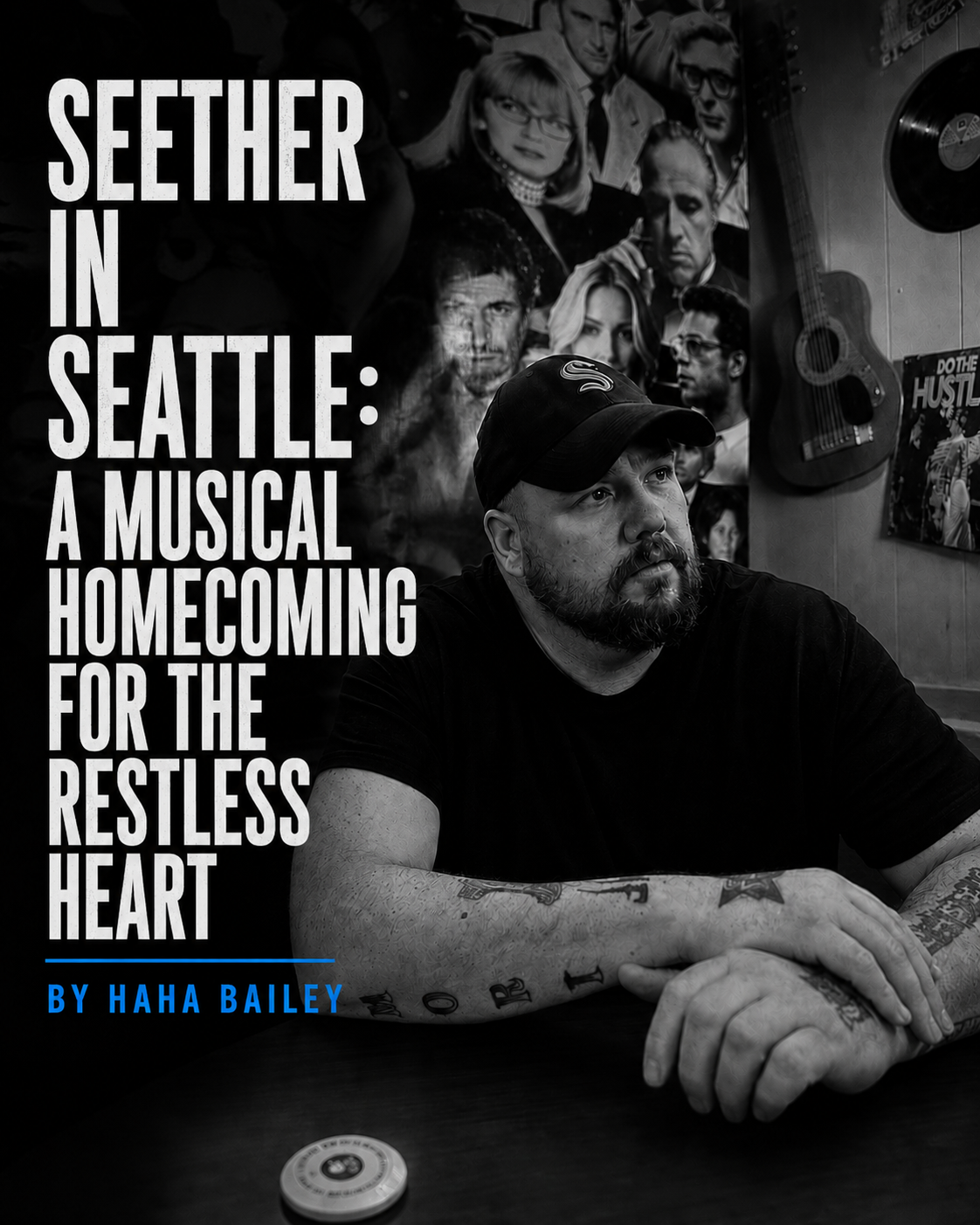
Seether in Seattle: A Musical Homecoming for the Restless Heart
When a Seether Concert Becomes a Compass
Some stories do not ask to be written right away.
They ask to be lived first.
They sit in your chest for a while.
They knock around in the quiet spaces.
They wait until the noise settles enough for you to understand what actually happened.
Not just what you saw.
Not just what songs were played.
Not just who opened, who closed, or how loud the room got.
But what shifted.
That is what Seether in Seattle was for me.
It was not a casual concert.
It was not a stop on a checklist.
It was not “another show.”
It was a reminder.
A recalibration.
A musical homecoming for the restless heart.
Not the kind of homecoming that requires a return address.
The kind that happens inside you, when a song finds the part of you that has been wandering and quietly says:
There you are.
I have learned over the years that live music does that when you let it.
When you stop chasing the experience and allow the experience to meet you where you are.
Music becomes a map when you are lost.
A compass when direction feels foggy.
An anchor when everything else feels temporary.
And a truth-teller when you have gotten too good at lying to yourself just to keep moving.
That night in Seattle, standing shoulder to shoulder with strangers, with GQ steady at my side — not as a distraction, not as background, but as presence — I remembered why Music Travel Repeat exists at all.
Because concerts are not just events.
They are mirrors.
They are milestones.
They are proof that we are still here.
Still capable of feeling.
Still capable of connection.
Still capable of being undone in the best possible way.
And sometimes, they are the only places where the truth can get loud enough to be heard.
Why Seattle Was the Right City for a Seether Concert
Seattle does not welcome you with sunshine and certainty.
It greets you with mist.
With gray.
With a sense that whatever you are carrying, the city has seen heavier things and will not flinch.
There is a gravity there.
Not depressing.
Not romanticized.
Just honest.
Seattle live music venues understand unfinished sentences.
You can feel it walking the streets.
In the way people move without needing to perform.
In the way the air smells like rain and memory.
In the way music history does not sit on pedestals, but seems to seep out of brick walls, cute coffee shops, old venues, wet pavement, and power lines.
You do not walk through Seattle without feeling the presence of what came before.
Not as nostalgia.
As lineage.
Kurt Cobain does not haunt the city like a ghost.
He hums through it.
Jimi Hendrix does not linger like a monument.
He floats through the frequency.
Every band that ever tried to scream its way into meaning left something behind.
Seattle remembers.
And when you walk into that city carrying your own restlessness, your own unspoken things, your own half-healed places, it does not rush you toward resolution.
It lets you be unfinished.
That is why Seattle felt like the right place to see Seether.
Because Seether does not clean things up for you either.
They do not sell you easy triumph.
They do not wrap pain in pretty paper.
They do not pretend the ending always ties itself into a neat little bow.
They offer honesty.
Scarred.
Unresolved.
Still standing.
And sometimes, that is exactly the kind of music a restless heart trusts.
The Long Road to Seattle
By the time I landed in Seattle, I was not tired in the normal way.
Not the kind of tired that sleep fixes.
Not the kind a hotel bed, a shower, and a late checkout can solve.
I was tired in the way people get tired when they have been holding themselves together quietly for too long.
I spend a lot of my life in motion.
Airports blur together.
Cities overlap.
Venues change, but the bones of them feel familiar.
My work in executive protection and high-pressure live event environments has trained me to be steady when things are not.
That steadiness is useful.
It is necessary.
It also comes at a cost.
You do not get to unravel publicly.
You do not get to be messy when people depend on your calm.
You learn how to regulate.
You learn how to stay sharp.
You learn how to read rooms, exits, movement, mood, and risk.
You learn how to pack your feelings neatly and deal with them later.
Or not at all.
Seattle felt like a pause button.
Not an escape.
A pause.
The kind where you do not run from your life.
You finally sit still long enough to hear it.
GQ felt that too.
There was no rush between us.
No need to fill every silence.
No need to explain why the night already felt important before the first note was played.
Just the quiet understanding that something about this trip mattered.
Sometimes the people who love you do not need to fix the moment.
They just need to stand beside you while it tells the truth.
And that is what she did.
Seether’s Origin: Pain With a Passport
To understand why Seether lands the way they do and why their music cuts through armor instead of bouncing off it —, you have to understand where the band came from.
Pretoria, South Africa.
A country still learning how to exist after decades of institutionalized violence.
A place where history does not disappear just because laws change.
It lives in families.
Neighborhoods.
Nervous systems.
Silence.
Tension.
Survival.
Three teenagers started making noise in that environment.
Not because they had a perfect plan.
Not because they were chasing some polished version of fame.
Because sometimes noise is the only thing loud enough to survive silence.
Before they became Seether, they were called Saron Gas.
The early days were not mythic.
They were messy.
Amps stacked wherever amps could be stacked.
Microphones screaming louder than they sang.
Sweat collecting on low ceilings.
Rooms full of kids who did not know exactly what they were looking for, only that they needed something.
The music was not polished.
It was not safe.
It was not trying to be liked.
It was honest.
As the band grew and crossed borders, the name changed.
Saron Gas became Seether.
Not to soften the sound.
To clarify it.
Heavy, but melodic.
Aggressive, but vulnerable.
Loud, but threaded with ache.
That duality is what makes Seether resonate.
Because most of us live there too.
Presenting strength while quietly managing fractures no one sees.
Smiling when we are tired.
Showing up when we are empty.
Carrying weight and hoping no one notices our knees shaking.
Seether makes music for that place.
Not the victory lap.
The middle.
The part where you are still standing, but you are not going to pretend it did not cost you something.
Shaun Morgan and the Sound of Surviving Yourself
Shaun Morgan does not sing like someone chasing perfection.
He sings like someone who has made it through nights he did not think he would.
There is grit in his voice, yes.
But more than that, there is restraint.
He does not oversell emotion.
He lets it crack naturally, like a truth that does not need decoration.
Some vocalists soar above the crowd.
Shaun sings inside it.
That is why his voice feels familiar, even if you have never met him.
It sounds like the voice in your own head when you finally stop pretending everything is fine.
Songs like “Fine Again” do not feel like victory songs.
They feel like survival notes.
“Broken” does not apologize for being vulnerable.
It stands there with its hands open.
“Rise Above This” takes grief and gives it somewhere to go.
These are not anthems for people who have it all figured out.
They are lifelines for people who do not.
And there is a difference.
As someone who has spent years protecting others while managing my own internal weight quietly, Shaun’s voice has always felt less like performance and more like permission.
Permission to feel without spectacle.
Permission to hurt without explaining the whole backstory.
Permission to exist in the gray without rushing to resolve it.
That is what Seether does when they are at their best.
They do not drag you out of the darkness.
They sit with you long enough for your eyes to adjust.
Showbox SODO: Where the Seattle Concert Actually Began
The venue matters.
Always.
A concert is not just a band and a set-list.
It is the room.
The floor.
The walls.
The people around you.
The weather outside.
The version of yourself you carried through the door.
Showbox SODO does not feel like a random stop on a tour.
It feels like a participant.
Low ceilings press the sound downward.
The floor holds the weight of bodies and history.
The walls do not just reflect music.
They absorb it.
Outside, the Seattle drizzle did what Seattle drizzle does.
It softened the edges.
Blurred the lines.
Slowed everything just enough to be noticed.
In line, people shared stories like quiet offerings.
First shows.
Last shows.
Songs that got them through divorces.
Funerals.
Sober anniversaries.
Relapses.
Second chances.
Concert lines are sacred that way.
Nobody shows up because life is perfect.
They show up because music still works.
Inside, the night unfolded in a way that felt intentional.
Nonpoint cracked the room open first — raw, aggressive, unapologetic.
The kind of set that wakes up whatever part of the crowd still thinks it came to stand politely.
Then Ayron Jones followed, bending the air with soul and grit, reminding everyone that heaviness can still groove.
Ayron Jones a Seattle native was there replacing P.O.D who couldn't make this date.
By the time the lights shifted and Seether stepped into the blue glow, the room was not just ready.
It was open.
And the building exhaled.
When the Armor Stops Working
I am good at armor.
Years in high-stakes environments will teach you that.
You learn how to stay neutral.
How to regulate.
How to be the calmest person in the room when things go sideways.
How to keep your face from telling the story your chest is trying to scream.
That skill has kept me useful.
It has protected people.
It has opened doors.
It has also made it easy to forget that armor is supposed to come off sometimes.
Concerts do not care about your coping mechanisms.
They do not negotiate with armor.
They do not ask whether you are ready to feel something.
They just start.
And if the right song finds the right crack, good luck pretending you are untouched.
The set moved like a conversation I did not know I needed.
From “Truth” to “Wasteland” to “Fake It,” each song peeled back another layer of composure I did not realize I was still wearing.
I was not thinking about work.
I was not thinking about identity.
I was not thinking about being strong.
I was just breathing.
In rhythm with strangers who understood the assignment without being told.
And then “Broken” hit.
The room changed.
People stopped performing their fandom.
They stopped shouting lyrics like a flex.
They sang like witnesses.
Like they were reminding themselves they were not alone in the damage.
That kind of moment cannot be manufactured.
It cannot be staged.
It only happens when honesty meets readiness.
Seattle was ready.
And apparently, so was I.
What Seether Understands About Emotional Weight
Heaviness is not only about volume.
It is about weight.
The weight of unsent messages.
The weight of lives that did not turn out the way you planned.
The weight of names you still cannot say without your chest changing shape.
The weight of versions of yourself you had to become just to survive.
Seether does not rush you through that weight.
They sit with it.
They do not promise redemption arcs or tidy conclusions.
They offer something more realistic.
Companionship in the mess.
That matters.
Because there are seasons where you do not need someone to tell you everything happens for a reason.
You need someone to say:
Yeah. That was heavy. I’m still here too.
Standing there with GQ beside me, feeling her presence without needing to explain anything, I realized something quietly important.
I was not there to escape my life.
I was there to re-enter it differently.
That is the difference between noise and meaning.
Noise distracts you.
Meaning returns you to yourself.
That night, Seether did not pull me away from the things I carry.
They helped me hold them honestly.
And sometimes that is more healing than pretending they are gone.
Live Music, Healing, and the Strangers Who Understand
There is something strange and beautiful about standing in a concert crowd with people you may never see again and somehow feeling less alone than you do in rooms full of people who know your name.
Live music does that.
It rearranges the room.
For a few songs, the usual rules loosen.
Nobody asks for your resume.
Nobody cares how together you look on paper.
Nobody needs you to be the responsible one.
You are just another person with a pulse, a history, a favorite song, and something you carried in that maybe you hope the music will help you carry out.
That is why concerts feel like church to some of us.
Not because they are perfect.
Because they are honest.
There is communion in a chorus.
There is confession in a bridge.
There is grace in looking around and realizing you are not the only one singing with your whole damage showing.
That is what happened in Seattle.
The crowd was not just watching Seether.
They were meeting themselves through the music.
And for a restless heart, that kind of recognition can feel like home.
The Silence After the Last Note
When the final chord rang out and the lights came up, the room did not explode.
It softened.
That is the part people do not talk about enough.
The hush after the noise.
The moment when the adrenaline drains and what remains is truth.
You hear your breathing again.
You feel your body again.
You realize you have been moved.
Not fixed.
Not solved.
Moved.
And sometimes, movement is the miracle.
Walking out of Showbox SODO, I did not feel euphoric.
I felt clear.
Clear enough to remember why I write.
Clear enough to remember why I travel.
Clear enough to remember that being open is not the same as being weak.
That matters when you have spent a long time confusing composure with strength.
Sometimes strength is not keeping it together.
Sometimes strength is letting the right song take you apart without running from what falls out.
What Seattle Gave Me
Seattle did not give me answers.
It gave me alignment.
It reminded me that music does not decorate your life.
It interprets it.
And Seether does not just perform songs.
They hold space.
For grief.
For anger.
For survival.
For the quiet relief of being understood without explanation.
That is why Music Travel Repeat exists.
Because somewhere, another room is filling up.
Another band is tuning.
Another person is walking in thinking they are fine and walking out remembering how to feel.
If you have ever stood in a crowd and felt recognized, this story is for you.
If you have ever needed a song to say what you could not, this story is for you.
If you have ever chased a show not because you were lost, but because you were learning how to stay found, then you already understand why Seattle mattered.
The city gave me rain.
Seether gave me honesty.
GQ gave me steadiness.
And the night gave me back a version of myself I had not realized I missed.
Why Seether in Seattle Still Matters
Some concerts fade fast.
You remember the shirt you bought.
The traffic afterward.
The price of parking.
A few blurry videos you swear you were not going to take but absolutely did.
Other concerts stay.
They become checkpoints.
You look back and realize something in you was different after that night.
Not magically healed.
Not brand new.
Just realigned.
Seether in Seattle was one of those nights.
It reminded me that a restless heart does not always need a destination.
Sometimes it needs a room loud enough to tell the truth.
Sometimes it needs a city honest enough to let it be unfinished.
Sometimes it needs the right person standing beside it in the blue glow while the songs do what songs have always done.
Find the wound.
Name the weight.
Leave the door open.
The Road Forward
Somewhere, another stage is warming up.
Another city is waiting.
Another version of you is about to be reminded that you are still here.
Pack the bag.
Charge the phone.
Take the trip.
Buy the ticket if you can.
Enter to win free concert tickets if cannot.
But do not let life convince you that these nights are extra.
For some of us, they are oxygen.
For some of us, they are mile markers.
For some of us, they are how we remember that the road is still open and the lights are still on.
I will see you there.
Catch you in the chaos,
Haha Bailey
About Haha Bailey & Music Travel Repeat
Haha Bailey is the voice behind Music Travel Repeat, where concerts, road trips, playlists, and the messy middle of life all meet.

His writing lives in the space between the stage lights and the long drive home , the place where songs stop being background noise and start telling the truth. In Seether in Seattle: A Musical Homecoming for the Restless Heart, Haha writes about live music as a compass, Seattle as a confession booth, and the kind of concert that does not just entertain you, but quietly realigns something inside you.
When he is not writing, chasing shows, building The Venue Ledger, or protecting chaos from the background, he is usually somewhere on the road with a playlist, a story, and one more reason to keep moving.
Every Entry So Far
- Cardboard Cowboys & Life Bans From Walmart
- Seether In Seattle: A Musical Homecoming For The Restless Heart
- The Immortality Equation: Concerts + Connection = A Life Well-Lived
- Brian Wilson, 1942-2025: A Tribute from Music Travel Repeat
- Letters To My Younger Self: What I Wish I Knew Before Hitting The Road
- The Loudest Silence: Sons, Fathers And The Stages That Never Clapped
- The Song That Undid Me
- Between Matches & Melodies: Make Little Moments
- Summer of Loud 2025 & The Ego At The Gate: What Petco Park's Door Guy Got Dead Wrong
- Another Year Older: Notes From The Messy Middle
- Why I Don't Take Pictures with the Wrestlers
- Mr. Misunderstood: The Art of Not Fitting In
- I Don't Know If I'm Tired or Just Lonely
- Why I Still Cry on Airplanes ( And Why That's Okay)
- A Ska Revival with Less Than Jake, The Suicide Machines, Fishbone & Catbite in Phoenix, Arizona!
- The Desert Road to Redemption
- Chevelle in Pittsburgh: Loud Medicine for a Restless Week
- James Taylor's Wolf Trap Concert and the Father-Son Lessons I Didn't Expect
- GQ: The Heartbest Behind The Chaos
- Why I Finally Asked For A Divorce ( 3 Years Later)
- Atreyu at The Nile: Blood, Banter, and the Beauty of Not Being On Duty
- Thanksgiving 2025